Gender Trouble at #Wikipedia, again

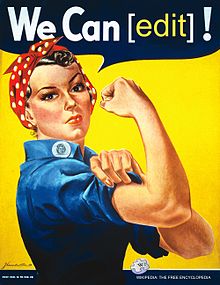
We_Can_Edit

via The Guardian, which reports that Wikipedia’s arbitration committee has banned five editors from making changes to certain articles “in an attempt to stop a long-running edit war over the entry on the “’Gamergate controversy’”.

This decision “bars the five editors from having anything to do with any articles covering Gamergate, but also from any other article about “’gender or sexuality, broadly construed.’ Editors who had been pushing for the Wikipedia article to be fairer to Gamergate have also been sanctioned by the committee.”

Blogger and former Wikipedia editor Mark Bernstein has written a series of posts condemning Wikipedia’s decision:  According to Bernstein, “This takes care of social justice warriors with a vengeance — not only do the Gamergaters get to rewrite their own page (and Zoe Quinn’s, Brianna Wu’s, Anita Sarkeesian’s, etc); feminists are to be purged en bloc from the encyclopedia.”

Wikipedia has replied to these critiques with a call for civility,   stating that “contributors on various sides of the debate have violated Wikipedia’s standards of civility. Civility is an important concept for Wikipedia: it is what allows people to collaborate and disagree constructively even on difficult topics. It ensures people are able to focus their energy on what really matters: building a collaborative free encyclopedia for the world.”

Wikipedia points out that “Several press stories have mistakenly claimed that Wikipedia has targeted and banned feminist or female editors. This is inaccurate. Although the Arbitration Committee may recommend that some editors be prevented from further contribution to this particular topic, they have not banned anyone from Wikipedia. The sanctions they are considering are broad, and affect many people. As of now, the Arbitration Committee is considering issuing some type of warning or sanction to around 150 people, from a range of perspectives, based on their participation and conduct. This is not about a small group of people being targeted unfairly. It is about a very large group of people using Wikipedia as a battleground.”

Readers of this blog know I’ve written about the woman problem at Wikipedia before, and hosted a women’s history Wikipedia edit-a-thon at the last Berkshire Conference on the History of Women last summer.

In March, my colleague Michelle Moravec is organizing a virtual Wikipedia edit-a-thon for the week of March 9-13.  If you’re interested in participating, sign up here.

Posted in Uncategorized | 1 Reply

Thoughts on #aha2015 #s69, Doing More with Less: The Promise and Pitfalls of Short-Form Scholarship in the Digital History Age”

Since I’m having my students in my Digital History class write about blogging, I thought I would (finally) give some of my observations on this session, especially the bit about blogging by Ben Railton, who somehow manages to write a daily post on his American studies blog. He uses his blog as a “generative space,” that is, a starting point for new directions in his research.  It also allows him to get rapid feedback from his readers.  I like this idea of using a blog to generate and sound out new ideas very much but I doubt I have the time or discipline to do this on a daily basis as he does. Railton also writes for other blogs such as Talking Points Memo.  This allows him to connect to new and larger audiences. The downside of writing for this kind of blog is that he has to write more aggressive, less historically nuanced articles than he normally would in order to get published and attract readers. Perhaps he should consider writing for History News Network.  I’ve written several articles for them and find I can be both timely and nuanced.  Then again, I probably don’t get as many views as articles at TPM. Another problem with this type of short form scholarship (and I would agree that blog writing is scholarship) is that it’s usually not peer-reviewed (with some exceptions), so is seldom considered for promotion and tenure purposes. Kathryn Nasstrom, editor of the Oral History Review discussed the journal’s new short-form article initiative, which was created to publish shorter articles  (3-4,000 words on average) than the usual articles that are 8-12,000 words.  The editors did this to get more ideas in circulation (the journal is only published twice per year), and allow authors to publish “thought pieces” that suggest new ideas but are not as definitive as fully developed research articles.  Nasstrom was careful to mention that these short-form articles are not watered-down scholarship — they go through the same peer review process as long-form articles. The Society for the History of Technology has a similar short-form platform called Technology’s Stories: Past and Present.  I had the privilege of having a short article on the 50th anniversary of the Pill accepted for this publication. It appeared in the Society’s print journal as well, but I like that its appearance on the website brought it to a broader audience. Another opportunity for short-form scholarship was presented by Kristin Purdy, editor of the Pivot Series at Palgrave Macmillan. This series provides a valuable middle ground between article-length and book-length works.  The typical length of a book in this series is 25-50,000 words.  These works are still peer-reviewed, but shorter length also allows for a much shorter production process (typically 12 weeks after acceptance).  This is especially attractive to those who need to beef up their CVs for promotion and tenure.  It also allows the press to get books on timely topics out quickly.  The main problem with this series is the books are still quite expensive (even the ebooks are over $20).  Still, it allows authors to try out unconventional ideas (e.g. The History of the Kiss) and have a greater and faster impact than they might with longer form monographs. Last up was Stephanie Westcott from the Center for History and New Media George Mason University, who discussed the Center’s PressForward Plugin for WordPress.  This plugin allows for aggregation of posts from across the web.  Digital Humanities Now is an example of a site developed with this plugin. According to the site’s description: DHNow highlights scholarship—in whatever form—that drives the field of digital humanities field forward as Editors’ Choice. Additional items of interest to the field—jobs, calls for papers, conference and funding announcements, reports, and recently-released resources—are redistributed as news. In other words, DHNow is one-stop shopping for keeping up on what’s happening in the field of Digital Humanities. So, in summary, it turns out there’s a lot you can do with short-form scholarship.  The various platforms discussed in the session allow academics to reach larger audiences quickly and efficiently.  One issue that did come up is the issue of ownership, i.e. how does one maintain control of one’s work once it’s on the web.  The short answer is to use Creative Commons to put a license on your work.

Further thoughts In Re: Cassandra C.

I should have read this before my previous post. It appears there is good reason to doubt that Cassandra C has the maturity to make medical decisions (i.e. it looks like Mom is running the show). Still, it’s worth using this case to think about what defines a mature minor and whether young people who meet these criteria should be able to refuse life saving treatment.

Dan Klau's avatarAppealingly Brief!

Governor Malloy recently reappointed former state Supreme Court Justice Joette Katz as Commissioner of the Department of Children and Families (“DCF”), reflecting his faith in her ability to run the critically important, but much maligned, agency. And, by accepting that reappointment, Katz revealed that she is either a saint or a glutton for punishment.

The punishment may continue (undeservedly so in my humble opinion) as the public learns more about a case that the Connecticut Supreme Court will hear, on an expedited/emergency basis, this Thursday, January 8.  The case, In re Cassandra C., involves a now 17-year-old girl who was diagnosed last September with cancer, specifically, high-risk Hodgkin’s lymphoma. (Several media entities reported on the case over the past few days. However, the existence of the expedited appeal has been reflected on the Supreme Court’s electronic docket since mid-December.)

As Cassandra’s attorneys acknowledge in their appellate brief, “[t]he…

View original post 2,152 more words

Preliminary thoughts on #CassandraC case in Connecticut

cassandra-cvia the Hartford CourantThis afternoon the Connecticut Supreme Court ruled that the 17-year old woman identified in court documents as Cassandra C. “is not legally mature enough to decide against life-saving chemotherapy” for Hodgkins lymphoma.

Despite a poor prognosis without chemotherapy, Cassandra refused treatment from the beginning and after she missed several medical appointments last fall her doctors reported her case to the state’s Department of Children and Families (DCF), accusing her mother, Jackie Fortin of Windsor Locks, with medical neglect. The DCF removed Cassandra from her home and placed her in state custody.  Cassandra ran away in November after receiving two treatments .  After she returned a week later, she was placed in Connecticut Children’s Medical Center where she continued to receive medical treatment. Meanwhile, Cassandra’s mother and lawyers  filed an appeal with the state’s highest court. The court documents contend  that the right to bodily integrity, “which is so fundamentally a part of the human experience that its recognition and protection stretch back long before any written constitution” applies to minors as well as adults.  Cassandra’s lawyers draw on the legal concept of a  “mature minor” which allows minors to give consent to medical procedures if they can show that they are mature enough to make a decision on their own.

Since I’ve written a book on the history of adolescent medicine, I’ve been following this case since last September. My university relations office has given my name to the local press, who may or may not be contacting me for an interview.  Meanwhile, I’ll post my preliminary thoughts.  The mature minor concept was the cornerstone of U.S. Supreme Court decisions involving a minor’s right to consent to health care, including receiving birth control and abortion, without parental approval or knowledge.  (see Baird v. Eisenstadt and Bellotti v. Baird).

As much as I disagree with Cassandra’s decision to refuse treatment, I think the mature minor concept is applicable to this case. Now I’m waiting for the phone to ring. . .