Unknown's avatar

About Heather Munro Prescott

I'm a professor of history at Central Connecticut State University.

Why the #baltimoremom and #sendinthemoms memes marginalize black women’s activism

via Baltimore City Paper, which reports on how the evolving narrative about the uprising in Baltimore marginalizes women who are at the heart of the protests against police brutality in the city following the death of Freddie Gray from a spinal injury incurred while in police custody.  “Many organizers at the forefront of the protests are women,” the article reports, “However, the visibility, or lack thereof, of black women in the protest narrative has also been problematic,” as “media tend to focus on the presence and actions of men more than those of women.”

The lone exception over the past twenty-four hours has been the extensive coverage of Toya Graham, the “forceful Mom” who saw her son Michael among a group of protestors throwing rocks and police and grabbed, hit, and screamed at him while pulling him out of the crowd.  That’s my only son, and at the end of the day I don’t want him to be a Freddie Gray,” she said. “But to stand up there and vandalize police officers — that’s not justice. I’m a single mom, I have six children. And I just choose not to live like that no more. And I don’t want that for him.”

Since then, social media has been flooded with messages praising the actions of this “mother of the year,” using the hastags #baltimoremom and #sendinthemoms.  (I find it interesting that so far, it’s mostly white women who are proclaiming that more black moms need to be like Toya Graham and slap some sense into their boys. Never mind that this perpetuates stereotypes about black, female headed households that originated with the Moynihan report in the 1960s).

The Baltimore City Paper makes it clear that the moms are already there and they are engaged in important, constructive community activism that has deep roots in African American history (like the Civil Rights activist Fanny Lou Hamer, they are sick and tired of being sick and tired).  Let’s make them the mothers of the year.

Chains of Freedom: The Bicycle’s Impact on 1890s Britain.

The value of cycling – especially for middle-aged women like myself!

letitbeprinted's avatarThe Victorianist: BAVS Postgraduates

Will is an MA student at the University of York. His dissertation studies how moving through the life cycle altered the masculinities constructed by middle-class cyclists, and the appeal of inter-generational mixing within cycling clubs. Further information on the weird and wonderful effects the bicycle had on late Victorian society can be found on his blog ‘The Victorian Cyclist’ (https://thevictoriancyclist.wordpress.com) and its Twitter feed (@theviccyclist).

It is now ten years since listeners of Radio 4’s You and Yours were asked to vote on what they thought to be the most significant innovation since 1800. The list of inventions was, to say the least, impressive – their share of the votes, perhaps less so. Three percent of voters thought that the internal combustion engine was worthy of the title. The Internet fared slightly better, receiving four percent of nominations. A dizzying five percent of people believed that the germ…

View original post 1,630 more words

Posted in Uncategorized | 1 Reply

Save the Date: #AAHM2015 Panel on #Reproductiverights after Griswold: A Fifty Year Retrospective

REPRODUCTIVE RIGHTS AFTER GRISWOLD: A FIFTY-YEAR RETROSPECTIVE

American Association for the History of Medicine

April 30, 2015, Ballroom, New Haven Omni Hotel, 5-7 p.m.

Moderator:

Barbara Sicherman is William R. Kenan, Jr., Professor Emerita, Trinity College, where she taught History, American Studies, and Women’s Studies. Her publications include: Well-Read Lives: How Books Inspired a Generation of American Women (2010) Alice Hamilton: A Life in Letters (1984), Notable American Women: The Modern Period (1980), and The Quest for Mental Health in America, 1880-1917 (1980). She is currently doing research on the illegal birth control clinics established in Connecticut in the 1930s, a follow up to “’Let’s Do It’: Women Making History in the Land of Steady Habits,” Connecticut History.(Spring 2012).

Introduction: I will set the stage by briefly summing up the Connecticut law prohibiting the use of contraceptives and Planned Parenthood’s efforts to overturn it, which culminated in the landmark Griswold decision.

  1. Rosemary A. Stevens is DeWitt Wallace Distinguished Scholar in Social Medicine and Public Policy at Weill Cornell Medical College, Department of Psychiatry, and the Stanley I. Sheerr Professor Emeritus in Arts and Sciences at the University of Pennsylvania. For the last few years she has been studying the services negotiated for US veterans after World War I and their associated politics, a great set of stories. The resulting book manuscript, Scandal Time, is almost done.

Being There

This is a personal history for me, because I was the witness testifying against the physician, Dr. C. Lee Buxton, at the trial in New Haven. Estelle Griswold was the activist social worker who initiated the campaign to overturn the ban on contraception in Connecticut. Buxton wrote the prescriptions which when used broke the law. I will describe the contentious atmosphere at the time, how I came to be involved and what happened; with brief comments on the case as history.

  1. Professor Reva Siegel is Nicholas deB. Katzenbach Professor of Law at Yale Law School. Professor Siegel’s writing draws on legal history to explore questions of law and inequality and to analyze how courts interact with representative government and popular movements in interpreting the Constitution. Her recent publications include Conscience Wars: Complicity-Based Conscience Claims in Religion and Politics, 124 Yale L.J. (forthcoming 2015) (with Doug NeJaime); Harris Lecture: Abortion and the “Woman Question”: Forty Years of Debate, 89 Ind. L.J. 1365 (2014), as well as Processes of Constitutional Decisionmaking (with Paul Brest, Sanford Levinson, Jack M. Balkin & Akhil Reed Amar, 2014); Before Roe v. Wade: Voices That Shaped the Abortion Debate Before the Supreme Court’s Ruling (with Linda Greenhouse, 2012); and The Constitution in 2020 (edited with Jack M. Balkin, 2009). Professor Siegel is a member of the American Academy of Arts and Sciences and an honorary fellow of the American Society for Legal History, and serves on the board of the American Constitution Society and on the General Council of the International Society of Public Law.

TALK: Reva proposes briefly to discuss the debates that engendered Griswold and the cases that followed in its wake; she will then consider how the culture wars of the 1980s shaped modern understandings of Griswold and its progeny, concluding with current conflicts over religious objections to contraception and over the right of same-sex couples to marry.

  1. Linda Greenhouse is Joseph Goldstein Lecturer in Law at Yale Law School. Prior to coming to Yale in 2009, she spent 30 years as the Supreme Court correspondent for the New York Times. In that capacity, she received a Pulitzer Prize and other journalism awards. She is the author of Becoming Justice Blackmun, a biography of the justice who wrote Roe v. Wade; The U.S. Supreme Court: A Very Short Introduction; and with Reva Siegel, Before Roe v. Wade: Voices That Shaped the Abortion Debate Before the Supreme Court’s Ruling. She is a vice president of the American Philosophical Society; a member of the Council of the American Academy of Arts & Sciences; a national board member of the American Constitution Society; and will shortly complete a six-year term as a member of the Harvard University Board of Overseers.

TALK: Linda will talk more specifically about Roe v. Wade as Griswold’s progeny and to show how the one crucially informed the other at a time when the sex equality claim for a right to abortion was not a plausible option for a Supreme Court that had not yet established a jurisprudence of sexual equality

  1. Heather Munro Prescott is Professor of History at Central Connecticut State University. She has written extensively on the history of birth control and reproductive health issues, and is the author of The Morning-After: A History of Emergency Contraception in the United States. New Brunswick, NJ: Rutgers University Press, 2011

TALK: Heather will look at the Griswold decision in light of her work on adolescent and young adult health. The Griswold decision only involved the right to marital privacy but said nothing about the rights of unmarried individuals. Nevertheless, many college students believed access to contraception was a right that was due to them and campaigned for reproductive health services. She will examine the partnership between students organizations and Planned Parenthood’s Program of Student Community Action that paved the way for unmarried minors’ access to contraception and abortion.


  1. JUDY TABAR is the President and CEO of Planned Parenthood of Southern New England (PPSNE), which serves Connecticut and Rhode Island. Prior to a 2009 merger with Planned Parenthood of Rhode Island, Judy was the CEO of Planned Parenthood of Connecticut, serving in that role since January 1997. PPSNE is a two-state affiliate with a budget of $30 million, serving over 70,000 patients at 18 health centers.

Judy joined Planned Parenthood in 1980 as a physician assistant providing direct patient care. She then went on to become the Associate Director of Planned Parenthood of Northern New England prior to moving to Connecticut. Judy has served in numerous leadership roles within the Planned Parenthood Federation of America (PPFA), including co-chair of the Leadership and Diversity Task Force, Affiliate Chief Executives Council (ACEC) Chair, ACEC Treasurer, and board member of the Affiliate Risk Management Services and Planned Protection Insurance Company. She currently serves on the Planned Parenthood Federation of America National Board and chairs the Business Innovations Committee.

During her tenure, the affiliate has received a number of awards. These include PPFA Excellence Awards in Clinical Services Expansion, Board Development, Special Efforts Serving Teens, and Clinical Training, as well as the Stand Up for Choice Award from the Planned Parenthood Action Fund, the Eastern Region Pepe Award for Excellence in Serving Diverse Communities, and the Ruth Mott Rawlings Mott Award for International Excellence. In 2007, Judy was the recipient of the Ruth Green Award, in recognition of her leadership excellence as a CEO.

Judy holds degrees from the University of Iowa in science and psychology, and is a physician assistant.

TALK: Access to contraceptives during the 50 years since Griswold has made a dramatic impact on the lives of women, men and families across our country. Judy will speak about the link between reducing unintended pregnancies and a whole host of positive effects for women and men, from improved health outcomes for women and their babies to expanded educational and career options for women and their partners when they use contraceptives to delay childbearing until the time is right for them. She will also discuss the evolution of the contraceptive methods available to women over the years, and note some of the challenges that we are still struggling to overcome, such as recent public policy debates to limit contraceptive access and the persistent racial and ethnic health disparities that exist in relation to reproductive health outcomes.

QUESTIONS AND DISCUSSION
How-to Write Women Back Into History

We_Can_Edit

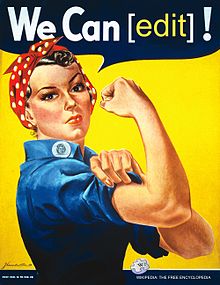
My graduate students in digital history and I are organizing our campus’ first ever Women’s History Wikipedia edit-athon on March 11th, 4:30 in the History Lab (Social Science Hall 201). If you have the time, please stop by.

Heather Munro Prescott's avatarHIST 511: Digital History Theory & Practice

In preparation for our Women’s History Wikipedia edit-a-thon on March 11, please check out this article and these instructional videos by  Michelle Moravec:

Introduction:

How to evaluate a Wikipedia entry:

De-gendering

How to improve entries about women

View original post

Gender Trouble at #Wikipedia, again

We_Can_Edit

via The Guardian, which reports that Wikipedia’s arbitration committee has banned five editors from making changes to certain articles “in an attempt to stop a long-running edit war over the entry on the “’Gamergate controversy’”.

This decision “bars the five editors from having anything to do with any articles covering Gamergate, but also from any other article about “’gender or sexuality, broadly construed.’ Editors who had been pushing for the Wikipedia article to be fairer to Gamergate have also been sanctioned by the committee.”

Blogger and former Wikipedia editor Mark Bernstein has written a series of posts condemning Wikipedia’s decision:  According to Bernstein, “This takes care of social justice warriors with a vengeance — not only do the Gamergaters get to rewrite their own page (and Zoe Quinn’s, Brianna Wu’s, Anita Sarkeesian’s, etc); feminists are to be purged en bloc from the encyclopedia.”

Wikipedia has replied to these critiques with a call for civility,   stating that “contributors on various sides of the debate have violated Wikipedia’s standards of civility. Civility is an important concept for Wikipedia: it is what allows people to collaborate and disagree constructively even on difficult topics. It ensures people are able to focus their energy on what really matters: building a collaborative free encyclopedia for the world.”

Wikipedia points out that “Several press stories have mistakenly claimed that Wikipedia has targeted and banned feminist or female editors. This is inaccurate. Although the Arbitration Committee may recommend that some editors be prevented from further contribution to this particular topic, they have not banned anyone from Wikipedia. The sanctions they are considering are broad, and affect many people. As of now, the Arbitration Committee is considering issuing some type of warning or sanction to around 150 people, from a range of perspectives, based on their participation and conduct. This is not about a small group of people being targeted unfairly. It is about a very large group of people using Wikipedia as a battleground.”

Readers of this blog know I’ve written about the woman problem at Wikipedia before, and hosted a women’s history Wikipedia edit-a-thon at the last Berkshire Conference on the History of Women last summer.

In March, my colleague Michelle Moravec is organizing a virtual Wikipedia edit-a-thon for the week of March 9-13.  If you’re interested in participating, sign up here.

Posted in Uncategorized | 1 Reply

Thoughts on #aha2015 #s69, Doing More with Less: The Promise and Pitfalls of Short-Form Scholarship in the Digital History Age”

Since I’m having my students in my Digital History class write about blogging, I thought I would (finally) give some of my observations on this session, especially the bit about blogging by Ben Railton, who somehow manages to write a daily post on his American studies blog. He uses his blog as a “generative space,” that is, a starting point for new directions in his research.  It also allows him to get rapid feedback from his readers.  I like this idea of using a blog to generate and sound out new ideas very much but I doubt I have the time or discipline to do this on a daily basis as he does. Railton also writes for other blogs such as Talking Points Memo.  This allows him to connect to new and larger audiences. The downside of writing for this kind of blog is that he has to write more aggressive, less historically nuanced articles than he normally would in order to get published and attract readers. Perhaps he should consider writing for History News Network.  I’ve written several articles for them and find I can be both timely and nuanced.  Then again, I probably don’t get as many views as articles at TPM. Another problem with this type of short form scholarship (and I would agree that blog writing is scholarship) is that it’s usually not peer-reviewed (with some exceptions), so is seldom considered for promotion and tenure purposes. Kathryn Nasstrom, editor of the Oral History Review discussed the journal’s new short-form article initiative, which was created to publish shorter articles  (3-4,000 words on average) than the usual articles that are 8-12,000 words.  The editors did this to get more ideas in circulation (the journal is only published twice per year), and allow authors to publish “thought pieces” that suggest new ideas but are not as definitive as fully developed research articles.  Nasstrom was careful to mention that these short-form articles are not watered-down scholarship — they go through the same peer review process as long-form articles. The Society for the History of Technology has a similar short-form platform called Technology’s Stories: Past and Present.  I had the privilege of having a short article on the 50th anniversary of the Pill accepted for this publication. It appeared in the Society’s print journal as well, but I like that its appearance on the website brought it to a broader audience. Another opportunity for short-form scholarship was presented by Kristin Purdy, editor of the Pivot Series at Palgrave Macmillan. This series provides a valuable middle ground between article-length and book-length works.  The typical length of a book in this series is 25-50,000 words.  These works are still peer-reviewed, but shorter length also allows for a much shorter production process (typically 12 weeks after acceptance).  This is especially attractive to those who need to beef up their CVs for promotion and tenure.  It also allows the press to get books on timely topics out quickly.  The main problem with this series is the books are still quite expensive (even the ebooks are over $20).  Still, it allows authors to try out unconventional ideas (e.g. The History of the Kiss) and have a greater and faster impact than they might with longer form monographs. Last up was Stephanie Westcott from the Center for History and New Media George Mason University, who discussed the Center’s PressForward Plugin for WordPress.  This plugin allows for aggregation of posts from across the web.  Digital Humanities Now is an example of a site developed with this plugin. According to the site’s description: DHNow highlights scholarship—in whatever form—that drives the field of digital humanities field forward as Editors’ Choice. Additional items of interest to the field—jobs, calls for papers, conference and funding announcements, reports, and recently-released resources—are redistributed as news. In other words, DHNow is one-stop shopping for keeping up on what’s happening in the field of Digital Humanities. So, in summary, it turns out there’s a lot you can do with short-form scholarship.  The various platforms discussed in the session allow academics to reach larger audiences quickly and efficiently.  One issue that did come up is the issue of ownership, i.e. how does one maintain control of one’s work once it’s on the web.  The short answer is to use Creative Commons to put a license on your work.