Sex and “Mad Men”

mad_menvia  Historiann, who asks what we think about the portrayal of sex on “Mad Men.”  Historiann observes that this is the era of Helen Gurley Brown’s Sex and the Single Girl (1962) — so where’s all the fun?  Well, my first reaction is that Brown’s main message was that because women were at a disadvantage economically, they needed to use their sex appeal to get ahead. I also find a lot of similarities between “Mad Men” and the classic Billy Wilder film, The Apartment (1960).  The key difference is that the film’s hero, Bud Baxter, is a mensch who actually respects women.  So far, there aren’t any of those in “Mad Men.”  [maybe they are hidden in the mail room with the token Jewish guy from Season One).

In addition, as a historian of sexuality and contraception, I need to deflate some myths about sex in the 1960s.  Here are some thoughts, from Chapter 7 of my recent book, Student Bodies, and my current project on the history of emergency contraception, complete with footnotes!

One of the most intractable historical myths about the contraceptive pill is the claim that this discovery caused the sexual revolution of the 1960s. Carl Djerassi, one of the chemists who worked on synthesizing the chemical components of the Pill, recalled that he had “no regrets that the Pill contributed to the sexual revolution of our time and possibly expedited it.”[i] Yet Alfred Kinsey’s surveys of sexual behavior indicated that a sexual revolution was underway well before the Pill arrived on the market. His Sexual Behavior in the Human Female (1953) disclosed that over 50 percent of the women in his sample had engaged in premarital sex.[ii] Kinsey’s findings were accompanied by the somewhat reassuring fact that the percentage of married teenaged girls increased markedly. By 1959, 47% of all brides had married before the age of nineteen, and the percentage of girls married between fourteen and seventeen had grown by one-third since 1940.[iii]

Commentaries written in the early 1960s reinforced the link between the sexual revolution and a contraceptive revolution. However, access to the Pill and other forms of contraception remained far from universal. Prior to the Griswold v. Connecticut Supreme Court decision of 1965, many states banned birth control even for married persons. Furthermore, Griswold only established the right to marital privacy. Few states allowed single women to obtain birth control, and those that did only allowed them to do so if they had reached the age of majority, which most states set at age 21. Some women were able to circumvent the law by convincing sympathetic physicians to prescribe the Pill for gynecological disorders. Even in areas where providing contraceptives for single women were not forbidden by law, physicians were often unwilling to contribute to “sexual immorality” by prescribing the pill to young unmarried women. When single women did manage to get a prescription there was no guarantee that they would find a pharmacist willing to fill it.[iv]

During season one of “Mad Men,” Joan Holloway gives Peggy Olson the name of a doctor who will prescribe the pill to unmarried women.  The scene between Peggy and the doctor is probably typical — he gives Peggy a prescription, but only after lecturing her about the irresponsibility of intercourse outside of marriage.  The show’s writers reinforce this moral framework with Peggy’s pregnancy and delivery at the end of Season One.

Let’s also not forget that Mad Men is set long before Roe v. Wade.  When Betty Draper finds herself pregnant at the end of Season Two, she tells her doctor that this is bad timing because her marriage is on the rocks.  The doctor is sympathetic and knows of doctors who will perform the procedure sub rosa, but says that the option of termination is really meant for young, single women who are “in trouble.”

In short, I think the show does capture fairly accurately the problems of this transitional period in the history of sexuality in the U.S.  Women were told to be sexy, but if you got pregnant (or raped), it was your own fault for “tempting” men.

Also, there is more continuity between the allegedly “repressed” 1950s and the so-called “sexual revolution” of the 1960s — as demonstrated in work by Beth Bailey.


[i] Carl Djerassi, This Man’s Pill: Reflections on the 50th Anniversary of the Pill (New York: Oxford University Press, 2004),  95.


[ii]Kinsey, Sexual Behavior in the Human Female (Philadelphia:  Saunders, 1953).

[iii] Beth L. Bailey, From Front Porch to Back Seat: Courtship in Twentieth-Century America (Baltimore, MD: Johns Hopkins University Press, 1988), p. 43.

[iv] Beth Bailey, “Prescribing the Pill: Politics, Culture, and the Sexual Revolution in America’s Heartland, Journal of Social History 30 (1997): 827-856; Heather Munro Prescott, A Doctor of Their Own: The History of Adolescent Medicine (Cambridge, MA: Harvard University Press, 1998); Prescott, Student Bodies: The Impact of Student Health on American Society and Medicine (Ann Arbor: University of Michigan Press, 2007).


Once Again, Jail and Bail Fundraisers aren’t cool

As I wrote back in April, fundraisers that “arrest” and “jail” volunteers for fundraising purposes are tasteless and outrageous.  Imagine my shock and dismay when I arrived at church this morning to find that the rector  has agreed to have a “warrant” put out for a fundraiser for Muscular Dystrophy Association (aka “Jerry’s Kids”)  hosted by a local restaurant.  I was so angry I wanted to say something during the announcements portion of the service but decided to hold my tongue and come up with a more coherent, constructive reaction to this.  So, here goes:

Dear Rev.

I am very disappointed to find that you have agreed to participate in the Jail and Bail fundraiser for MDA. Please understand that this is not an objection to the idea of helping out children with disabilities.  However, there are two major  problems with this fundraiser.  First of all is the whole notion of “jailing” someone for fun — sorry, but I fail to see anything funny about incarceration.  I’m sure you are aware of the arrest of Harvard Professor Henry Louis Gates, Jr. in his own home last summer, as well as the  experience of my colleague Ravi Shankar, who was arrested for “driving while brown” following a poetry event in Manhattan earlier this year. Unfortunately, this kind of racial profiling is all too common in America, and is part of the legacy of slavery and racial discrimination you spoke about so eloquently in your sermon today.  An event that makes fun of those who are wrongly imprisoned is, in my opinion, incredibly tasteless and insensitive.  When I was in high school, we had senior “slave auctions” for fundraisers.  Teachers wisely told us that these were offensive.  I consider “jail and bail” fundraisers to be just as outrageous.

The secondary issue has to do with the perspective on disability presented by the MDA, aka “Jerry’s Kids.” A number of disability rights activists have spoken out against Mr. Lewis’ work which tends to stigmatize persons with disabilities by making them into objects of pity.  This type of marginalization is perpetuated by the phrase in the fundraiser which calls neurodegenerative diseases “crimes.” For more on this issue, see the website The Trouble with Jerry: Pity Isn’t Progress.

I will leave it to you to decide whether to share these views with the congregation and/or continue to participate in the fundraiser.  I just thought I would let my views be known to you in the hope to educate you on these issues.

A Transwoman in need of Feminism 101

In this month’s The History of Science Society | Newsletter, historian Alice Dreger writes about the kind of an encounter at the National Women’s Studes Association meeting that they don’t prepare you for in graduate school (although maybe on the middle school playground).  For those unfamiliar with Dreger’s work, she is best known for her book Hermaphrodites and the Medical Invention of Sex, which I gave a hearty thumbs up in the NWSA Journal when it first came out, and which I used in my graduate seminar last spring to great success.  This book and her tireless work for the Intersex Society of North America (which she ran out of her home for several years), firmly established her reputation as a queer rights activist, all this desepite being a cis-gender, married, heterosexual woman.

How ironic, then, that Dreger should find herself being bullied by a transwoman whom she refers to as “Madame X.” On her website, Madame X refers to Dreger’s son as a ” precious womb turd” and mocks both Dreger’s work and Dreger’s appearance  — how very unfeminist, right?  After the NWSA session, Madame X went up to Dreger and said, “Alice, honey, I am not done with you. In fact, I haven’t even started with you. I am going to ruin you.” Fortunately, another transwoman, Rosa Lee Klaneski from Trinity College in Hartford, came to the rescue, inserting herself between and Dreger and Madame X and telling the latter to get lost. Unfortunately, the bullying did not end with the conference session: Madame X rallied others via her website, leading to complaints filed with the administration at Northwestern, threats against Dreger and her family, and appropriation of Dreger’s internet identity.

I already knew about some of this conflict  from this article, and  a protracted exchange  on the WMST-L listserv two years ago.   I access most of my lists through web archives, so by the time I started following the discussion, the list manager had already shut down the discussion.  So, here I am on my blog defending Dreger and her work two years later.

Added later:  for another perspective on this issue, see this post at eminism.org


Knitting Clio really does knit, doesn’t feel guilty

My colleague Aimee wrote a great post on creativity and academic work at ProfHacker.com.  This reminded me of a book I read about ten years ago called The Artist’s Way by Julie Cameron.  [she also has a similar book called The Artist’s Way at Work: Riding the Dragon].  The book describes how to get in touch with one’s creativity by working through various “road blocks” — especially self-critical thinking.  One of the recommendations is to make an “artist’s date” at least weekly, preferably daily.

Reading this book helped me give myself permission to do something creative that didn’t have the high stakes and stress of the creative work I do for my job.  This helps me decompress, recharge, and be more productive during the times I am doing research and writing.   I even know of another women’s history scholar who knits while she writes (she must do it while waiting for ideas to perculate — can’t see how you could do it and type at the same time!)

Knitting Clio Goes to Stitches East

Last weekend I went to Stiches East, a large knitting/crochet/fiber expo at the Connecticut Convention Center.  I started my day by taking a class on standed color (aka Fairisle knitting) with Beth from See Jane Knit.  This really got me hooked on Fair Isle — and I can see myself doing more of this in the future.

I then spent several hours wandering around the market floor.  This was truly overwhelming.  Since I’ve put myself on a “yarn diet” (i.e. am limiting yarn purchases until I finish more projects), and took the advice of someone on Ravelry to go in armed with specific projects in mind, I kept my spending under control.  I wore my completed February Lady Sweater, and received lots of complements.  I also met the author of the comic book, Handknit Heroes, who also gave me a great idea for a Halloween disguise.

Stitches East will be in Hartford again next year at the end of October.  Here is the preliminary information.

Sloppy Medical History Reporting at NPR

This is in reply to the story “Accidents of History Created U.S. Health System” on yesterday’s All Things Considered:

I’m a medical historian and find several historical inaccuracies in this report. The first and most egregious is the claim that early twentieth century medicine was “medieval.” This was hardly the case — by this point there were vaccines and treatments for a number of major contagious diseases, including diptheria, syphillis and typhoid fever. Surgery had also made great advances with the advent of sterile surgical procedures.
Yes, “quack” medicines still continued but the FDA (created in 1906) helped to quell some of the most outrageous medical claims.

The report also ignores other major developments in providing affordable medical care, such as the growth of managed care plans. Among the first was Kaiser-Permanente, developed during the Second World War.

To answer other commentors’ questions about why the U.S. doesn’t have a single-payer universal health plan — this is because every attempt to develop one (starting with initiatives during the New Deal era) was fiercely opposed by the American Medical Association and other powerful lobbying groups who called any government intrusion into health care “socialized medicine.” The same argument was made against Medicare and Medicaid in the 1960s.

——-

I ran out of space in the comments section.  The authors of this report are clearly lazy and/or misinformed.  I also hated the smart-assed way in which they commented on early twentieth century medical care.

New Feminist Disability Blog Launched

via Our Bodies Our Blog.  According to their About section:

“FWD/Forward is a group blog written by feminists with disabilities. It is a place to discuss disability issues and the intersection between feminism and disability rights activism. The content here ranges from basic information which is designed to introduce people who are new to disability issues or feminism to some core concepts, to more advanced topics, with the goal of promoting discussion, conversation, fellowship, and education.”

In short, disability is a feminist issue.  Right on!

CFP: Berkshire Conference

berksbanner-1024x313
The Berkshire Conference of Women Historians has just posted its call for papers for the 15th Berkshire Conference on the History of Women, which will be held at the University of Massachusetts-Amherst, June 9-12, 2011. The theme is “Generations,” and the link to the call will remain in the sidebar at left until March 1 2010, the closing date for proposals.

I’ve been attending this conference for almost twenty years — the first one I attended was at Douglas College, Rutgers University, in 1990.  I’ve gone to every one since then.  I even attended the Little Berks for the first time last Fall.  It’s a great place to meet others working in the field of women’s history — like summer camp for academics.  Oh yes, and there’s a dance!

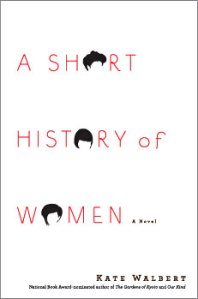
Book Club: A Short History of Women

shorthistorywomenThe book club selection for September was the National Book Award finalist,  A Short History of Women by Kate Walbert. The book centers around the descendants of a British suffragette, Dorothy Trevor Townsend, who starved herself to death for the cause because there was nothing else she could do – a perfect example of what Joan Jacobs Brumberg calls “the appetite as voice.”

The choices made by her descendants also demonstrate the constraints placed on women throughout the twentieth century.  The suffragette’s daughter, Evelyn, moves to America to attend Barnard College, eventually becoming a respected professor of chemistry.  Like other women scientists (or other academics) of her generation, she must give up family and children for her career.  The suffragette’s grand niece, also named Dorothy, goes in the opposite direction, choosing the standard female script of marriage and motherhood, only to find herself at a consciousness raising group in the early 1970s among other women suffering from the feminine mystique. Dorothy’s daughter, on the other hand, is part of the “opt out” generation, confronting boredom and isolation broken only by the occasional carefully orchestrated playdate.

In my opinion, this book fully deserves all the positive press it’s received.  As with her earlier books, Walbert’s writing is beautiful and compelling. Yes, the book’s structure is difficult to follow at times, but for me that contributed to its charm.  If you don’t like nonlinear narratives, then it’s best to avoid this book, or at least be very patient.  If you love Virginia Woolf or similar authors, then this book is for you.