Happy B-day to Me and DJ Hope

cat-prezent.jpg

Hi folks,

Today’s my birthday, which I share with my identical twin sister, aka DJ Hope. The theme of this week’s Disability Blog Carnival is my favorite things — my birthday is certainly one of them!

People often ask me, so what’s it like being a twin? I always reply, well, what’s it like being a “singleton”?

[p.s. just got one of my other favorite things — a snow day! Too bad it got called AFTER I drove to work, only to turn around an hour later and spend 1.5 hours to get home (3 times the usual amount of time).

Gig at AHAP

Just returned yesterday from a trip to Akron, Ohio to give a talk at the Archives of the History of American Psychology. The folks there were very friendly and helpful. The talk was a big hit as well. I was a bit nervous because most of those who attended my Cheiron session last summer didn’t seem to get be that interested in clinical issues, and completely missed the point of the disability perspective (John Burnham, for example, said he agreed with most of it but said the seriously mentally ill should really be locked up for their own good — okay he was a bit more tactful than that but it was the general drift).

Most of the audience members at AHAP were graduate students and faculty in counseling or clinical psychology. Some of the most intriguing questions were from a fellow named Fred Frese, who is a clinical professor of psychology at Case Western who is also a recovering schizophrenic and advocate for other mentally ill individuals. He introduced himself right before my talk, which gave me the courage to “come out” right away as a person with bipolar disorder. He suggested looking at the Association on Higher Education and Disability which has a special interest group on psychiatric disability. He also mentioned attempts to reform the Javits-Wagner-O’Day act to include mental illness (originally this legislation was created in 1930s to assist the blind, then was extended to physically disabled in 1970s). As Frese put it, mentally ill individuals want to be on the bus, even if it’s at the back. He asked if I was willing to work for this, to which I said “absolutely!”

Other things to look into: Andrew Sperling, legal counsel at NAMI,
Tony Young, Senior Public Policy Analyst at NISH, decriminalizing mental illness (apparently the LA county jail is one of the largest psychiatric facilities in the country by default!)

New Blog Name

Hi folks(or rather the handful of family/friends who read this thing!),

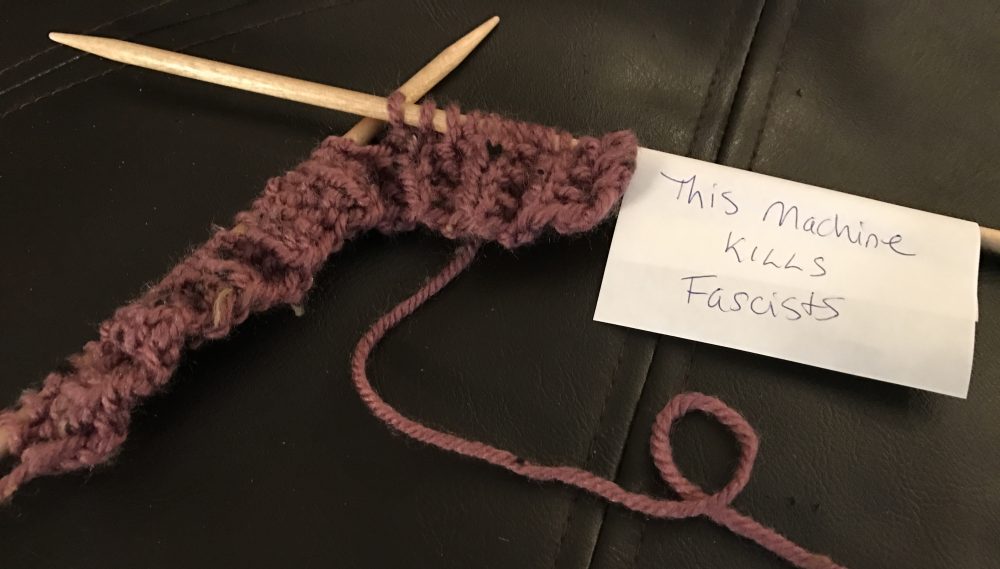
I’ve decided that since this blog is about more than medical history (and very few of my posts are about medical history), to make a name change that more fully reflects the posts on this site. It’s also a take on the conservative history/current events blog,  Spinning Clio.

Most importantly, as you can see from my many posts on the subject, I just plain like to knit! It’s a way to relieve stress, especially during long meetings of Faculty Senate and AAUP.

Back to School

A recent post on Dan Cohen’s Digital History Blog reminded me to update my blog and use it to brainstorm about ideas for using my recently acquired skills in the classroom! My idea for the week is to do some kind of riff on the uses/abuses of Wikipedia, similar to that described by Christopher Miller in the May 2007 issue of AHA Perspectives. At first I thought I would do this just for HIST 162 (the U.S. survey) but think I may do a version for each of my courses. Wish me luck!

Cheiron/EHHS Annual Meeting, wrap-up

As promised, I’m finally getting around to writing more about this. I’ve submitted an overview of sessions on childhood/youth for the Society for History of Childhood and Youth newsletter which will come out later this summer. [older issues can be viewed here].

Overall I found the meeting really interesting and the folks very welcoming — I like these smaller more specialized meetings. As I say in my SHCY review, I found Ian Hacking’s keynote to be particularly enlightening (for those who missed it, this was an expanded version of his article in London Review of Books.] he shows a great deal of empathy towards parents of autistic children, and more importantly individuals with autism.