Presentism, Poxes, and Pap Smears

Today’s post tries to bring together a bunch of issues that have come up in my various listserv and blog reading. First, the issue of presentism came up on Christopher Green’s blog, Advances in the History of Psychology. I don’t usually read this blog, but Chris advertised this exchange on Cheiron’s listserv. Chris is concerned about edits to his history of psychology entry in Wikipedia, about 6,000 words of which Chris wrote himself. Chris objects to a contributor named “Jagged 85” who has been inserting material on medieval Islamic psychology. Because part of what Jagged 85 writes argues that the Islamic world pioneered in the treatment of mentally ill individuals, including building the first mental asylums, I asked the question, “It seems to me that a related question is what “counts” as the history of psychology. Much of the Islamic section seems concerned with treatment of mentally ill patients, i.e. clinical psychiatry. Isn’t this part of the history of psychology? If not, why not?” So far, no one has addressed this point. I should note that a certain kind of presentism is at work in Chris’ blog in that he starts from the point of view of what “counts” as psychology today, and then works backward to the field’s roots in 18th century laboratory science.

Another kind of presentism appears on in a post on Historiann. regarding the new vaccine for HPV. She ties the current controversy regarding Guardasil to earlier debates about smallpox inoculation. Since I’m currently teaching about Cotton Mather and the inoculation debate in early 18th-century Boston in my history methods class, I wrote that in Mather’s time inoculation was a risky procedure — there was no certainty that the patient would not develop a full-blown case of smallpox, the patient could still transmit smallpox to others, and because inoculation consisted of introducing pus or scabs under the skin, the risk of infection at the inoculation site was not insignificant. So, we should be careful about attributing opposition to Mather solely to ignorance — there were legitimate concerns about the safety of the procedure which were raised by physicians and laypersons alike. For more on this issue, see Maxine VandeWetering, “A Reconsideration of the Inoculation Controversy.” New England Quarterly 58/1 (1985): 46-67.

Now on to pap smears. I recently submitted a proposal for a conference on “Cancer Vaccines for Girls? The Science, Ethics, and Cultural Politics of HPV Prevention,” which is going to be held at Rutgers University in May. My plan is to relate this debate back to my earlier work on the history of gynecological exams for girls. I’d also like to comment on Karen Houppert’s article in the Nation. Although I think Houppert raises some good points, I that the term “strange bedfellows” that lumps together religious conservatives, anti-vaccine libertarians, Big Pharma critics, and “and a smattering of women’s health advocates” too easily dismisses attempts by feminist health activists to craft a nuanced reaction to this new technology. I think she is particular unfair to Amy Allina at the National Women’s Health Network. My thoughts on the issue, thus far, are that by focusing on individual attitudes and choice, and emphasizing what Allan Brandt calls the “moral valence of individual risk,” the push for universal vaccination overlooks larger public health issues such as socioeconomic status and access to health care services. Until there is a greater social commitment to meeting the health needs of uninsured and underinsured women, a disproportionate number of whom are from racial minorities, these women will lack the routine preventive care more privileged women take for granted.
Press Release on my book

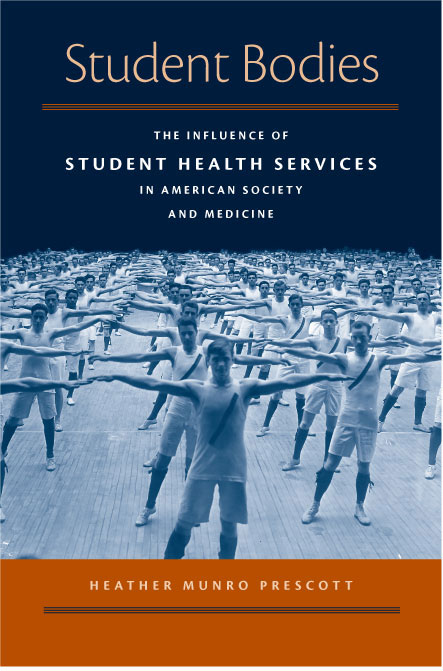
Well, the book is now officially out, and can be ordered here and here.

Our public relations office wrote a great press release (see below). Now, let’s hope it will appear in more than the New Britain Herald!

NEWS

from Central Connecticut State University
Honored as a “Leadership Institution” by the Association of American Colleges & Universities


Media contact: Peter Kilduff, Director of University Relations
(860) 832-1791;
Kilduff@ccsu.edu

CCSU’s Dr. Heather Munro Prescott is the author of the new book “Student Bodies – The Influence of Student Health Services in American Society and Medicine”

NEW BRITAIN — January 10, 2008 — Dr. Heather Munro Prescott, professor of history at Central Connecticut State University, is the author of the new book “Student Bodies – The Influence of Student Health Services in American Society and Medicine.”

Published by the University of Michigan Press, the book explores connections between university health centers and the evolution of American health and medicine. According to the publisher, Prescott’s book is the first to link developments in college health with larger trends in American cultural and medical history.

Dr. Prescott’s comprehensive study describes the origins and development of health services at U.S. institutions of higher education from the early 1800s –when administrators sought to restrict habits “unfavorable to study and morality” such as drunkenness, gambling, and solicitation of prostitutes — to the present, as health professionals face issues ranging from sexually transmitted diseases to depression to eating disorders.

Drawing on a variety of primary sources, Professor Prescott examines the relationship between administrative regulation of “student bodies” and broader social-cultural views about young adults and their status in 19th- and 21st-century America.

“Student Bodies” explores little-known but significant aspects of college health. They include the importance of women’s colleges in the development of student care, the use of physical entrance examinations to deny admission to those with “undesirable” bodies, the sometimes controversial handling of health concerns specific to minority and lesbian, gay, bisexual and transgender (LGBT) students, as well as the rise and fall of “in loco parentis” (Latin for “in the place of a parent”, referring to the legal responsibility of a person or organization to assume some responsibilities of a parent).

Prescott‘s book is geared toward medical scholars and college administrators, as well as anyone wishing to gain a better understanding of medical history, women’s health, and the history of college life in America. Prescott is winner of the Will Solimene Award of Excellence in Medical Communication for her previous book “A Doctor of Their Own: The History of Adolescent Medicine.”

Professor William A. Christmas of Duke University hailed Prescott’s book as “well researched, written, and referenced … [it] explores a number of areas of college health not previously covered …”

According to Professor Sarah W. Tracy of the University of Oklahoma, the book is “a worthy and important contribution to our knowledge of the history of American medicine and higher education … a pioneering effort that weaves together many different historical fields, appealing to all those interested in American medicine, public health, and education.”

Back from the AHA

Well, I’m back from the AHA and trying to get unpacked and organized (ha!) The AHA blog and History News Network both give reports on the meeting highlights. Since my session was on a contemporary event, I was disappointed that HNN decided not to cover it along with sessions on 9/11, the Iraq war, and Hurricanes Katrina and Rita, among others. [I was also bummed that the University of Michigan book display did not include my book, which is now officially out and available for purchase!] So, here’s an overview of “Secure .. for Whom? Campus Violence in Historical Perspective from the Bell Tower to Blacksburg“, without the benefit of Youtube:

First up was Kathleen Jones from Virginia Tech, who was fortunate to be out of town visiting her daughter and new granddaughter during the shootings. The title of her presentation was “The Thirty-Third Victim: Representations of Seung Hui Cho in the Aftermath of the ‘Virginia Tech Massacre.'” She focused on how media coverage shifted from presenting Cho as the “face of evil” to “symbol of mental illness” and the failure of mental health services, as well as his erasure from campus memorials, or as she called it his “public death.” Her major point was that despite the fact that this was a murder-suicide, “the issue of suicide is virtually absent in a report about protecting campuses from future deadly ‘rampages.'” She reported the alarming estimate that there are 1100 college student suicides in the U.S. each year — so far this year, there have been three at Virginia Tech alone. She concludes that while it is important to have greater openness about crime on campus, “it is equally vital to have greater openness about suicide.”

Next was Steven Mintz’ paper, “The Texas Sniper: The First Student Rampage of the Media Age,” which I’ve already commented on in an earlier post. To this I would add that he repeatedly refers to Charles Whitman as a “juvenile” even though he was in his mid-twenties and married.

In my presentation, I picked up where Steve left off and discussed developments in college mental health since the mid-1960s. I mentioned that Dana Farnsworth at Harvard criticized UT psychiatrist Maurice Dean Healy for failing to report Whitman’s thoughts about going into the tower with a deer rifle and shooting up the place to campus authorities. As promised, I mentioned Szasz’ critique of college psychiatrists, referring to them as “double agents” who pledged to serve both students and the administration, “but owing real loyalty to neither.” I focused on students’ demands for rights to privacy in mental health care, which culminated in passage of the U.S. Family Educational and Privacy Act of 1974. I concluded by arguing that discussions of security needed to include providing a welcoming environment for individuals with psychiatric diagnoses, and cautioned against the kind of profiling that followed 9/11.

The session ended with Roger Lane who gave some “Thoughts on School Shootings.” Like Jones, Lane suggested that school shootings are “in fact forms of suicide.” He also criticized Steve for offering ex-post facto diagnosis of Whitman. Although his talk was funny and somewhat irreverent (he referred to his suspicions about “shrinks as finks”) he ended on a rather pessimistic note, stating that he didn’t expect any solutions in his lifetime. He mentioned that Haverford has 13 deans and nine counselors — something that our counseling service, with only 2 fulltime counselors for 12,000 students, would envy.

Attendance for the session was rather low — about 12-15 people wandered in and out — and questions centered around safety issues like, what do you do with students who make concrete threats of violence to specific individuals. It seems to me that this is a no-brainer — but apparently some campuses don’t kick students out for saying they are going to get their guns and blow away their professors!

The good news is that the Marlie Wasserman from Rutgers University Press attended the session, said that Kathleen and my papers were the most compelling (yay!) and said she is interested in having us put together a collection of essays on the subject of campus violence. So, all in all, this was a success.

Happy New Year, getting ready for AHA

Happy New Year folks! I’m getting ready to go to the American Historical Association meeting tomorrow. I plan to stop in at the Library of Congress to look at some finding aids to plan a future extended visit, then off the the sessions in the afternoon. Found an interesting article related to my presentation at Scholars and Rogues, which comments on the incident at UC Boulder last Fall.

On that note, the folks at UCB decided to go with another speaker — Joseph Silva, who is a psychologist with the Student Disability Center at UC Davis. He looks more appropriate anyway — i.e. someone who works directly with students with mental illness and is more involved with student disability issues and rights than I am at this point. Here’s an article on him.

IRBs and the Constitution

A flurry of discussion on IRBs continues on the Cheiron listserv, much of it regarding the claim that IRBs are by their very nature unconstitutional and should therefore be abolished. One respondent referred me to the ACLU website.

I couldn’t find any information from ACLU regarding the ways in which IRBs limit free speech — although I did find some interesting things on privacy of patient records and protection of human subjects involved in medical research (especially “captive” populations in prisons and juvenile detention centers.”

This brings us all back to why these IRBs were created in the first place. Laura Stark sent me a copy of her excellent article, “Victims in our Own Minds? IRBs in Myth and Practice,” in the most recent issue of Law and Society Review. The article does an excellent job of reminding us why review for social science research originated in the first place. She also confirmed my impression that many of the replies on the listserv were patronizing, and the charge of unconstitutionality just plain silly.

I also plugged my own article, “Using Student Bodies: College and University Students as Research Subjects,” Journal of the History of Medicine and Allied Sciences 57 (2002): 3-38, which gives my further thoughts on human subjects research.

Historians and IRBs

Speaking of the AHA, the organization has asked for members to weigh in on a movement at HHS to create policy for IRBs regarding oral histories (see the AHA blog on this). Naturally, this has caused the usual flurry of outrage about allegedly out of control IRBs and “intrusion” into faculty research. (one person called this whole thing “insane.”) Here are my thoughts as posted on the Cheiron listserv:

As a scholar of disability history, and a person with a mood disorder, I suggest being more careful about tossing around terms like “insane.” Furthermore, I don’t understand how this is a bar to academic freedom — why should historians be exempt from the standards and practices of other human sciences? What does this say about our attitudes towards our research subjects?

If you read carefully through all the material from HHS, they are actually recommending that our kind of research be eligible for expedited review — i.e. they are making it easier for us rather than more difficult.

Perhaps if I give some details on my encounter with my IRB I can make my points clearer. Since I have known our IRB chair for years and we are good friends, it was easy for me to approach this process in a collegial rather than adversarial manner. I realize that others are not this fortunate. During my review, the commmittee determined that my oral histories were not “research” as defined by HHS — i.e. they did not contribute to generalizable knowledge. My anonymous surveys were considered research, but because the identities of the respondents were concealed even from me, the committee gave me the green light to go ahead with the survey. Their only concerns were with sample bias, and they gave me lots of excellent suggestions on how to avoid that. In short, the process helped rather than hurt my research project.

The new guidelines, while inconvenient, are now redefining oral history as research — doesn’t this make our work more legitimate to scientists?

I ran this issue by my IRB chair, (who is also a psychologist by the way). He says that the APA has a task force on this issue. His sense from reading quickly through the material from AHA is that HHS is attempting to clarify things for local IRBs. This may make the process less arbitrary. In my case, my IRB considered the professional standards of the oral history association and the release forms our department has developed as acceptable. Because I was applying for funding from HHS (via the publication grants at the National Library of Medicine) I think going through the IRB made my application stronger — that was certainly reflected in my priority score and summary statement from the review committee at NIH.

American Historical Association Panel

Last week I received a draft from my co-panelist Steve Mintz for a session at the annual meeting of the American Historical Association. Wow that guy is organized, so now I’ve got to get cracking on my presentation! The theme of the panel is

“Secure … for Whom? Campus Violence in Historical Perspective, from the Bell Tower to Blacksburg”

Some thoughts on Steve’s draft:

1. He discusses the bell tower shootings by Charles Whitman at University of Texas, Austin in 1966. Steve prefaces this with a discussion of Charles Starkweather and Caril Fugate and says these murders “were not disseminated through a sensationalized media, nor were they viewed as cultural symptoms.” This claim seems at odds with the historical record — Starkweather was compared with, and even cultivated, the image of James Dean in “Rebel without a Cause,” and described as a symbol of postwar youth out of control. They later went on to inspire a number of popular culture representations of youth murder and anomie, including the films “Badlands” and “Natural Born Killers.” I would agree that Whitman’s shooting was portrayed “as a shocking symbol of the social disintegration of the 1960s” but this was not new. One sees the same themes in discussions of Starkweather and Fugate, as well as the Leopold and Loeb trial in the 1920s.

2. Steve argues that “rampage killings challenge popular conceptions of mental illness.” On the contrary, I think they reinforce misconceptions about mentally ill individuals as prone to violence. [see excellent article on media coverage of Virginia Tech shootings by Otto Wahl].

3. warning signs — only became available after the shootings. Should these have been released? Patient rights to privacy being debated in mid-1960s, largely in response to criticisms of college psychiatry by Thomas Szasz as well as revolt against “institutionalized paternalism” by students.

4. describes Whitman as “superfically normal” — seems to reinforce notion of mentally ill as a different species from the rest of humanity. What is normal exactly? Who decides? Description of Whitman parallels that of Leopold and Loeb — i.e. precocious but unstable, brain abnormalities, etc.

5. mentions misogyny/harassment of women — this was true of Cho as well.

6. Overall, theme of security is aimed at victims and survivors — what about security for those who share diagnosis with the killer? Should they be labeled as “threats”?

For my paper, I may start with Szasz’ critique of college psychiatry since it was published shortly after the Texas shootings.

Gig at AHAP

Just returned yesterday from a trip to Akron, Ohio to give a talk at the Archives of the History of American Psychology. The folks there were very friendly and helpful. The talk was a big hit as well. I was a bit nervous because most of those who attended my Cheiron session last summer didn’t seem to get be that interested in clinical issues, and completely missed the point of the disability perspective (John Burnham, for example, said he agreed with most of it but said the seriously mentally ill should really be locked up for their own good — okay he was a bit more tactful than that but it was the general drift).

Most of the audience members at AHAP were graduate students and faculty in counseling or clinical psychology. Some of the most intriguing questions were from a fellow named Fred Frese, who is a clinical professor of psychology at Case Western who is also a recovering schizophrenic and advocate for other mentally ill individuals. He introduced himself right before my talk, which gave me the courage to “come out” right away as a person with bipolar disorder. He suggested looking at the Association on Higher Education and Disability which has a special interest group on psychiatric disability. He also mentioned attempts to reform the Javits-Wagner-O’Day act to include mental illness (originally this legislation was created in 1930s to assist the blind, then was extended to physically disabled in 1970s). As Frese put it, mentally ill individuals want to be on the bus, even if it’s at the back. He asked if I was willing to work for this, to which I said “absolutely!”

Other things to look into: Andrew Sperling, legal counsel at NAMI,
Tony Young, Senior Public Policy Analyst at NISH, decriminalizing mental illness (apparently the LA county jail is one of the largest psychiatric facilities in the country by default!)

The Book Cover

Just received news that my book is now off the printer and will be out within the next 5-6 weeks. Meanwhile, here’s the book cover.

prescott_front.jpg

I thought it came out really well — certainly is eye-catching.  Hopefully this one will sell!

Things have been extremely frantic around the U the past month and a half, as our campus newspaper has once again decided to be offend as many people as possible. Don’t believe me, take a look

This have course has raised a complete uproar again over free speech, responsible journalism, and so forth.