Signal Boost: New Video on the History of Women’s History

via National Women’s History Museum:

The National Women’s History Museum pays homage to the academic field of women’s history with the release of its newest mini-documentary series, “Keepers of History: Women Who Protected One Half of Our Nation’s Story.” The 20-minute video traces the development of the women’s history field and shines a spotlight on the women historians, who against tough barriers preserved the stories, contributions and experiences of American women. The video also pays tribute to the tremendously valuable contributions that women’s history archives played in the development of the discipline.

For much of its existence, the standard field of U.S. history ignored and diminished the importance of women’s lives, work and experiences. The type of history that long was taught focused almost exclusively on white men, usually those in politics and the military; and women historians as well as women’s history were relegated to the footnotes of our national story.

It was only in the mid 1960s that women’s history began to solidify as an academic field. Yet, for as long as there has been a United States of America, there have been female historians. Mercy Otis Warren, for example, not only helped create the American Revolution with her anonymous anti-British plays; she also recorded the war’s history in three handwritten volumes.

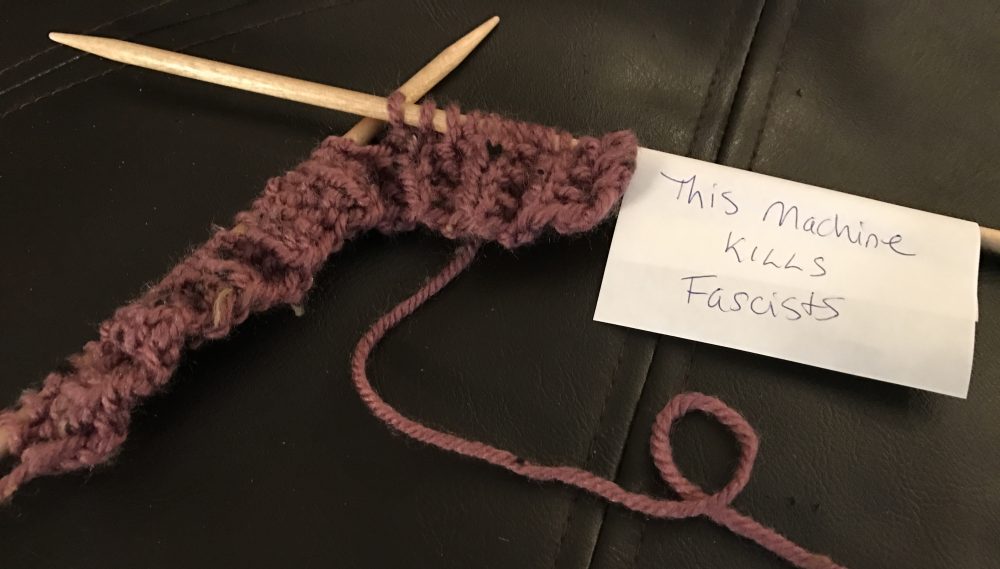
Historian Mary Ritter Beard (left) not only participated in the Suffrage Movement for the vote, but she also published on the topic of women’s history as early as 1915. Her seminal work, Women as a Force in History (1946), challenged the foundation of popular viewpoints that held women as inconsequential in the rise of American and global civilization. It also provided a guide to those historians who later would establish the field of American women’s history.

The documentary also features other important women’s history scholars, such as Gerda Lerner, who was paramount to the development of the field. She founded the first graduate program in women’s history in 1972 at New York’s Sarah Lawrence College.

The documentary is an informative and fascinating look at the challenges women historians faced in preserving the history of our foremothers, grandmothers, aunts, and sisters, and incorporating it into the larger story of U.S. History. To view the video go to  http://www.nwhm.org/about-nwhm/press/featured-press/keepers.
Thoughts on Bachmann’s “Viral Politics”

via Student Activism(among many others).  At Tuesday night’s CNN/Tea Party Republican presidential debate, Michelle Bachmann chastized Texas governor Rick Perry  for his 2007 support of a mandatory state program vaccinating girls against Human Papilloma Virus — a sexually-transmitted virus that can lead to cervical cancer.  during the debate, Bachmann called the vaccine  a “government injection,” and Perry’s decision as “a violation of a liberty interest.” She also suggested that Perry’s support of mandatory vaccination was payback for Merck’s support of his campaign (Perry’s former chief of staff was a lobbyist for Merck). After the debate, Bachmann went even further:

“When you have innocent little 12-year-old girls,” she said, “that are being forced to have a government injection into their body — this is a liberty interest that violates the most deepest personal part of a little child. … A little girl doesn’t get a do over — once they have that vaccination in their body, once it causes its damage, that little girl doesn’t have a chance to go back.”

Student Activism says he was “gobsmacked by the language itself — the use of such heavily loaded molestation imagery to describe a non-invasive, voluntary medical procedure.”

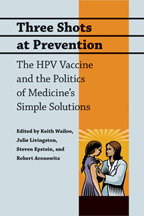
I wasn’t going to get mixed up in this but because I contributed to the volume picture at left, and I’ve been getting links to articles about this asking for my thoughts, I’ve decided to weigh in after all.

I agree that Bachmann’s rhetoric is outrageous (especially since she shows little  concern for women who have been sexually assaulted, or those who need basic reproductive health care like pelvic exams or cervical cancer treatment).

Even the conservative paper  Wall Street Journal has condemned Bachmann’s “viral politics” and demagoguery, calling this “the kind of know-nothingism that undermines public support for vaccination altogether and leads to such public health milestones as California reporting in 2010 the highest number of whooping cough cases in 55 years.”

Wow, it’s not often I agree with the WSJ!  It’s also not often that the WSJ critiques a Republican candidate — obviously Backmann is beyond the pale (and I bet Perry’s ties to Big Pharma is a plus for the pro-business publication).

At the same time, I’m going to plug my and my colleagues’ work in Three Shots of Prevention and suggest critics get it and learn about the multiple moral, ethical, and scientific questions regarding HPV vaccines.

Update:  I’m addressing Dr. Pete’s comments here rather than in the comments section.  First, I and others who work on adolescent health issues acknowledge that there is a qualitative difference between young children and teenagers.  One of the keys to successful adolescent health care is involving teenagers in the process (and as they age, asking Mom and Dad to step out of the room). In other words, girls (and boys) who are being offered the HPV vaccine should be part of the conversation about whether or not to receive it.  So individual liberty includes teenagers too, not just parents. The imagery used by Bachmann in her remarks does not acknowledge the developmental differences between teenagers and younger children.


Happy Women’s Equality Day!

via National Women’s History Project.  Here is President Barack Obama’s proclamation:

WOMEN’S EQUALITY DAY,  August 26, 2011
BY THE PRESIDENT OF THE UNITED STATES OF AMERICA
A PROCLAMATION
The 19th Amendment to the United States Constitution tore down the last formal barrier to women’s enfranchisement in our Nation and empowered America’s women to have their voices heard in the halls of power.  This Amendment became law only after decades of work by committed trailblazers who fought to extend the right to vote to women across America.  For the women who fought for this right, voting was not the end of the journey for equality, but the beginning of a new era in the advancement of our Union.  These brave and tenacious women challenged our Nation to live up to its founding principles, and their legacy inspires us to reach ever higher in our pursuit of liberty and equality for all.

Before the Amendment took effect, women had been serving our Nation in the public realm since its earliest days.  Even before they gained the right to vote, America’s women were leaders of movements, academics, and reformers, and had even served in the Congress.  Legions of brave women wrote and lectured for change.  They let their feet speak when their voices alone were not enough, protesting and marching for their fundamental right to vote in the face of heckling, jail, and abuse.  Their efforts led to enormous progress    millions upon millions of women have since used the power of the ballot to help shape our country.

Today, our Nation’s daughters reap the benefits of these courageous pioneers while paving the way for generations of women to come.  But work still remains.  My Administration is committed to advancing equality for all of our people.  This year, the Council of Women and Girls released “Women in America:  Indicators of Social and Economic Well-Being,” the most comprehensive report in 50 years on the status of women in our country, shedding light on issues women face in employment, crime, health, and family life.  We are working to ensure that women-owned businesses can compete in the marketplace, that women are not discriminated against in healthcare, and that we redouble our efforts to bring an end to sexual assault on college campuses.

On the 91st anniversary of this landmark in civil rights, we continue to uphold the foundational American principles that we are all equal, and that each of us deserves a chance to pursue our dreams.  We honor the heroes who have given of themselves to advance the causes of justice, opportunity, and prosperity.  As we celebrate the legacy of those who made enormous strides in the last century and before, we renew our commitment to hold true to the dreams for which they fought, and we look forward to a bright future for our Nation’s daughters.

NOW, THEREFORE, I, BARACK OBAMA, President of the United States of America, by virtue of the authority vested in me by the Constitution and the laws of the United States, do hereby proclaim August 26, 2011, as Women’s Equality Day.  I call upon the people of the United States to celebrate the achievements of women and recommit ourselves to the goal of gender equality in this country.

IN WITNESS WHEREOF, I have hereunto set my hand this twenty fifth day of August, in the year of our Lord two thousand eleven, and of the Independence of the United States of America the two hundred and thirty-sixth.

BARACK OBAMA
Women’s Rights and Women’s Equality Day Resources

National Women’s History Project
3440 Airway Dr Ste F
Santa Rosa, CA 95403
http://www.nwhp.org
(707) 636-2888
nwhp@nwhp.org

Reminder to Certain Feminists: Teenagers have rights to choice and bodily autonomy too

via Historiann, who discusses Mary Elizabeth Williams’ Twitter battle with Katha Pollitt and Amanda Marcotte over her Salon article about her daughter getting the wrong vaccineat her annual checkup. Williams knew she would get flak for the article, but she “wrote it anyway, because I felt strongly about two key issues of the story. If you’re going in for any procedure, drug or vaccination, take a moment to double-check that the person administering it is giving you what you’re there for. Also, I believe my daughters should have final say in whether or not they receive the HPV vaccine. And flak, indeed, I got.”

As  an expert on the history of adolescent medicine and contributed to an edited collection on the politics of HPV vaccines, I have to say “right on.”

Certain feminists in the twiterverse disagreed, though:  “Amanda Marcotte took some mighty big umbrage on Twitter,”  calling Williams’ piece an “‘overreaction’ and then proceeded to engage in something that looks remarkably like overreacting.

“A single tear shed over this causes everyone else to wonder if you don’t have real problems,” she wrote. “I’m honestly not invested in freaking out on an innocent mistake that resulted in no real problems… I mean, I have real shit to deal with in my life… If that’s the most awful thing you’ve learned at 11, you live in a big time bubble…. I’m sure her mother’s reaction to it had nothing to do with the little girl thinking this was the worst thing ever.”

Author Katha Pollitt also jumped into the fray, calling the story “ridiculous.” Not the review I’d wish for, but all right. But I’d like to correct her assessment that “I just felt this woman was hyperfreakout helicopter parent, infecting her kids with anxiety.”

Unlike Historiann, I’m a twitterstorian who tweets regularly (see my feed to the right) although I must confess I find it impossible to keep up with all the people I follow and use an automatic aggregating program to compile all these posts into the Knitting Clio daily (paper.li does this automatically — I don’t stay up late at night putting the daily together!)  I went to Twitter to look at the exchange between Williams and her critics (and fans).  I especially liked Angus Johnston’s comment:  “I think it’s utterly reasonable for a parent to want to choose when and how she discusses the HPV vaccine with her daughter.”

I made the following comment at Historiann’s blog;  “Wow, this woman dares to treat her adolescent daughter as a developing adult (i.e. follows the recommendation of experts in adolescent medicine). Kudos to her. Interesting that feminists like Marcotte and Pollitt are all for choice and bodily autonomy, unless the body in question belongs to a teenager.”

Now looking forward to my own Twitter battle!

More highlights from #Berks2011

Now that I’ve unpacked and recovered from a full weekend, I’m now ready to fill you in on the rest of my conference highlights:

Friday:

I went to the DuBois Library to check out the University’s Digital History Lab.  I was very impressed by the lay out and state-of-the art equipment in the lab itself but the staff didn’t seem prepared for the open house and just showed us the website.  I could have done that on my own!  Nevertheless, the website is a great introduction to the field.  I then checked out the book exhibit, where I collected a bunch of discount flyers and plan to order way more books than I need or can possibly read!  Then it was off to lunch with my fellow panelists for the first of my Saturday afternoon session (more on that later). In the afternoon, I attended an excellent session, #55 on “Racialized Childhood and Youth: Gendered Visions of the Coming Generation in Transnational Perspective.” A The most useful paper for my work was Zora Simic’s “What Sort of ‘Problem’ is Teenage Pregnancy.”  One of the most interesting points I got out of her talk was the ways in which the “epidemic” of teenage pregnancy described in the 1970s conflicted with the female timetable and aspirations for girls set by liberal Second Wave feminists.  I mentioned a post on Ms. Magazine blog complaining about Forever 21’s maternity line.  The post complained that “With 65 percent of their clientele under the age of 24, the real issue here is the normalization of teen pregnancy.”  Many of the commentators rightly clobbered Ms for that one — some observed that 20-somethings are not teens, some said they would have loved to have fashionable and affordable clothes when they were pregnant at age 19/20, and argued that the whole article did nothing more than shame pregnant teens.  Finally, one teenager observed:  ” As a 16 year old girl, I don’t walk into a store see maternity clothes and think ‘I guess it’s time to get pregnant” or “I suppose it’s alright to get pregnant because they’re selling clothes for pregnant women in a store targeted at my age group.’ Just saying.”

fter that, I attended part of session #72, “Researching and Interpreting Feminist Activism of the 1960s and 1970s: an Intergenerational Roundtable.”  The session was packed and a bit uncomfortable because it was in an un-airconditioned room in 80 degree heat.  I only had my iPod with me, so only got out a couple of tweets:

Problems of writing recent history and getting corrected by those who were there #Berks2011

Sheila Rowbotham women’s hist not just great rev moments need to look at stuff in between #Berks2011

It was a good thing I was monitoring the Twitter backchannel, because I almost missed the poster session.  This is the first time the Berkshire Conference has offered this option.  There were lots of great posters, but I also kept running into people I knew, or who wanted to introduce themselves to me, so I didn’t really get to look at any of them in depth.  Tenured Radical has a brief clip of one of the presenters. Next time I hope the conference organizers have more than one day or at least a longer time period than two hours that doesn’t overlap with other sessions.

The highpoint of the day was the blogger meet-up in the graduate student lounge (aka bar)– here’s Tenured Radical at left presiding.  After that, I went to the Green Street Cafe in Northampton for another great restaurant week meal.

Saturday was very busy — I did check out session #82, “Performing the Body,” where Lori Rotskoff’s paper “From ‘Daughters of Maybelline’ to ‘Sisters of Freedom’: Second Wave Feminism, Girls’ Activism and the Politics of Appearance in the United States” made me nostalgic for “Free to Be You and Me” and other feminist children’s programming of the 1970s.

I then took the morning and lunchtime to fine-tune my presentation for session 150, “The Transgressive Body: Young Women as Objects and Agents of Desire”; and my comments for session 154 “In and Out of the Doctor’s Office: Medicine, Health Policy, and Gendered Expectations.”  After that, I was pretty well spent, so met up with some friends to knit and drink in the graduate student lounge followed by another restaurant week dinner at Sierra Grille.

Overall this was an excellent conference — the campus hotel was comfortable, quiet, and affordable.  The conference staff were helpful and friendly and the quality of the sessions I attended were very high.    If you attended the conference, submit your comments at the section of the conference blog called “Think/Learn/Teach/Do,”  If you didn’t attend, I encourage you to attend the next one in Toronto, Ontario in 2014 — this will be the first time the Berkshire conference will be held in Canada.

For other reports, see the ones by the aforementioned Tenured Radical, “Classy Claude” at Historiann (who was unable to attend herself because of a last minute family emergency), and Another Damned Medievalist who calls on future Berkshire organizers to include more pre-16th century sessions.

#BigBerks #Berks2011 First day highlights

Hi folks,

Thought I would post a quick update before heading off to a busy day of sessions and workshops.  I arrived around 2pm.  The campus center and hotel was easy to find but there was no elevator in the parking garage — huh?  How does UMass get around ADA on that one?!

Fortunately, things went splendidly after that.  Got checked into the hotel and conference very quickly (it helps to arrive early!)  Then I attended the session, “Using the Past to Shape the Future: Interpretation at Historic Sites and Museums.”  The major theme of this session was community engagement — i.e. how to be more in touch with the local community and expand civic role by encouraging people in the surrounding area through programming that uses the collections to illuminate contemporary issues. For example, Lisa Junkin from the Jane Addams Hull House Museum said that the site is both a traditional house museum and a place that looks at the “unfinished business” of the settlement movement, such as “what happened to the Progressive era origins and intentions of the juvenile justice system.”  Junkin also cracked that it was easier than expected to start a Sex positive film series at the museum because her director acknowledged that Hull House was “one of the queerest sites in Chicago!”  (e.g. the partnership between Jane Addams and her life-long companion Ellen Starr Jordan).  Rosa Cabrera talked about the Field Museum’s work on collecting stories from immigrant communities in Chicago and how these personal accounts reflect these individual’s environmental values.  For the stories, see their blog.  Vivien Rose from the Women’s Rights National Historical Park also emphasized that women’s history sites, as they have become part of the “establishment” are in danger of becoming too static and need to be more creative about finding ways to connect to their communities (at least I think this was her point — I’m not an expect in museum studies!)

I had to meet some knitting friends for an outing to WEBS (for those who are not fiber freaks this is the famous yarn store in Northampton) so I left towards the end of Dawn Adiletta’s presentation on the Salons at the Harriet Beecher Stowe Center— so by way of apology, I’ll give a big plug for these programs and make an effort to finally attend one myself!

After the trip to WEBS where I used the gift card I received for Christmas, we went to downtown Northampton for dinner where we discovered it’s restaurant week.  We had a huge three course meal at Spoleto for only $21.95.    Now I’ve got to decide which one to go to tonight.

Today I’m planning to go to the Digital History Lab at the library so I can find out what the folks here at UMass are doing, and then copy it for my courses this fall!

Getting Ready for #BigBerks aka #Berks2011

Hi folks,

Like many historians of women I’m getting ready to head off to the Fifteenth Berkshire Conference on the History of Women  at the University of Massachusetts in Amherst on June 9-12.  (See the program here).  Note:  this is a conference on the history of women, not a conference just for female historians — men, both cis and trans, are welcome as well (as are, of course, trans-women).

If you want to meet other women’s historians who blog, come to the  meet-up organized by Historiann.  This will be held Friday afternoon from 5:30-6:30  in the Grad Lounge of the Lincoln Campus. If you consult the campus map on page 27 of the program, you’ll see that the Lincoln Campus Center is also the conference hotel, and is right across the street from Worcester Dining, where you can find your dinner after the meetup.In addition to yours truly, you can meet Tenured RadicalClio Bluestocking, Another Damned Medievalist, Janice Liedl

Now, why am I using this “#” thing in the title of this blog post?  Well, because I’ve set up this blog so that my posts are automatically sent to my Twitter feed (see column at left.  My Twitter name is @hmprescott).  You can follow the Berkshire Conference feed using @Berksconference.  But that’s only part of the Twitter experience.  If you want to find out what other Twitter users are saying, use #BigBerks and/or #Berks2011.

I’m one of the few people who was allowed to appear more than once on the program because a session commentator dropped out.  This is quite an honor — but I can’t help expressing a minor gripe to the conference organizers:  did you have to put both my panels back to back, on opposite sides of campus?!  Otherwise, great job at putting together an impressive program.

Yesterday, I got an important question from Cliotropic, aka Shane Landrum via Twitter (@Cliotropic).   Shane will be attending his first Berkshire Conference and wanted to know what to wear.  He said in a direct message: “Since you’ve attended the Berks before & I haven’t: how dressed-up is it? I’m assuming “tie, no jacket” for presenting but want to be sure.”  To which I replied, ” The Berks are supposed to be casual and I’m fighting those who want to turn it into the AHA. So, shorts, no tie!”  I then tweeted:  “recommended dress code for #BigBerks aka #Berks2011 — casual please! #nottheAHA”

Seriously, the first time I attended the Berkshire Conference, at Douglass College, Rutgers University, in 1990, it was like a summer camp.  Most of the attendees wore shorts and t-shirts — the most dressed up had on sun dresses and casual skirts.  Then I noticed a disturbing trend, starting with the 1993 conference at Vassar — folks were dressing to impress.  There were power suits!  Fancy dresses.  Oh no, we’re becoming the AHA.  Not good!

So, I’m making a plea to all of you who are packing to head off to Western Massachusetts — please think casual casual.  Dress for comfort.  In particular, keep in mind that we are going to have record heat — mid-90s — for the first day or two of the conference, with high humidity.  Unlike other areas of the country, air conditioning is not a standard feature of college and university buildings in the Northeast.  So, don’t assume that the room you’ve been assigned will be cooled to perfection (or beyond — seriously, why do you folks in warm climates set the thermostat at or below 60 degrees — isn’t that considered winter where you are?)  This being New England, the weather will go in the other direction — it cool off by Saturday with showers during the day and perhaps downright chilly evenings.

Okay, enough advice.  Got to finish the comments for my second panel.  Hope to see some of you soon!

Celebrating the anniversary of Griswold v. Connecticut

via Ms Magazine blog. On June 7, 1965, the U.S. Supreme Court issued the decision, Griswold v. Connecticut [PDF] which struck down an 1879 state law “that prohibited the use of contraceptives and made it illegal to assist, abet or counsel someone about contraceptives. Griswold established a constitutional right to marital privacy that, in the words of Justice William O. Douglas, would no longer allow ‘the police to search the sacred precincts of marital bedrooms for telltale signs of the use of contraceptives.'”

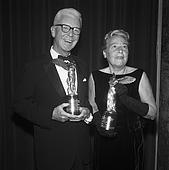
At left is a photo from Corbis.  The image is from an awards ceremony on October 19, 1965.  

Original caption: Dr. C. Lee Buxton (Left) and Mrs. Estelle T. Griswold are shown with planned Parenthood awards they received on October 19, at the annual dinner of Planned Parenthood at the Waldorf Astoria Hotel here. Along with the gold statuettes each gets a scroll and they share the 2,500 Albert Lasker Award of Planned Parenthood-World population.
Now, I’ve always wondered why Dr. Buxton seldom if ever gets mentioned in the commemoration of this event.  I reckon it’s because he was a male doctor, and that just doesn’t fit with the over-simplified narrative of the women’s health movement of women combatting the “evil,” mostly male medical profession.
I don’t want to overdo it and give Buxton too much credit — but what I’ve heard from the residents who worked under him at Yale-New Haven Hospital  is admiration for his willingness to put his reputation and career on the line to fight the state’s restrictions on contraception.  This acknowledgement came even from Virginia Stuermer,  who said that while Buxton was very progressive on issues of birth control and abortion, he was not”so hospitably disposed toward young women who wished to become resident physicians in our department. At a time when the government was scrutinizing the hiring practices of universities which received federal grants(vis-a-vis women and minority groups),our chairman still felt he could ask women residency candidates if they would forego childbearing for the duration of the four-year program. Needless to say,fewwomen became residents during that chairman’s tenure.Today, a preponderance of residents in our department is female. This fact has certainly brought a sea of change in the attitudes of physicians in my field in this community.”  Nevertheless, Stuermer acknowledged that Buxton’s work along with Griswold’s, was “paramount” in the struggle against Connecticut laws banning birth control.  Buxton also was willing to enlist Stuermer and another junior faculty member as clinicians at the New Haven Planned Parenthood clinic.  After the Griswold decision was handed down, Stuermer replaced Buxton as medical director at Planned Parenthood, and abortion became the “next battleground” in the Nutmeg state’s history of reproductive rights.  At the forefront of these efforts were female physicians and law students at Yale.
This “sea change” among women professionals in medicine and the law deserves more attention,.  For a start, see  the essays by Sandra Morgen and Naomi Rogers in Women Physicians and the Cultures of Medicine, edited by Ellen S. More, Elizabeth Fee, and Manon Perry (Johns Hopkins, 2009).

Two Invitations from Judy Norsigian of Our Bodies Ourselves

Yesterday I got an exciting email from Judy Norsigian, asking me if I’d finished my book on the history of emergency contraception (yes!) and even more thrilling, whether I’d like to guest blog on the history of EC for Our Bodies, Our Blog.  My reply was — you betcha!  (Okay, that’s not exactly what I said but that’s what I meant).  So, here I have an opportunity to plug my work to a larger audience than the dozen or so folks who read Knitting Clio.

The second invitation was to a 40th anniversary celebration of Our Bodies, Ourselves that will be held in Cambridge on October 1st.  Unfortunately I have a prior commitment that day but said I’d spread the word about it.  So, for more information, go here.

Invigorated and Exhausted from American Association for the History of Medicine meeting

I got back from the annual meeting of the American Association for the History of Medicine meeting yesterday as as usual am bursting with ideas and buried in work.  So, this will be quickie overview with more reflection and analysis at a later date.

First, I’d like to report that my forthcoming book  (cover photo at left) is moving much closer to actually being out.  I received the page proofs about a week ago and am working on getting them back ASAP.  Unfortunately the editor decided not to have them available at the meeting because they aren’t corrected — but there’s always next year.  Hopefully they will be available at the Berkshire Conference of Women Historians next month.

Meanwhile, I got an opportunity to plug my book and establish myself as an authority on the “morning after pill” in an interview for a documentary by Caryn Hunt, President of the Philadelphia chapter of the National Organization for Women.  It was a lot of fun and I wasn’t as nervous as I expected.  Also, I got a new suggestion for a doppelganger. Thanks,  I agree!

My presentation on The Pill at 50: Scientific Commemoration and the Politics of American Memory went very well and I had a substantial audience (at least 30) despite it being on first thing on the last day of the conference.  The reaction was enthusiastic (especially from this leading authority on the history of the Pill) so I’m planning to expand this and submit it to the Bulletin of the History of Medicine.

Since I’m teaching in a public history graduate program, and living in Connecticut, my “commemorative mania” will continue with some kind of commemorative event celebrating the 50th anniversary of Griswold v. Connecticut in 1965 (which follows soon after my own half-century mark).  Not sure what this will be but the folks at Yale and Planned Parenthood are keen so looks like it will happen.  I also told the editor at Rutgers that I’m interested in doing a narrative history (as opposed to a legal history that uses Griswold as a lead-up to Roe v. Wade rather than an event in it’s own right).  As it turns out, a very distinguished senior historian of medicine and public health was one of the witnesses who testified.  It seems that the New Haven police was willing to shut down the clinic so that birth control advocates in the state could use this as a test case, but they needed evidence that the clinic was dispensing birth control.  This historian was a graduate student at Yale and was one of Dr. Buxton’s patients.  She volunteered to get the evidence (a tube of contraceptive jelly) and then went straight to the police department to turn in the incriminating evidence and give a statement.  When she blurted out that contraception was “women’s right”, the Irish cop asked her, “don’t you mean a married woman’s right?” What a story!

I heard lots a great papers and connect with all my history of medicine buddies.  However, work awaits so I’ll have to continue these conference report later (most likely much later since research papers and finals will be landing on my desk shortly).