Should the Pill be Set Free from the Prescription?

via Newsweek, which reports on the work of the Over-the-Counter Oral Contraceptives Working Group.  As it so happens, this is not the first time this question has been asked — something I’m exploring in an article I’m revising for a edited volume on The Prescription in Perspective: Therapeutic Authority in Late 20th Century America edited by Jeremy A. Green and Elizabeth Siegel Watkins for Johns Hopkins University Press.  Historically, the arguments in favor have tended to come from public health experts who see the prescription as paternalistic and an unnecessary barrier to timely access.  This is the position taken by Kathleen Reeves at RH Reality Check, who says that the prescription “seems like a holdover from the days when contraception was forbidden: when women who wanted it were reprimanded and those who provided it were jailed.”

[P.S. here’s another article on this same subject from RHReality Check].

Meanwhile, Elizabeth Kissing over at the Society for Menstrual Cycle Research’s blog re:Cycling has this to say:

“I have mixed feelings, myself. I’m in favor of just about anything that makes contraceptives more accessible to the people who need them, but I fear that the likely increase in cost of OTC pills means the availability won’t benefit those who most the need them – the young and the poor. Also, there are some contraindications for pill use, such as high blood pressure, history of migraine, and use of certain anti-seizure drugs for epilepsy. And despite the happy, shiny images of Yaz and Seasonique commercials, some women just can’t tolerate the side effects, for any number of reasons.”

This is pretty much the argument that was made by the National Women’s Health Network and other consumer protection groups the last two times this issue was raised — in 1993, and again in 2000.   Despite claims by FDA Center for Drug Evaluation and Research direct Phillip Corfman that the Pill was “safer than aspirin” and should therefore be sold over the counter, these consumer protection advocates argued that the pill was just too dangerous for OTC use.

Now the issue has come up again, no doubt because the success in getting emergency contraception sold, well, not quite OTC, but at least behind the counter without a prescription.   The OTC OCs working group includes representatives from NWHN and others who were against nonprescription status for birth control pills.  It will be interesting to see how this develops, and whether it will get in my paper.  Now, this is the problem with doing very recent history — the history keeps on happening while you’re writing it and there are continual updates!

According to the OTC OCs Working Group’s July newsletter, the Newsweek article does a nice job of summarizing the issue, but here are some corrections:

  • Regarding the timeline for an OTC switch, the article says, “They hope to have a proposal before the FDA within the year and an over-the-counter pill available in five years.” When I spoke with the author, I said that we hoped to have a meeting within a year (and hopefully this year) with the FDA to get feedback on the draft study protocols and labeling the working group has developed. The actual use and label comprehension studies would need to be completed before an application could be submitted, and those studies will take time–and additional funding. The working group is still in the process of exploring partnerships with pharmaceutical companies, since such a company would likely be the sponsor of a switch application to the FDA. I also said that the five-year goal of having an OTC pill on the market depended on a lot of factors, including an assurance that low-income women would be able to access such a product.
  • The article confuses the FDA advisory panel’s recommendation on the EC product ella with an actual approval, and incorrectly describes ella as containing progestin when it is composed of ulipristal acetate.
  • The article misquotes the Pharmacy Access Partnership’s national survey, which asked women about pharmacy access to hormonal contraception, rather than OTC access.
  • The article references our paper on contraindications among Mexican OC users, but that paper did not find “that women who buy pills directly from pharmacies often have greater understanding of the contraindications than women who visit clinics.”
  • The working group is currently supported by a grant from the Hewlett Foundation, which is misspelled in the article.

So, what do readers out there think?  Should women be freed from the tyranny of the prescription?  Or do we need the Rx to protect us from unsafe products?  [remember there’s a class action lawsuit against the manufacturers of Yaz and Yasmin filed by women who have suffered strokes and blood clots and other serious side effects)?

Happy Belated Birthday to Griswold v. Connecticut

Last week I was so buried in my writing that I plumb forgot to honor the 45h  anniversary of  the U.S. Supreme Court decision Griswold v. Connecticut (June 7, 1965).   So, here’s some history (based on information from contemporary newspaper accounts, as well as  David J. Garrow, Liberty and Sexuality:  The Right to Privacy and the Making of Roe v. Wade (Berkeley:  University of California Press, 1998) and John W. Johnson, Griswold v. Connecticut:  Birth Control and the Constitutional Right of Privacy (Lawrence:  University of Kansas Press, 2005) ).

Yale New-Haven Hospital was at the center of birth control politics in both the state of Connecticut and the nation. In 1958, Dr. C. Lee Buxton, chair of the department of Obstetrics and Gynecology at Yale Medical School, along with three of his patients, filed a lawsuit claiming that the state’s laws prohibiting the sale, distribution, and use of contraceptive drugs and devices were unconstitutional. The suit reached the U.S. Supreme Court in June of 1961, but the Court dismissed the case since no state laws had been violated. Yet, the court opinion that accompanied the decision also declared Connecticut laws were “dead words and harmless, empty shadows.” On November 1 of that year, the Planned Parenthood League of Connecticut, led by Buxton and PPLC Executive Director Estelle Griswold, decided to test the validity of the court’s opinion, and opened a birth control clinic in New Haven. Nine days later Buxton and Griswold were arrested for violating state laws outlawing contraception. The defendants appealed their case all the way to the U.S. Supreme Court culminating in the court’s decision in Griswold v. Connecticut (1965) declaring “Connecticut’s birth-control law unconstitutionally intrudes upon the right of marital privacy.”

Immediately following the Griswold decision, the Connecticut Birth Control League opened the New Haven Planned Parenthood clinic. Initially, league officials reported an “uphill fight” in gaining acceptance, due to a lingering “moral stigma” against family planning among some individuals. By 1967, “unbelievable change” had occurred, and “birth control is booming in the Elm City” — especially among female graduate students at Yale University (this is before the undergraduate college admitted women).

Unmarried women in other states were not necessarily so fortunate: in Massachusetts, Bill Baird was arrested for “crimes against chastity” for giving contraceptive foam to an unmarried teenage girl following a lecture at Boston University in 1967.  His conviction was overturned in the decision Eisenstadt v. Baird (1972), in which the Supreme Court rule  “If the right of privacy means anything, it is the right of the individual, married or single, to be free from unwarranted government intrusion into matters so fundamentally affecting a person as the decision whether to bear or beget a child.”

As a recent editorial in the Roanoke Times observes, these rights to privacy still “remain suspect”.   So, go out and enjoy them while you still have them!

Sexism in Science, or Why There was no Alberta Einstein

via NYTimes.com.  Oh boy, here we go again. John Tierney tackles another controversial topic by “daring” to side with the tired sexist conventional wisdom  that the reason there are fewer women in science than men is because of innate differences in intelligence.  Various replies in the comments section have nicely addressed the various studies that have demonstrated persistent social barriers to women in science, starting with social conditioning in childhood (e.g. boys are given trucks and tools, girls dolls and dresses.  Boys are praised for being smart, girls for being pretty).  For a great round-up of how women in STEM are addressing sexism in science, see the blog Geek Feminism.

Since I’m a historian, I’m going to limit myself to addressing this  one of the nearly 300 comments:

“When the Summers controversy erupted, I wondered why there was no Alberta Einstein and no Roberta Fisher. Solitary study of physics or chess doesn’t require much more than obsessive dedication, a piece of paper and a pencil or a chess board. Albert Einstein didn’t need an expensive lab, nor did Bobby Fisher. Both were clearly extreme in many ways. Equally extreme women could have duplicated their efforts, but not one did. Where are the extreme women?”

As an homage to Virginia Woolf’s reflections on what would have happened if Shakespeare had had an equally talented sister name Judith. here are my thoughts on why there was no Alberta Einstein. In this case, I don’t have to make up a fictional talented sister.  There is already a real-life example of  a woman of this era who equaled or even surpassed Einstein in terms of ability and performance as measured by professional accolades:  that would be double Nobel laureate Marie Curie.

First, let’s deflate the myth that Einstein was a lone genius scribbling out his theories in pencil while laboring in a Swiss patent office.  While Einstein did face the not insignificant social barrier of Antisemitism, he was well-connected to the academic and scientific institutions of the era.  He received his Ph.D. from the University of Zurich in 1905 and in less than a decade was a full professor at the University of Prague.  In 1921, Einstein received the Nobel Prize in physics for his work on the photoelectric effect. He was forced to flee German during the Nazi era, and spent the rest of his life at the Institute for Advanced Study in Princeton, NJ.

Here’s a summary of Marie Curie’s career.  Curie was fortunate enough to have a family who supported her educational aspirations.  She attended a prestigious gymnasium for girls in her native Poland, and later studied at the Sorbonne in Paris where she met her future husband Pierre.   Despite her academic achievements, she was denied a position at Krachow University solely because she was a woman.  Instead, she married Pierre and together they did the groundbreaking scientific research that led to them being awarded a Nobel Prize in Physics in 1903.  Eight years later, Marie received a second Nobel Prize, this time in chemistry, “in recognition of her services to the advancement of chemistry by the discovery of the elements radium and polonium, by the isolation of radium and the study of the nature and compounds of this remarkable element.”   Despite being the only person, male or female, to be awarded two Nobel prizes by that time, she was denied entry to the French Academy of Sciences, again, solely because she was a woman.  She never received an academic appointment but did manage to get funding from the French government and private sources to run her own laboratory.

So, this is what happened to the most talented female scientists of Einstein’s generation.  For numerous other examples of women scientists from this period and beyond, see the excellent and exhaustive work of Margaret Rossiter.

Women and Memorial Day

via National Women’s History Museum.  Since this is a holiday weekend, I’m posting their message verbatim:

“NWHM celebrates this year’s Memorial Day through a mini-documentary recognizing the significant roles women played in the holiday’s origin. In the aftermath of the Civil War, women worked to transcend the horrors of war by bringing civility and peace to a wounded nation. Let this holiday be a reminder of women’s many inspirational roles in shaping our nation.

Women were instrumental in creating this annual holiday–from the establishment of the first Memorial Associations following the Civil War to collecting flowers for what is sometimes still called “Decoration Day.” One of the earliest leaders in the movement to create Memorial Day was Ellen Call Long. Just weeks after the Civil War ended in 1865, she organized a women’s memorial society to reconcile embittered enemies. On June 22, 1865 the memorial society created a resolution which led to the creation of Memorial Day.

To view the video, go to http://www.nwhm.org/about-nwhm/press/featured-press/memorial-day.

#####

The National Women’s History Museum affirms the value of knowing Women’s History, illuminates the role of women in transforming society and encourages all people, women and men, to participate in democratic dialogue about our future. Founded in 1996, NWHM is a nonpartisan, nonprofit 501 (c) 3.”

That’s So Twentieth Century: Women’s History and Web 2.0

In my last post, I reproduced an announcement from the women’s studies journal  Frontiers about a new “interactive” column by Eileen Boris, in which she will cook up a “gumbo” of emailed responses, “mixing, seasoning, and throwing in her own ingredients, as she enables us to engage in feminist dialectic.”

As Pennamite observed in the comments section, “Isn’t that gumbo going to be a bit old, if the deadline for submissions is over a year away…? Seems like an awkward way to shoehorn social media into a paper journal format.”

Right on, Pennamite!  So this post is a response to Penny’s observation and a contribution to a new venture that Dan Cohen and  Tom Scheinfeldt started cooking up at ThatCamp this past weekend. They propose writing an edited book entitled Hacking the Academy:

“Let’s write it together, starting at THATCamp this weekend. And let’s do it in one week.

Here’s my question — can we do better than use a twentieth-century technology (email) to create an interactive feminist discussion?  To steal Pennamite’s motto — you betcha!

In fact, I would argue that the call from Frontiers is barely twentieth century (even if the announcement was posted on Facebook)– one could easily imagine this being done with old fashioned snail mail.  It’s not even as  technologically sophisticated as H-Women, which, while moderated, at least allows for give and take between subscribers.

Speaking of which, I have a great fondness for the good old days of H-Women, i.e. the 1990s, when I served as an editor.   Some of the original H-Net folks and I discussed how to make H-Net Web 2.0  at an H-Net reception at the AHA a few years ago — how to bring H-Net into the Web 2.0 era.  One can now “subscribe” to the discussion lists through RSS feeds instead of by email.   However, there’s not a lot of activity in terms of scholarly exchange — most of the content consists of CFP, queries, and announcements of various kinds.

Other experiments –organizers of the last  Berkshire Conference of Women’s Historians, more specifically Historiann,  put together a blog right before the most recent Big Berks meeting (this was   So, you can find a number of women’s historians who blog.  In October 2008, I was on a panel for the little Berks meeting with Tenured Radical and Clio Bluestocking. The Journal of Women’s History commissioned TR to coordinate a roundtable on the relationship between feminist history blogging and the professional world of feminist history. However, this roundtable will appear in a subscription-only traditional publication (although available electronically as well as in print).  Where’s the 2.0?  Will there be opportunities for readers to respond in an online forum?

Maybe I shouldn’t be such a smart-ass — after all, I’m a relative newcomer to digital history, and was lucky enough to get money from my university to build up my skills in this area.  Many people aren’t so fortunate. How do we get more women’s historians and feminist scholars on the Web 2.0 bandwagon?  Is this a worthwhile endeavor?  I await your answers.

Frontiers wants to hear from feminist community

We at Frontiers: A Journal of Women Studies are delighted to introduce our readers to a new interactive column, “Feminist Currents,” by Eileen Boris, Hull Professor and chair of the Women’s Studies Program at the University of California, Santa Barbara. In the paragraph below Boris poses a question to our readers and all interested feminists, whether they find this column in Frontiers or on any number of postings in cyber space. All are invited to e-mail Frontiers their answers, which Boris will edit by synthesizing and summarizing. Her intent is to cook up a gumbo out of our responses: mixing, seasoning, and throwing in her own ingredients, as she enables us to engage in feminist dialectic.  Boris’s response will appear in our next spring issue along with another question posed by her. We see this exchange as a way to strengthen and enrich our feminist community. Or, in Boris’s words, “‘Feminist Currents’ is a place for feminists to debate pressing and not so pressing (sometimes whimsical but hopefully compelling) issues of the day, to share perspectives and thoughts, develop strategies, and connect scholarship and teaching to social justice.”

A Question:
As I write this question, the fate of health care reform is still up for grabs. We do not know what the final bill will look like or what the outcome will be—or whether getting the people’s business done will trump the misinformation and noise of this summer. What stakes do women have as women in the politics of health care? While scholars have uncovered the workings of gender in the shaping of medical research and delivery, here we want to collect personal experiences and prescriptions for change from feminist perspectives.

Replies:
You can respond in two different ways. You can give your answer on the Frontiers Facebook page . Or you can email your reflections, from 30 to 300 words, to frontiers@asu.edu no later than September 1, 2011. In your subject line please type “Feminist Currents.” Unless you notify us otherwise in your email, your response signifies that we may paraphrase your thoughts, quote directly from them, and use your name and affiliation.

FRONTIERS: A Journal of Women Studies
Arizona State University
PO Box 874302
Tempe, AZ 85287-4302
http://shprs.clas.asu.edu/frontiers

This reproductive health article needs a Reality Check

via RHReality Check.  In an article entitled “A Natural Alternative to the Pill?” a “social media professional/Twitter lover” who goes by the name “jaz” expresses some healthy skepticism about the outpouring of praise surrounding the 50th anniversary of the Pill.

Unfortunately, the article contains a lot of misinformation as well.  So, here’s a reality check.

First, Jaz claims that  “With the Pill off the table, we are left with very few options besides condoms (or diaphragms and cervical caps which are essentially out of existence and have lower effectiveness rates), or more permanent solutions like the IUD and sterilization which do not make sense for younger women or women who want to have children in the next few years.”

According to this table, male condoms have a 2% failure rate if used “perfectly” — i.e. every time a couple has intercourse, and the condom doesn’t break or fall off.  Diaphragms have a 6% failure rate.  IUDS are not the same as sterilization either.

Second, the article tries to suggest that herbal contraceptives are effective. Jaz discusses an herb called wild carrot (aka Queen Anne’s Lace) and mentions the work of Robin Rose Bennett which “has been surrounded by controversy and naysayers in her efforts to bring this to American women.”  Well, count me in as one of the naysayers.  Even Bennett says that her study was unscientific, i.e. was not a controlled clinical trial.  Her sample was also very small — only 13 women — and three of them became pregnant.  So far, not a good alternative to barrier methods.

Jaz implies that this natural remedy is safer than oral contraceptives.  According to Bennett, wild carrot is an estrogenic herb — in other words, it contains the same chemical as many birth control pills.  So, the same contraindications for use of oral contraceptives would apply to wild carrot.

The underlying assumption of the article is that natural remedies are safe because, hey, they’re natural.  Well, those who are looking to try this method on their own better be sure they can tell the difference between wild carrot and poison hemlock.  Even jaz says she’s “a little wary of making my own contraception, since it’s more serious than making a smoothie or a mojito, though I do want to experiment with my inner alchemist and my green thumb!”

She should be just as wary of herbal treatments prepared by so-called experts.  Since herbal remedies are considered dietary supplements,  they not regulated by the FDA as are drugs.  This means no one is checking to make sure the health claims are valid.  Also, there is no national system of licensure or certification for herbalists.  This means that anyone can hang out a shingle and call her/himself an herbalist.

[NB: if you take St. John’s Wort be aware that it can interfere with the effectiveness of oral contraceptives].

So, while I agree with jaz that “women deserve to have a wide range of options readily available to make the ideal decisions for their bodies and sexual health,” they also need accurate and reliable health information.  RHReality Check usually does this and gives guides on how to detect inaccurate information.  In their section, “Fact v. Fiction,” the editors write:

“One trademark of the far right is misinformation. They make ideology sound like fact, belief sound like scientific data. We bring you the most widely circulated fictions about reproductive health, and the facts and resources to dispute them. If you are confused about how to determine if a study is real, this primer provides you with a great framework to evaluate any research study you read.”

Too bad the editors of the site didn’t apply these same criteria to misinformation from the left.  Women deserve better.

Added later:  RHRealityCheck has reposted this entry on their website.  Please join the discussion.

Discloser: My research is funded by the National Library of Medicine and the Connecticut State University American Association of University Professors Research Grant.  I have no financial ties to pharmaceutical companies of any kind.

The Alternative History of the Pill

In an article at  RHRealityCheck.org, Bianca Laureano of LatinoSexuality.com states why she will not be participating in the celebration of the 50th anniversary of the Pill:

“Excuse me if I do not partake in all of the celebration of The 50th Anniversary of The Pill because from my perspective it is still very much a reminder of the exploitation and violation of human rights among Puerto Ricans (and Haitians, and working class women in general) that continues today. Ignoring this reality is easy. Yet, it is a part of my, our history that I can’t simply forget or overlook. If I choose to ignore this history I also choose to ignore the history of activism by members of my community that has helped to create change at an institutional level. Ignoring this reality and history also perpetuates the ideas that historically oppressed communities are not important in the work we do today. . . On anniversaries such as these, I ask that we all take a moment and think about the people who have been directly impacted negatively during trials, especially when historically discussions are not comprehensive and exclude us. Also think about how pharmaceutical companies are still engaging in some questionable actions and continue to purchase land in Puerto Rico, which does bring jobs to the island, yet those jobs are not always permanent.”

Excellent points and a reminder that not all women viewed this technology as “liberating.”  For more on this issue, see the work of Loretta Ross and SisterSong.

The Society for Menstrual Cycle Research has another alternative take on the history of the pill, this one from a white woman who raises significant safety issues.

Ms. Magazine Gets it Wrong

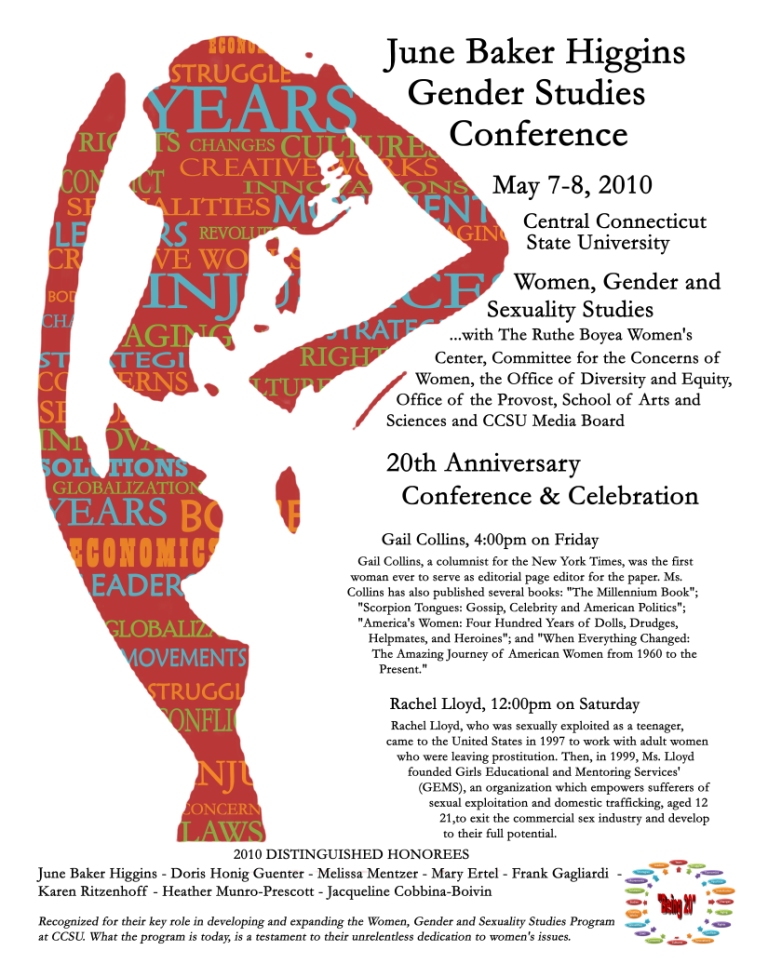
Last week, our Women, Gender, and Sexuality Studies Program celebrated its 20th anniversary with a fabulous research conference (see poster at left).  One of the highlights was a screening of the film “Very Young Girls” and a keynote address by Rachel Lloyd, founder and Executive Director of GEMS, an organization in New York to serve girls and young women who have experienced commercial sexual exploitation and domestic trafficking. Ms. Magazine selected Lloyd as one of “50 women who change the world.”

So, I was rather disappointed when I saw this article on sex-trafficking, “Babes in Scandal Land,” on the Ms. Magazine blog. The article discusses a “sexual double standard” in “reports that a rabidly anti-gay, self-righteous Christian crusader spent a 10-day European vacation with a paid companion he found on rentboy.com.” She compares the relatively mild accounts, compared with the “tsunami” of outrage in cases of female sex workers such as Ashley Alexandra Dupre, “the woman Eliot Spitzer retained from a high-class escort service for sexual trysts in a Washington hotel room.” She asks where is the moral outrage “following revelations that anti-gay leader George Rekers’ consort was not one of “those innumerable girls,” but rather, a rented boy? It’s not that I think the boy in question, Jo-Vanni Roman, a.k.a. Lucien/Geo, needs Kristof—or anyone else—to save him. . .What I am concerned about is a sexist double standard which regards female sex workers by definition as vulnerable victims in need of rescue, while male sex workers are simply guys who have sex for money.”

Although I agree with the suggestion “to stop assuming that men are always sexual agents and women are always sexual victims,” the author fails to make a distinction between adult behavior (the “boy” in question) and the sexual exploitation of girls under the age of consent.  Furthermore, notions that underage girls are sexual “agents” have been used to trivialize cases of human trafficking involving girls and young women.  For example,  this  article on sex trafficking and the Lawrence Taylor case observes that

“responses to one Internet report showed 3,000 views and 2,000 comments.  An oft-repeated question asked, “Was he supposed to ask for the birth certificate of a prostitute?” Another recommended, “Write him a ticket and let him go.”  Only a few observers engaged with the issue of human trafficking.  There were numerous calls to legalize prostitution, but few reflections on where the culpability of customers and traffickers fits into the equation.

This is a conversation that goes far deeper than Lawrence Taylor’s personal actions.  It’s time for the media to take responsibility for how the language used in telling such a narrative, adds to the lack of awareness about the ramifications of human trafficking. In the struggle to eradicate the exploitation of girls and women, this would be an excellent first step.”

Ms. Magazine, are you listening?

Blogging against Disabilism Part II

via Ms Magazine Blog.  In an article called “Kervorkian and the Right to Choose,”  reproductive rights activist Carol King (not the singer) reviews the new HBO film “You Don’t Know Jack.”  She claims:

“The opposition to assisted suicide in Michigan was led by the same people (Right to Life of Michigan) who oppose abortion. . . The “right-to-lifers” enlisted the disabled in their cause when they cautioned that allowing people to choose to die would soon become their “duty to die.”

First off, it’s not appropriate to use a term like “the disabled” — it objectifies persons with disabilities. Also, the position of disability rights activists on the “right to die” movement is far more complex than King presents.  The group Not Dead Yet provides a solid argument against the devaluation of persons with disabilities implicit in Kervorkian’s work, while also critiquing the anti-abortion movement for co-opting the rhetoric of the disability rights movement.  For more on how to be a feminist AND an advocate for disability rights, see the FWD blog.