Sloppy Medical History Reporting at NPR

This is in reply to the story “Accidents of History Created U.S. Health System” on yesterday’s All Things Considered:

I’m a medical historian and find several historical inaccuracies in this report. The first and most egregious is the claim that early twentieth century medicine was “medieval.” This was hardly the case — by this point there were vaccines and treatments for a number of major contagious diseases, including diptheria, syphillis and typhoid fever. Surgery had also made great advances with the advent of sterile surgical procedures.
Yes, “quack” medicines still continued but the FDA (created in 1906) helped to quell some of the most outrageous medical claims.

The report also ignores other major developments in providing affordable medical care, such as the growth of managed care plans. Among the first was Kaiser-Permanente, developed during the Second World War.

To answer other commentors’ questions about why the U.S. doesn’t have a single-payer universal health plan — this is because every attempt to develop one (starting with initiatives during the New Deal era) was fiercely opposed by the American Medical Association and other powerful lobbying groups who called any government intrusion into health care “socialized medicine.” The same argument was made against Medicare and Medicaid in the 1960s.

——-

I ran out of space in the comments section.  The authors of this report are clearly lazy and/or misinformed.  I also hated the smart-assed way in which they commented on early twentieth century medical care.

New Feminist Disability Blog Launched

via Our Bodies Our Blog.  According to their About section:

“FWD/Forward is a group blog written by feminists with disabilities. It is a place to discuss disability issues and the intersection between feminism and disability rights activism. The content here ranges from basic information which is designed to introduce people who are new to disability issues or feminism to some core concepts, to more advanced topics, with the goal of promoting discussion, conversation, fellowship, and education.”

In short, disability is a feminist issue.  Right on!

CFP: Berkshire Conference

berksbanner-1024x313
The Berkshire Conference of Women Historians has just posted its call for papers for the 15th Berkshire Conference on the History of Women, which will be held at the University of Massachusetts-Amherst, June 9-12, 2011. The theme is “Generations,” and the link to the call will remain in the sidebar at left until March 1 2010, the closing date for proposals.

I’ve been attending this conference for almost twenty years — the first one I attended was at Douglas College, Rutgers University, in 1990.  I’ve gone to every one since then.  I even attended the Little Berks for the first time last Fall.  It’s a great place to meet others working in the field of women’s history — like summer camp for academics.  Oh yes, and there’s a dance!

Book Club: A Short History of Women

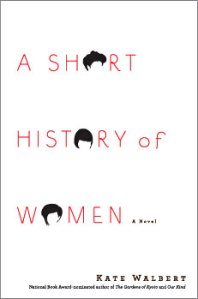
shorthistorywomenThe book club selection for September was the National Book Award finalist,  A Short History of Women by Kate Walbert. The book centers around the descendants of a British suffragette, Dorothy Trevor Townsend, who starved herself to death for the cause because there was nothing else she could do – a perfect example of what Joan Jacobs Brumberg calls “the appetite as voice.”

The choices made by her descendants also demonstrate the constraints placed on women throughout the twentieth century.  The suffragette’s daughter, Evelyn, moves to America to attend Barnard College, eventually becoming a respected professor of chemistry.  Like other women scientists (or other academics) of her generation, she must give up family and children for her career.  The suffragette’s grand niece, also named Dorothy, goes in the opposite direction, choosing the standard female script of marriage and motherhood, only to find herself at a consciousness raising group in the early 1970s among other women suffering from the feminine mystique. Dorothy’s daughter, on the other hand, is part of the “opt out” generation, confronting boredom and isolation broken only by the occasional carefully orchestrated playdate.

In my opinion, this book fully deserves all the positive press it’s received.  As with her earlier books, Walbert’s writing is beautiful and compelling. Yes, the book’s structure is difficult to follow at times, but for me that contributed to its charm.  If you don’t like nonlinear narratives, then it’s best to avoid this book, or at least be very patient.  If you love Virginia Woolf or similar authors, then this book is for you.

Roman Polanski and The History of “Rape-Rape” in America

Now that I’ve cooled down a bit about Whoopi Goldberg’s clueless remarks regarding the arrest of Roman Polanski, I think I’ll write a little historical primer for all those out there who are wondering, WTF?

The core of Goldberg’s argument, as I see it, is that Polanski accepted a plea bargain to the charge of “having sex with a minor” aka statutory rape.  So, according to Goldberg, this isn’t “rape rape” — i.e. a sexual assault on an adult woman.  If the 13-year old had been over the age of consent (16), Goldberg seems to suggest, then it wouldn’t “really” be rape.

In order to explain why this line of argument is a crock of shit extremely faulty, here’s a brief history of rape law in the twentieth century (which I’m still working through so be patient folks):

The Women and Social Movements in the United States database has an excellent document project on the age of consent campaign at the turn of the twentieth century.  Since this database is subscription only (although you can access their blog for free), I’ll summarize.  Then as now, the “age of consent” referred to the age at which a girl could consent to sexual relations. A man who had sex with a girl below that age could be tried for statutory rape.  In the late nineteenth century the age of consent in many states was as low as ten or twelve, and in Delaware the age was seven (eww!).   Hoping to protect young girls from sexual predators, reformers started a campaign to raise the age of consent to at least sixteen, and preferably eighteen.  They based their work on that middle- and upper-class men were seducing and impregnating young, white, single girls who were flocking to the cities to find work.  Some of these girls were also victims of “white slavery” (aka sex trafficking) and were lured to the city by the promise of employment, only to find that the job was prostitution.  By 1920, most states had passed laws establishing sixteen or eighteen as the age of consent.

Now, as with other Progressive-era reforms, there were shortcoming to this reform campaign.  Most reformers were white, and overlooked the plight of African-American girls and women entirely (in fact, the reasoning was that by nature, all African-American women were hypersexual, hence it was impossible to rape a black girl or woman because men could not resist these “temptresses.  Ida B. Wells unsuccessfully tried to dispell this myth). The age of consent campaign also was based on compulsory sexual purity for girls and women outside of marriage. In fact, it was at this time that the notion of “sexual delinquency” was conceived.  Moral reformers created homes for “delinquent” and “wayward” girls — ostensibly to “protect” these girls from sexual predators, but also to “reform” their behavior — i.e. make them into virtuous, pure, respectable women.  This resulted in a major asymetry in punishment: men convincted of statutory rape typically served 2-3 years in prison.  A young girl sentenced to a reformatory for sexual delinquency (which included assault by an adult male), was incarcerated until she reached the age of majority (usually 21).  So, a fourteen year-old would serve seven years in a reformatory.

Now, what about “rape rape” — i.e. sexual assault of women over the age of consent?  Well, it depends.  If a white woman charged a black man with rape, then the myth of black male hypersexuality and the culture of white male chivalry ensured that the man would be found guilty (or more likely, lynched before he even came to trial).  Even young boys  (see the Scotsboro boys and Emmett Till). For white men, it was much easier to get away with the crime of rape, since a woman’s previous sexual experience could be admitted as evidence.  So, if a woman was a “slut” — i.e. had intercourse outside of marriage — then it was obviously her fault she got raped because she was “asking for it.” The so-called sexual revolution of the 1960s and early 1970s in some ways actually made this situation worse for awhile: teenage and young adult women reclaimed their sexual agency yet the criminal justice system still assumed that girls who “slept around” deserved to get raped, or rather, that it wasn’t “really” rape because the girl led the guy on.

By the 1970s, this assumption was becoming increasingly untenable.  As I’m finding in my work on the history of emergency contraception, health care workers  along with feminist  activists, fought for more humane treatment of rape victims by police officers, emergency room personnel, and the criminal justice system. As Estelle Freedman’s recent review of the feminist classic, Against Our Will, by Susan Brownmiller, “our view of rape has transformed since the 1970s, from an unavoidable and unmentionable price of being female to an unacceptable crime against the human rights of women.”  During the 1970s and 1980s, feminist groups created rape crisis centers, and courts declared that a woman’s sexual history was irrelevant in a rape trial.  In the 1990s, there was increasing awareness of the problem of date rape, and marital rape became a crime in all 50 states.

The Polanski case occurred when definitions of rape were still evolving.  So, if the victim had been an adult, her sexual history probably would have been used as a way to weaken or dismiss the case against Polanski.

However, by today’s standards, what Polanski did was not just statutory rape, but actual, full-on, rape.  If Samantha Geimer had been over the age of consent,   Polanski would still be charged with “rape-rape” because she said no, multiple times, and was under the influence of drugs and alcohol.  [again, see her testimony before the grand jury].

Added later: see the Rape is Rape website for more information on how you can take action on this issue.

Roman Polanski’s arrest not outrageous but long overdue

roman-polanski-1977--121636799050739400via Edge of the American West.  I agree — Anne Applebaum’s defense of Polanski because he’s old and has had rough life are nearly as creepy as the original crime itself. Historiann has an exceptional commentary on this story as well.

For more ickiness, see the recent documentary about the case, and the victim’s testimony here.

Where was this outpouring of sympathy for Mary Kay Latourneau? Oh yeah, she’s not a French cultural treasure.

Added later:  got in an argument with my sister who thinks that California is wasting too much money going after Polanski.   Needless to say I don’t agree, but then again, I live in the Nutmeg state.

Dirty Dancing Moves to Feminist Beat

dancing460via RHRealityCheck.org.  I had no idea that this film is “near and dear” to some feminists.  Certainly I was aware that this is a quintessential “chick flick,” but feminist too?  When I saw it over twenty years ago I thought it was just a sappy melodrama (sorry DD lovers).  Now I’m going to give it a second chance and see whether this really does have a feminist message.

Movie review: Julie and Julia

julie_and_julia_ver2_xlgSummer is nearly over and I finally got around to taking Tenured Radical’s advice and seeing the her pick for best grown-up summer movie,  Julie and Julia, even though I’m rather meh about Nora Ephron’s work.  Like TR, I found the Julia portions of the film more entertaining and compelling — largely because of my fond memories of watching “The French Chef” on WGBH in the early 1970s.  I enjoyed  Julie’s story too — the depiction of blogging as a form of self-discipline especially intriguing.  In some ways, both characters embark on their endeavors as a means of self-improvement — Julia because she needs “something to do” besides serve as a diplomat’s wife, Julie because she needs an escape from cubicle life (not to mention the stress that must have accompanied dealing with 9/11 claims and complaints).  In the end, both find what they first did for themselves can serve a wider audience.  I thought the two stories complemented each other nicely, but must admit there was more about Julia.  I hope someday someone will make a full-length feature about Child’s extraordinary life.  Meanwhile, I’ll have to make do with My Life in France.

I tagged this entry as women’s history because Julia Child’s place in twentieth-century women’s history is significant.  Heck, the Schlesinger Library, which specializes in history of women in the United States, has Child’s papers (along with those of her collaboration Simone Beck) as part of their reknowned  culinary history collection.