History Matters: Final Installment

The final installment of the discussion of History Matters featuring a reply by author Judith Bennett.  Now that I’ve (finally) finished the book I’ll admit I was a bit hasty in making my “golden age” comment.  Still, my overall reaction to the book was rather “meh.”  I learned a lot about medieval women’s history, but I think Bennett operates from a hegemonic view of feminism.  I also think she could more thoroughly consider how women of color have problematized the term “feminism.”

Overall this was a great way of engaging a group of women’s historians across various blogs.  I hope this will happen again next year.

Back Up Your Birth Control Blogging, One Day Late

back_up_birth_controlAs usual, I’m a day late in blogging, but I’ll just blame it on the fact that I was exhausted from my trip to Bethesda for my talk at the NLM!

So, better late than never — yesterday was the Back Up Your Birth Control Day of Action sponsored by the National Institute for Reproductive Health.  Since this is the subject of my current research project, I’m blogging about it.  Please take action and respond to my Emergency Contraception survey — the link is at the end of my blog.

Encouraging news — a federal judge instructed the FDA to make Plan B available to 17-year olds without prescription.  This is a start anyway.

Good News, Bad news, and a shameless plug

Recent issues of the Chronicle of Higher Education have reported good news and bad news in college health.  The good news:  it looks like the new spending bill will lower the cost of contraceptives at campus health centers.  The bad news is that while demand for mental health services has increased, college counseling centers remainded understaffed.

And now for the shameless plug:  I will be talking about my recent book, Student Bodies, at the National Library of Medicine next Tuesday, March 24th.  Go here for more information.

Knitting Clio=Gloria Steinem

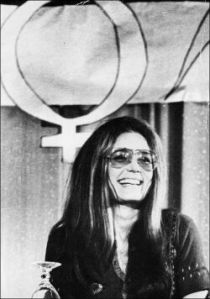
1063932546_ia_steinem Kittywampus posted a poll, Which Western feminist icon are you? [Kitty is Angela Davis — interesting result for a white woman from North Dakota]

I’m a sucker for these, so I took it, and my result — Gloria Steinem:

“You are the McDonalds(tm) of liberal feminism, though you used to expouse some pretty radical ideas, you ended up working the system. Because it’s easier? Maybe. But thanks for the only mainstream feminist magazine and for heading one of the most significant feminist lobbys in the history of the US. We wouldn’t be where we are without NOW and Ms., as much as some of us are loathe to admit it.”

Yup, that pretty much is right on target.  I have to say I’m a big fan of many of her essays, especially the wicked satire, “If Men Could Menstruate.”

I’ll tell Ms. Steinem how much we have in common when she comes to give a lecture at CCSU on March 19th, 2pm, Torp Theatre.

Women’s History Book Club: History Matters Part II

bennetthistorymatters1-192x300 Part II of the discussion of Judith Bennett’s History Matters is now up at Historiann.  I’ve only read the first few chapters of the book, so don’t feel like I can comment on the work as a whole.  What I will say is that Bennett, while criticizing historians who presume a premodern “golden age” for women, seems to have constructed a “golden age” model of the development of women’s history as a discipline — i.e. she and her generation were more “authentic” and genuinely feminist than us youngins’.  My professors in graduate school (Cornell, late 1980s/early 1990s) came of age around the same time, but also pointed out the methodological flaws and lack of rigor in some of the earliest works in women’s history.

Look for next week’s installment at Tenured Radical, and the March 23 edition by Another Damned Medievalist at Blogenspiel!

Celebrate International Women’s Day

womentalking

Today is International Women’s Day.  Here is the official website.  For more on the origins of IWD and National Women’s History Month, go to the National Women’s History Project.  They also have sent out the following proclamation from President Obama:

Presidential Proclamation on Women’s History Month
Obama pays tribute to women who helped preserve, protect the environment
THE WHITE HOUSE
Office of the Press Secretary
March 3, 2009

WOMEN’S HISTORY MONTH, 2009
BY THE PRESIDENT OF THE UNITED STATES OF AMERICA

A PROCLAMATION
With passion and courage, women have taught us that when we band together to advocate for our highest ideals, we can advance our common well-being and strengthen the fabric of our Nation. Each year during Women’s History Month, we remember and celebrate women from all walks of life who have shaped this great Nation. This year, in accordance with the theme, “Women Taking the Lead to Save our Planet,” we pay particular tribute to the efforts of women in preserving and protecting the environment for present and future generations.


Ellen Swallow Richards is known to have been the first woman in the United States to be accepted at a scientific school. She graduated from the Massachusetts Institute of Technology in 1873 and went on to become a prominent chemist. In 1887, she conducted a survey of water quality in Massachusetts. This study, the first of its kind in America, led to the Nation’s first state water-quality standards.


Women have also taken the lead throughout our history in preserving our natural environment. In 1900,
Maria Sanford led the Minnesota Federation of Women’s Groups in their efforts to protect forestland near the Mississippi River, which eventually became the Chippewa National Forest, the first Congressionally mandated national forest.

Marjory Stoneman Douglas dedicated her life to protecting and restoring the Florida Everglades. Her book, The Everglades: Rivers of Grass, published in 1947, led to the preservation of the Everglades as a National Park. She was awarded the Presidential Medal of Freedom in 1993.


Rachel Carson brought even greater attention to the environment by exposing the dangers of certain pesticides to the environment and to human health. Her landmark 1962 book, Silent Spring, was fiercely criticized for its unconventional perspective. As early as 1963, however, President Kennedy acknowledged its importance and appointed a panel to investigate the book’s findings. Silent Spring has emerged as a seminal work in environmental studies. Carson was awarded the Presidential Medal of Freedom posthumously in 1980.


Grace Thorpe, another leading environmental advocate, also connected environmental protection with human well-being by emphasizing the vulnerability of certain populations to environmental hazards. In 1992, she launched a successful campaign to organize Native Americans t o oppose the storage of nuclear waste on their reservations, which she said contradicted Native American principles of stewardship of the earth. She also proposed that America invest in alternative energy sources such as hydroelectricity, solar power, and wind power.


These women helped protect our environment and our people while challenging the status quo and breaking social barriers. Their achievements inspired generations of American women and men not only to save our planet, but also to overcome obstacles and pursue their interests and talents. They join a long and proud history of American women leaders, and this month we honor the contributions of all women to our Nation.
NOW, THEREFORE, I, BARACK OBAMA, President of the United States of America, by virtue of the authority vested in me by the Constitution and the laws of the United States, do hereby proclaim March 2009 as Women’s History Month. I call upon all our citizens to observe this month with appropriate programs, ceremonies, and activities that honor the history, accomplishments, and contributions of American women.
IN WITNESS WHEREOF, I have hereunto set my hand this third day of March, in the year of our Lord two thousand nine, and of the Independence of the United States of America the two hundred and thirty-third.

BARACK OBAMA
Book Club double shot: Netherland and The Women

Regular readers of this blog probably noticed that there have been no book club entries for quite some time (the last one was back in December).  That’s because this week was the first time we’ve been able to meet.  The January meeting got postponed so that folks could watch the Inauguration festitivites, and February got cancelled because of snow.  So, we decided to discuss two books — bad idea as it turns out because only a few of us (including me) were able to finish the second one.

First up was Joseph O’Neill’s outstanding novel Netherland, which just received the Pen/Faulkner award (nah, nah to the 14 publishers who foolishly turned O’Neill’s manuscript down before Random House picked it up).  My first reaction when we selected this one was, “not another novel about 9/11.”  Well, this is one of the best — it perfectly captures the sense of alienation and moorlessness that this event created in many New Yorkers.  Of course, it’s also about a lot more than the terrorist attacks — the central character, Hans, is a Dutch financial analyst who came to New York for a plush job and found his life turned upside down by the attacks. His English wife leaves him, taking along their young son.   This catapults Hans out of what appears to have been a pretty complacent life.  He finds some sense of community among his oddball neighbors in the Chelsea Hotel, as well as a multicultural community of fellow cricket enthusiasts. The one who most shakes up Hans’ life is the Trinidadian Chuck Ramkissoon, who introduces him to the weird side of New York immigrant life that wealthy residents (and tourists) seldom encounter.  Critics have called Ramkissoon “Gatsby-esque” — since my memories of that novel come mainly from the movie with Robert Redford and Mia Farrow, I really don’t see the connection.  Like Gatsby, Ramkissoon meets an untimely end (we know this from the beginning of the novel so this is no spoiler), and he’s basically a fraud and an operator, but otherwise there is little resemblance to Fitzgerald’s character.  I enjoyed this book tremendously and may even re-read it so I can savor it all the more.

The other selection was The Women by T.C. Boyle.  This book has received a lot of positive buzz, and frankly, I don’t understand all the fuss.  Maybe I was spoiled by reading Loving Frank before this one, but honestly this is not Boyle’s best work. He uses the awkward device of having the story of Frank Lloyd Wright’s various wives and mistresses told through the point of view of Tadashi Sato, a composite character who works as an apprentice under Wright at his famed compound Taliesin.  Boyle does a good job of capturing Wright’s arrogance and cluelessness to the feelings of others around him, but his treatment of the women is rather shallow.  I think the novel would have been much better had he focused on developing his treatment of the eccentric community at Taliesin — i.e. did a midwestern version of Drop City — or had Sato play a role similar to that of Charles Ossining in The Road to Wellville, i.e. a naive young fellow who watches chaos erupt around him.  As always the writing is fabulous, but the structure of the book just did not work for me.

Lizzie Simon at CCSU: Stigma Busting Par Excellence

detour Wednesday night I had the pleasure of attending a talk by  Lizzie Simon

author of Detour: My Bipolar Road Trip in 4D.  The talk was organized by the Central Access and Student Development office at CCSU, NAMI On Campus, and the Farmington Valley Chapter of NAMI-CT.   She started with describing how she explained mental illness to a hockey team — the person with mental illness is like the goalie, but instead of one team charging towards him/her, there are three: the disease itself, the mental health system, and stigma.  So, the goalie needs support from the rest of his/her team.  Great analogy!

I wish some of my students from my disability history class had been able to attend.  I think it would be helpful for them to see a young person  who is more typical of the majority of students with mental illness — i.e. neither violent nor weird.  Maybe her book will be as useful as Clifford Beers’ memoir from the early twentieth century.

Respecting Choice

Since my work is on contraception, not assisted reproductive technologies (ART), I’ve been hesitant to weigh in on the controversy surrounding Nadya Suleman.  Since this has come up in my course on disability history — in the context of eugenics (especially sterilization of women deemed “feeble-minded”) and “freak shows” (step right up and see “Octuplet Mom” folks), I thought I would just make some comments.   Two recent posts at GlobalComment and Reproductive Health Reality Check express most of my thoughts on the issue e.g. it revives the “welfare Mom” stereotype, and echoes historical discussions about who is fit to reproduce.

To these I would add the various strains of disability prejudice — e.g. that Suleman has “cheating” on her disability claims, that if she is disabled, why is she reproducing, she must be “crazy” to have so many children,  and so forth.    It seems that little has changed when it comes to the sexuality of women with disabilities.