I’m speechless, except to say I’m glad everyone at Wesleyan is okay. Tenured Radical, aka Claire Potter in the History Department at Wesleyan, has very insightful commentary here.
Wesleyan Murder and Violence Against Women
Reply
I’m speechless, except to say I’m glad everyone at Wesleyan is okay. Tenured Radical, aka Claire Potter in the History Department at Wesleyan, has very insightful commentary here.
 I’m back from the AAHM meeting in Cleveland, so am too lazy busy to write a full post (but I will try to give some highlights of the meeting later this week. Briefly, swine flu was a major topic of conversation). Meanwhile, enjoy this guest post on Wollstonecraft at Historiann.
Since I’m too lazy busy to come up with a blog post of my own right now, I’ll refer KC readers to a fascinating discussion over at Historiann. I commented on the issue of anti-Catholicism in the academy. Having spent most of my life in New England, and my entire career teaching at a state university that is closed on Good Friday, if there is anti-Catholic prejudice I haven’t seen it (then again, I’m not Catholic). Jewish colleagues, though, do feel that our university privileges christianity — I would have to agree. Again, why does a state university close on a christian holiday but none of the Jewish or Muslim holidays?
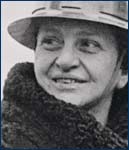 Today at Trinity Collinsville we had a guest sermon by our bishop suffragan, the Rt. Rev. Laura Ahrens [the audio file of the sermon should be up in a few days). She started the sermon by talking about the tragic Triangle Shirtwaist Factory Fire in 1911, the worst industrial disaster in U.S. history up that that point. Being a smarty-pants women’s historian I thought, okay where is she going with this? Well, Prof. Smarty Pants didn’t know that Frances Perkins (pictured at left), witnessed the fire and as a good Episcopilian, was called to find a way to prevent this from happening again. So, Perkins became active in the U.S. labor movement, fighting for the rights of workers in New York State, and later as Secretary of Labor under Presidents Roosevelt and Truman.
Since today is Palm Sunday, the bishop made a link between the horrors witnessed by Perkins, and the horrors of the Passion, asking us what we will do to prevent things like this from happening again. Good question — I guess this is what this week is for, to mediate on such things.
The final installment of the discussion of History Matters featuring a reply by author Judith Bennett. Now that I’ve (finally) finished the book I’ll admit I was a bit hasty in making my “golden age” comment. Still, my overall reaction to the book was rather “meh.” I learned a lot about medieval women’s history, but I think Bennett operates from a hegemonic view of feminism. I also think she could more thoroughly consider how women of color have problematized the term “feminism.”
Overall this was a great way of engaging a group of women’s historians across various blogs. I hope this will happen again next year.
This was recorded at last year’s June Baker Higgins Gender Studies Conference, but it’s taken this long to get it edited and posted. I’m the one on the guitar. The good singer is Beth Lorenzo from the Music Department here at CCSU.
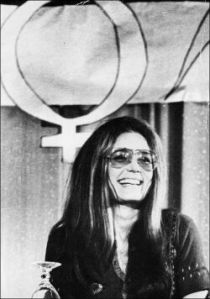 Kittywampus posted a poll, Which Western feminist icon are you? [Kitty is Angela Davis — interesting result for a white woman from North Dakota]
I’m a sucker for these, so I took it, and my result — Gloria Steinem:
“You are the McDonalds(tm) of liberal feminism, though you used to expouse some pretty radical ideas, you ended up working the system. Because it’s easier? Maybe. But thanks for the only mainstream feminist magazine and for heading one of the most significant feminist lobbys in the history of the US. We wouldn’t be where we are without NOW and Ms., as much as some of us are loathe to admit it.”
Yup, that pretty much is right on target. I have to say I’m a big fan of many of her essays, especially the wicked satire, “If Men Could Menstruate.”
I’ll tell Ms. Steinem how much we have in common when she comes to give a lecture at CCSU on March 19th, 2pm, Torp Theatre.
 Part II of the discussion of Judith Bennett’s History Matters is now up at Historiann. I’ve only read the first few chapters of the book, so don’t feel like I can comment on the work as a whole. What I will say is that Bennett, while criticizing historians who presume a premodern “golden age” for women, seems to have constructed a “golden age” model of the development of women’s history as a discipline — i.e. she and her generation were more “authentic” and genuinely feminist than us youngins’. My professors in graduate school (Cornell, late 1980s/early 1990s) came of age around the same time, but also pointed out the methodological flaws and lack of rigor in some of the earliest works in women’s history.
Look for next week’s installment at Tenured Radical, and the March 23 edition by Another Damned Medievalist at Blogenspiel!

Today is International Women’s Day. Here is the official website. For more on the origins of IWD and National Women’s History Month, go to the National Women’s History Project. They also have sent out the following proclamation from President Obama:
Presidential Proclamation on Women’s History Month
Obama pays tribute to women who helped preserve, protect the environment
THE WHITE HOUSE
Office of the Press Secretary
March 3, 2009
Ellen Swallow Richards is known to have been the first woman in the United States to be accepted at a scientific school. She graduated from the Massachusetts Institute of Technology in 1873 and went on to become a prominent chemist. In 1887, she conducted a survey of water quality in Massachusetts. This study, the first of its kind in America, led to the Nation’s first state water-quality standards.
Women have also taken the lead throughout our history in preserving our natural environment. In 1900, Maria Sanford led the Minnesota Federation of Women’s Groups in their efforts to protect forestland near the Mississippi River, which eventually became the Chippewa National Forest, the first Congressionally mandated national forest.
Marjory Stoneman Douglas dedicated her life to protecting and restoring the Florida Everglades. Her book, The Everglades: Rivers of Grass, published in 1947, led to the preservation of the Everglades as a National Park. She was awarded the Presidential Medal of Freedom in 1993.
Rachel Carson brought even greater attention to the environment by exposing the dangers of certain pesticides to the environment and to human health. Her landmark 1962 book, Silent Spring, was fiercely criticized for its unconventional perspective. As early as 1963, however, President Kennedy acknowledged its importance and appointed a panel to investigate the book’s findings. Silent Spring has emerged as a seminal work in environmental studies. Carson was awarded the Presidential Medal of Freedom posthumously in 1980.
Grace Thorpe, another leading environmental advocate, also connected environmental protection with human well-being by emphasizing the vulnerability of certain populations to environmental hazards. In 1992, she launched a successful campaign to organize Native Americans t o oppose the storage of nuclear waste on their reservations, which she said contradicted Native American principles of stewardship of the earth. She also proposed that America invest in alternative energy sources such as hydroelectricity, solar power, and wind power.
These women helped protect our environment and our people while challenging the status quo and breaking social barriers. Their achievements inspired generations of American women and men not only to save our planet, but also to overcome obstacles and pursue their interests and talents. They join a long and proud history of American women leaders, and this month we honor the contributions of all women to our Nation.
NOW, THEREFORE, I, BARACK OBAMA, President of the United States of America, by virtue of the authority vested in me by the Constitution and the laws of the United States, do hereby proclaim March 2009 as Women’s History Month. I call upon all our citizens to observe this month with appropriate programs, ceremonies, and activities that honor the history, accomplishments, and contributions of American women.
IN WITNESS WHEREOF, I have hereunto set my hand this third day of March, in the year of our Lord two thousand nine, and of the Independence of the United States of America the two hundred and thirty-third.
Since my work is on contraception, not assisted reproductive technologies (ART), I’ve been hesitant to weigh in on the controversy surrounding Nadya Suleman. Since this has come up in my course on disability history — in the context of eugenics (especially sterilization of women deemed “feeble-minded”) and “freak shows” (step right up and see “Octuplet Mom” folks), I thought I would just make some comments. Two recent posts at GlobalComment and Reproductive Health Reality Check express most of my thoughts on the issue e.g. it revives the “welfare Mom” stereotype, and echoes historical discussions about who is fit to reproduce.
To these I would add the various strains of disability prejudice — e.g. that Suleman has “cheating” on her disability claims, that if she is disabled, why is she reproducing, she must be “crazy” to have so many children, and so forth. It seems that little has changed when it comes to the sexuality of women with disabilities.
It is a truth universally acknowledged that a single woman must be in want of a drink
Orientalism and Yoga in the 21st Century
is a Vice Provost, Dean, and Professor at Northeastern University
History for the Future
By Norse code
Follow me on twitter: @jmedwards29
Why Do You Write Like You're Running Out Of Time?
A site to think about my academic work the same way I do everything: by overthinking it.
Blog for History 511: Digital History
History in the Digital Age
History Happens
A Group Blog on Early American History
A journal of New England cultural, literary, political, and social history
The latest news on WordPress.com and the WordPress community.
 Knitting Clio