Improvising a Conference Program

This past Friday was our annual June Baker Higgins Gender Studies Conference (see the program here.) Our keynote speaker cancelled due to a family emergency, so this forced me to improvise, literally, by putting together a lunchtime show of suffrage songs from the early twentieth century, with my colleague Beth Lorenzo from the Music Department singing lead and me on guitar and backup vocals. We performed “Uncle Sam’s Wedding,” set to “Yankee Doodle” and “Keep Woman in her Sphere” set to “Auld Lang Syne.” We even asked folks to sing along. This was my first time performing in front of an audience since I took up guitar again a few years ago and I must say it went a lot better than I expected. A friend recorded us on her digital camera so we should be on Youtube shortly!

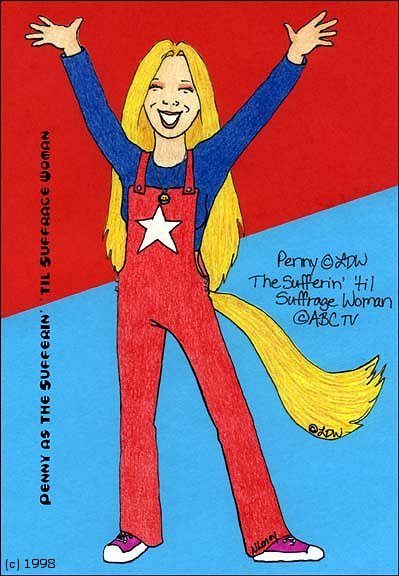
I concluded the show by playing a Youtube video of a live performance the song “Suffering for Suffrage” from the Schoolhouse Rock cartoon of the same name.

The illustration above is one of the characters from the Schoolhouse Rock cartoon. Now, I was a big fan of Schoolhouse Rock, especially “Conjunction Junction,” but I don’t remember seeing this one. Maybe it wasn’t as widely circulated because it was, egads, “feminist”?

On Bullshitters

One of my male friends in the Philosophy department sent me the following in reply to the latest exchange with the resident troll.

This comes from a stand-alone essay by Harry Frankfurt, “On Bullshit” (Princeton: 2005), which a friend recently lent. It further addresses how B. should be described.

46 It does seem that bullshitting involves a kind of bluff. It is closer to bluffing, surely, than to telling a lie.

48 The bullshitter is faking things. But this does not mean that he necessarily gets them wrong.

51 This involves not merely producing one instance of bullshit; it involves a program of producing bullshit to whatever extent the circumstances require.

52 He is prepared, so far as required, to fake the context as well.

53 This is less a matter of craft than of art. Hence the familiar notion of the “bullshit artist.”

54 Both he and the liar represent themselves falsely as endeavoring to communicate the truth.

55 The fact about himself that the bullshitter hides…is that…the motive guiding and controlling it [his speech] is unconcerned with how the things about which he speaks truly are.

56 He does not care whether the things he says describe reality correctly. He just picks them out, or makes them up, to suit his purpose.

60 Through excessive indulgence…a person’s normal habit of attending to the ways things are may become attenuated or lost.

Frankfurt goes on to hypothesize three sources of contemporary bullshitting. The closest to a troll’s desire for recognition is a bullshitter’s denying we can have reliable access to objective reality:

65 a retreat from the discipline required by dedication to the ideal of correctness to a quite different sort of discipline, which is imposed by pursuit of an alternative ideal of sincerity. Rather than seeking primarily to arrive at accurate representations of a common world, the individual turns toward trying to provide honest representations of himself.


Given B’s many self-contradictions on the listserv, surely he’s not attempting sincerity. Just a troll. . . Who’ll, hopefully and presumably, be put in a rightful place after the U adopts a new method of community-postings. As will be the Middle Eastern-looking abductor.

more of the same

Howdy partners,

Here’s the latest from our cyberbully, ellipses indicate deletion of specific names:

It is certainly true that genetics has a role in how we look, and certainly has an effect on the pigment of our skin. That is science. However, when we generalize beyond a particular individual to describe characteristics that could be applicable to all in a certain class, then we can run into the difficulties of ethical stereotyping and misperceptions, which led Senator McCain to recently say in public that Iran is training Al Quida terrorists, which must be surprising to the Iranians who Shiite Persians as opposed to Al Quida, most of whom are Sunni Arabs. What, exactly is a Middle-East appearance or accent? We have such people on our faculty, and if there is a common denominator in either category, it escapes me. And yet some of the comments that have been posted seem downright silly to me. No one discounts the seriousness of the crime, not the state of mind of the victim. But S., T., L, and I are trying to show people how easy it is to confuse facts with inferences and to assign putative or circumstantial blame to “the other.” Years ago there was a single male in my department who, at the time. was single as I was. He was interested in American History, as I am, so I invited him to my apartment where I cooked a meal for us. afterwards I asked if he would like to go to a place with live music and see if we could meet some women and go dancing. He politely declined, said he was working on an article and wanted to do some more writing before retiring. About a dozen years later a friend of mine from graduate school took me out for lunch at a convention and told me that my colleague was gay, and that is why he declined to go out dancing with me. I learned an important lesson then. You seldom can see gay people, and most of the ethnic, racial, and geographical generalizations are myths. Not all Swedish women are blond, not all Italians drink wine (I know my step-=mother doesn’t drink anything alcoholic). The description that M.  put on our list said that the perp was a “MIDDLE EASTERN MALE WITH BUSHY EYEBROWS. It did not say that the victim thought that he might have been. No, it states, as a fact, that he IS Middle Eastern, has bushy eyebrows and is six feet tall. How many of you will wager with me that all three descriptors are correct. That the perp is Middle-Eastern, has bushy eyebrows, and is six-feet tall? Furthermore, should we now be afraid of G? Now the woman was under stress. But let us assume that the Police and M. are not equally stressed.

. . . stereotypes are dangerous. The people who live in and come from the Middle East probably have enough stress in their lives without imputing criminality or terrorism to them. Perhaps it will turn out that the perp was all three: Middle-Eastern with bushy eyebrows and six-feet tall. And I reject the argument that female victims of crime deserve special consideration or pathos. I have always contended that Central would benefit from a Committee on the Concerns of Men. I had to wait many years before I arranged a program on Prostate Cancer. I once listened to a student speech about abortion. The speaker sired the child and asked the class, rhetorically, if he had any rights concerning it being aborted. When I read Heather, I sometimes believe that I belong to a disenfranchised gender, at least in the work place. which explains why I protested the Take Your Daughters to work day. Sexist, isn’t it?”

Here’s my reply:

I was inclined to let this go, but since B__ has both questioned my intelligence (by referring to me and others who dare disagree with him as a “dumb-dumb”), called me a redneck, and in his latest message seems to suggest I’m sexist as well, then I’ve decided not to remain “dumb,” i.e mute.

First off, let me agree with L__ — you’re right, we need to pay attention to both the young woman who was attacked and the problem of racial profiling. S__, thanks for explaining your position, I understand your concerns much better now. B__, I find your messages counterproductive in that they replicate prejudice as much as they seek to criticize it. The word “dumb” was once a slur against deaf/mute persons, and is still seen as such by many members of the Deaf community since it links hearing impairment with cognitive disability. Also, the term “redneck” show class prejudice, in that it was coined by southern elites to refer to poor southern whites. There’s also an element of regional snobbery as well.

What concerned me from the start, and what still concerns me, is the underlying assumption that the description is a fabrication (and on that note I regret my use of the word “erroneous.”) We don’t have the first hand account of the young woman. Perhaps she say the attacker’s skin color, heard an accent that sounded like persons from Iraq and other middle-eastern countries she’s seen on T.V., and came up with middle-eastern male. Or maybe that inference was made in the police department. Perhaps I’m misreading all of this, but several of you seem to be suggesting that someone is lying, either the victim, the police, or both. Until we have more information, I don’t think it’s appropriate to question this young woman’s integrity or honesty.

I would add that we have had numerous police reports regarding perpetrators from other racial minorities. Yet, the issue of racial profiling has never come up in that context.

Finally I have an anecdote similar to M.A. — Back in the 1990s, I was pulled out of line, had my luggage examined, was patted down, and questioned at Heathrow on the way back to the U.S. from London. I just thought it was a random search, but it turns out I fit the profile Scotland Yard had for IRA suicide bombers — i.e. young, white female, traveling alone.
Apparently I’m just a dumb redneck gal. . .

Or at least I am according to the resident cyberbully on our faculty listserv. It all started when the campus police issued an alert after one of our female students was abducted from her off-campus apartment and driven around New Britain until the perp crashed the stolen van they were in an made a get away on foot. She described her attacker as middle-eastern, based on the skin color she could see through his mask and his accent. She also said he had prominent eyebrows. Somehow, this led one male faculty member that mentioning the suspects race is anti-Arab prejudice. [funny how he’s never mentioned the problem of racism when the perpetrator has been described as African-American or Hispanic or some other minority]. Now, I realize that racial profiling is a serious problem, but I did bring up the point that when race is a significant detail in describing an alleged assailant, shouldn’t that be part of the police report? I then got responses from men, such as, well criminals come to a college campus because they know there’s women there to attack (in other words, the equivalent of “stuff happens” — shall we lock the ladies up after dark like they used to do in the old days? How about we just keep them out of college altogther). Exchanges continued along these lines, leading to me and others who defended me being called “dumb-dumbs” [let’s mention the disability slur, shall we] and “rednecks.” Aw shucks.

So, readers of this blog, tell me — am I just a dumb redneck gal? There sure is one guy I’d like to make squeal like a pig right now, that’s for sure.

Tribute to Barbara Seaman: Better Late than Never!

It must be spring break, because I have time to write two posts in one day! Seriously spring break is the time when I get caught up on various projects and get editors off my back by turning in work that is weeks late. One of the projects is the paper for the Cancer Vaccines for Girls conference at Rutgers. Given the very contemporary nature of this project, much of my sources are web-based, or at least from electronic library databases. I could even get the full transcript of the Gardasil docket from the FDA website instead of schlepping down to the Dockets Management reading room in Rockville. Plus, my web crawling brought me to this excellent tribute to Barbara Seaman on Our Bodies, Our Blog, which also criticizes the rather catty obituary of Seaman in the New York Times, which trivializes her accomplishments and contributions to women’s health activism. [why are some women so mean to other women? Jealousy? Wanting to be one of the guys? Sure is obnoxious]

I never had the good fortune to meet Barbara in person — she died before I could schedule an interview with her. But, I got a sense of how generous she was with her time when I posted a query on a listserv about how I could get in touch with her, and within twenty-four hours received an enthusiastic message from the lady herself! There followed a fast and furious exchange, most of which I was smart enough to keep. She also sent me free, autographed copies of her various publications. She must have had tremendous energy, even at the end of her life. I can only hope I’m as productive.

Now that I’ve made some headway on my writing, I feel like I can take a few real days off so I won’t be so cranky when I go back to teaching next week.

Book Club: People of the Book

This month’s selection was Geraldine Brook’s latest, People of the Book. Brooks has been a favorite of our group — we’ve read Nine Parts of Desire, Year of Wonders, and of course the Pulitzer Prize winning March. I really enjoyed this selection but missed our gathering because I got the night wrong. Oops!

Brooks is especially gifted at creating compelling characters with rich interior lives. The novel centers on Australian book-conservation expert Hanna Heath. I just loved her intelligence, wit, and independent spirit. Who could have thought that the subject of a book and its history would be so exciting, even sexy?

My field is U.S. women’s history, so my knowledge of early modern and modern European history is a bit rusty (last time I took Western Civ was in 1983). This book certainly forced me to go back and review and/or fill the holes in my memory. I found the historical characters and settings very convincing for the most part. The only one that didn’t really wring true for me was the last one set in fifteenth-century Seville. Like the ending to Year of Wonders, it just didn’t ring true to me. I also thought that the explanation of how this character fit with the illustrations of the Sarajevo Haggadah was really a stretch. Finally, I think the book could have done without the potboiler ending — seemed to me she was trying to duplicate The Da Vinci Code here. Nevertheless, the detective work certainly beats that predictable piece of crap by a million miles. I’d love to see this book made into a film — I could easily imagine Rachel Griffiths as Hanna.

I also really admire her approach to historic preservation. In the voice of Hanna, she writes: “To restore a book to the way it was when it was made is to lack respect for its history. I think you have to accept a book as you receive it from past generations, and to a certain extent damage and wear reflect that history. The way I see it, my job is to make it stable enough to allow safe handling and study, repairing only where absolutely necessary.” Now, I used to serve on the board of the Burlingon, Ct Historical Society — one of the goals of the group is to preserve the Elton-Brown Tavern in the center of town. One member stubbornly insists that the name should be restored to just the Elton Tavern — this seems to me to ignore the history of the town’s inhabitants. Also, the tavern was in private hands for many years, only being bought and restored in the 1970s. I think it would have been really cool to preserve some of that history — I wonder if the kitchen had any of those funky avocado appliances from the 1970s, or orange shag carpeting?!

The book group discussion guide on Brooks’ website asks a question about Hanna’s mother Sarah, a neurosurgeon who left Hanna in the care of nanny’s so she could pursue her career. I’d agree with the guide that gains in women’s rights owe something to gusty women like Sarah, but it’s too bad Brooks felt it necessary to portray her as such a bitch (yes, I know female surgeons of her generation had to be bitches to survive). Also, it seems to me that Sarah’s story is an individual struggle, not one for women as a class, although she does show respect for nurses (unlike some other female surgeons my Mom, a retired OR nurse supervisor, has told me about). My intro to WGSS class just finished reading “Mommy Wars” — I’ll say more about this later, but my main problem with that book is that with the exception of Jane Smiley’s essay, the book portrays each women’s story as an individual balancing act rather than examining the structural problems that place women in this dilemma to begin with.

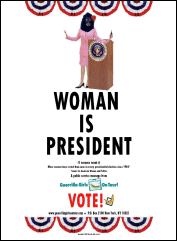
Guerrilla Girls on Tour, Super Tuesday

womanispres.gif

I’m pretty wiped out from the planning and implementation of a visit by Guerrilla Girls on Tour for our annual Women’s History Month celebration (why can’t we spread this out the rest of the year? Oh yeah, those are men’s history months!) It was pretty exciting and energizing all the same. My favorite bit was a bit with Hilary and Obama singing “Anything You Can Do, I Can Do Better” from “Annie Get Your Gun.” [“yes I can” says the Obama character over and over, while Hilary says “I wish I’d thought of that first”] One of my students from the Intro to WGSS class had a part in their closing bit and she did a great job. She brought along her mother and a bunch of her mother’s friends, all women of a certain age who were active in the 1960s and 1970s. One of them said that 2008 is the “year of infinite possibilities” for women because 8 turned on it side is the symbol for infinity. Cool!

The results of the Ohio and Texas primaries are somewhat encouraging, if only to prove that Clinton is not entirely dead in the water. It will certainly be an interesting couple of months.

Cancer Vaccine Conference at Rutgers


Well, my proposal for the conference “Cancer Vaccines for Girls?” at Rutgers University was accepted — now I just need to figure out how to get it done before May 16! 😉

Yesterday’s New York Times had an interesting article on “Vaccinating Boys for Girls Sake.” I liked it because it made fun of the jolly “Gardasil Girls” — who typically are quite a bit older than the target demographic of girls aged 10-12. The article reminds me of a paper on rubella vaccines that Leslie Reagan gave at AAHM couple of years ago — in order to protect pregnant Moms, you have to go after the boys not just the girls. It’s also encouraging to see boys given some responsibility for preventing a disease that affects women! [historically, women have been portrayed as “reservoirs” of STDs — see some of the posters from this online exhibit at National Library of Medicine].

Book Club: Two Lives by Janet Malcolm

Last week, we discussed Janet Malcolm’s book Two Lives, a biography of Gertrude Stein and Alice B. Toklas. As a women’s historian I was looking forward to reading this book even though like most I find Stein’s writing style tedious and dull. However, I was really disappointed as were other members of the book group. Despite reviews that say this book sheds new light on this relationship, there really isn’t anything new or particularly surprising. Stein’s fascism is pretty well known, so the fact that she and Toklas survived WWII because of connections with a wealthy French fascist is not really earth-shattering news. We decided that this book is really more about Malcolm’s position as a biographer, which in many ways resembles the rather arrogant and self-worshiping voice of Stein in The Autobiography of Alice B. Toklas. Malcolm claims she spent extensive time in the Beinecke Library at Yale, but what she gleaned from the Stein collection is pretty trivial and not well documented (i.e. no footnotes — an automatic “F” for my classes!] In other words, this book suffers from the same flaws and hubris described in Craig Seligman’s article in Salon a few years ago.

Next up: People of the Book by Geraldine Brooks, a writer who has not let us down yet!