Week of Action: Make #EmergencyContraception Fully Over-the-Counter

I’m about to go to the American Association for the History of Medicine meeting.  Meanwhile, I’ll share this announcement (sorry that it’s late).
National Women’s Liberation, with the support of our allies  Women Organized to Resist and Defend (WORD), is organizing a week of action. We are uniting to demand “Access for all, No restrictions!” Birth control is a cornerstone of women’s freedom.  If the Obama Administration thinks women will simply let this go, they are wrong!
Join us for actions in the cities listed below, or plan an action in your city! Please contact us if you would like to participate in a planning meeting. Organizing kits are available.  If you hold a sign, drop a banner, or organize a flashmob to put the Morning-After Pill on the shelf, send us video or pictures. We will compile them.  Please forward this message widely.
Tues 5/14: NYC, Los Angeles, San Francisco, Washington DC, New Haven, Albuquerque, New Paltz, and Seattle
Fri 5/17:  Gainesville (FL)
CONTACT US TO GET INVOLVED:
Sign the Petition! 
Tell the Obama Administration to Stop the Appeal:
Morning-After Pill Fully Over-the-Counter
We demand:
  • Access for all, no restrictions! No age limit, no prescription, no identification!
  • Obama Administration: Stop the Appeal!
  • The Morning-After Pill should be available on any shelf in any store, next to the condoms or aspirin.
  • Women and girls must have the right to control when and if we have children; it is a cornerstone of our freedom.
Click here to read the petition in its entirety.
PLEASE ADD YOUR NAME TO THIS PETITION
Then share the petition with others!
MAKE A DONATION!
Your contribution will help us grow and win more. Make a donation  here or become a monthly dues paying member  here

What’s Wrong with Right-to-Know Breast Density Laws

via Our Bodies, Our Blog

As part of their ongoing discussion of the about routine mammogram screening for breast cancer, OBOS mentions the complicating  issue of breast density.” Dense breasts have less fat and more glandular and connective tissue. While some women’s breasts become less dense and more fatty as they age, other women’s breasts remain relatively dense. Why does this matter? Having dense breast tissue makes it harder to obtain an accurate reading of mammograms. It also increases a woman’s risk of developing breast cancer. However, questions remain about what women should do with that information. In fact, recent research suggests that actual risk of death from breast cancer is not increased for women with denser breast tissue.”

So far, so good.  What surprised me is OBOS’ position on “right-to-know” laws that mandate physicians share this information with patients.

“Despite a lack of certainty about how dense breast tissue affects health outcomes, a handful of states have mandated that providers discuss breast density with women. On April 1, California will become the fifth state with a breast density notification law in place. Similar bills have been introduced in other states.

At the federal level, the Breast Density and Mammography Reporting Act was introduced in Congress in 2011, but never made it out of committee. It, too, would require that women be told about breast density, the correlation with cancer, and that they might benefit from supplemental screening tests.”

Since the OBOS’ history is rooted in fighting medical paternalism, I’m puzzled as to why they would oppose efforts to provide women with MORE information.   This issue also hits home because I’m “dense” (i.e. have dense breast tissue).  Because Connecticut has a right-to-know law and a law mandating health insurance coverage for additional screening, my additional sonograms have not cost me anything but time.  Not every woman has these kind of health care benefits, but that’s no excuse for keeping women in the dark about this issue.  Sure these added tests are inconvenient and nerve wracking but it’s better than having cancer.

Now, one would think that radiologists would be all over these laws because it means they would get more  income, right?  Well, it turns out that the American College of Radiology (ACR) opposes right-to-know laws, because, among other things, it would “cause anxiety” in patients and they wouldn’t know how to interpret this data. In a reply to these objections submitted at the National Mammogram Quality Assurance Advisory Board FDA Hearing November 4, 2011, the Institute for Health Quality and Ethics stated:

“There are thousands of medical professionals, researchers, and awareness advocates who have done tremendous work towards advancing the science of breast cancer, from detection to cure. We respect the work that has been done in this field and the many individuals who have dedicated their lives to this commendable pursuit.

However, there is a very real danger here for the ACR and other organizations (equipment manufacturers and prominent breast cancer awareness organizations) which have benefited financially from years of ubiquitous mammogram screening programs. Some of the awareness campaigns and recommendations to women overstate the effectiveness of mammography overall, and completely neglect to inform women of the limited benefits of mammography in dense breast tissue.
Withholding this information from millions of women, many of whom could prevent their premature deaths and years of painful treatment for late stage cancer, calls the motivation of these organizations into question.”

Since I spend a lot of time looking at FDA records for my historical research, I decided to look at the rest of the transcript for this advisory committee meeting.  The testimony from breast cancer survivors, including the founders of the patient advocacy organization Are You Dense, reminded me of the women who protested at the 1970 Senate Hearings  on the Pill.  For example, here’s an excerpt from the testimony of Lynne Farrow from Breast Cancer Choices:

“After the dense breast disclosure was vetoed in California, one of the reasons given was disclosure would cause anxiety in women. I can tell you what causes anxiety in women. Being lied to causes anxiety. Not disclosing that mammography is severely limited in its diagnostic abilities causes anxiety. Not being offered other means of detecting cancer causes anxiety. We are grown women. Our lives are at stake. We don’t want any bureaucrats or insurance companies denying us information because we might get anxiety. We’ll be the judge of what causes anxiety.”

Right on!  What’s wrong with a woman’s right-to-know?  I’d rather have TMI than not enough.

Update:  In reply to a comment I made at OBOS, Rachel writes:

“Thanks for your comments, everyone, and for the added links. Heather, speaking only for myself as an individual – absolutely patient engagement and advocacy is a good thing, but in this case it’s not clear that these laws actually do anything to save women’s lives, and may really just subject them to more and costly tests and interventions. There’s nothing really evidence-based we can tell women to actually do in response to the information. So unless the laws require telling women in the form, “Hey, you have dense breasts, but we don’t really know how to follow up on that, and it probably doesn’t make a difference in terms of your survival,” they’re probably not that helpful. Peggy’s post has a nice exploration of those concerns, by the way. Thanks for commenting.”

Rather than clog up the OBOS comment section, I’ll reply to Peggy’s post here.  One of her chief complaints is the law “violates the free speech of physicians.”  She suggests that it might not be a bad idea for radiologists to file a free speech lawsuit.  This bothers me since as the Institute for Health Quality and Ethics report indicated, “free speech” for radiologists includes withholding material medical information from female patients.  The report argues “the continued resistance of the ACR and other organizations to providing this material medical information to women has begun to seriously undermine the faith that women have in our medical establishment.” I wrote on Peggy’s blog, “Informed consent is the cornerstone of modern medical practice. It wasn’t that long ago that physicians withheld information from patients (especially women) “for their own good.” Too much information is better than none at all.”

 

Signal Boost: Speakout against age restrictions on over-the-counter #emergencycontraception #fem2

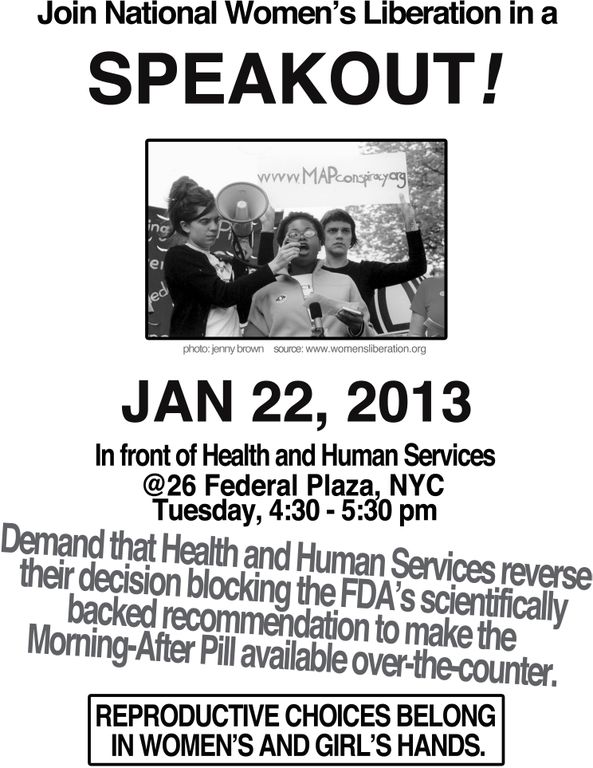
MAP flyer final-2via National Women’s Liberation.  The New York chapter of NWL will hold a speakout on January 22, 2013, in front of the Health and Human Services office at 26 Federal Plaza, New York, NY, to demand unrestricted access to the Morning-After Pill.  According to their press release, “we are holding our speakout on the anniversary of Roe v Wade because we believe that all women and girls should have access to all tools that enable us to control our reproductive lives.”

Members of this group have been fighting against age restrictions on over-the-counter emergency contraception since January 2004, when they “led the Morning-After Pill Conspiracy Coalition to show the injustice of the restriction on the MAP and to show that woman are the real experts when it comes to birth control.  On February 15, 2004, we began a civil disobedience campaign where 4,500 women signed a pledge promising to give a friend the MAP in defiance of the FDA’s prescription only requirement.  In January 2005, nine if us were arrest’s at the FDA’s headquarters as part of a larger protest of the FDA’s inaction.”

It’s nice to see the return of this group of activists. As I describe in my book.  the Morning-After Pill Conspiracy was inspired by the grassroots activism of the women’s liberation movement of the 1960s and 1970s: In an interview, one of the group’s founders, Annie Tummino said,  “We speak out and engage in civil disobedience. Our goal is to send the message that women are the experts on our bodies and lives.” MAPC used a variety of direct-action techniques to protest the FDA and the Bush Administration’s stance on emergency contraception. They held consciousness-raising sessions; speak outs in major cities; and committed various acts of civil disobedience including passing along emergency contraceptive kits to women without a prescription.

march4-04fMost emblematic of their ties to Second Wave feminist organizing were their actions at the March for Women’s Lives Washington, DC on April 25, 2004. The group held a mini-rally where a dozen women “testified about rushing around trying to get the Morning-After Pill after a condom broke during sex, about the prohibitive costs associated with a doctor’s visit, and about the tragicomic idea that anyone can get a doctor’s appointment in twenty-four hours, especially starting on a Friday or Saturday night.” In defiance of “unjust” prescription laws, the group flung boxes of Plan B® into the crowd. They also invited spectators “to join them in signing the Morning After Pill Conspiracy pledge to defy the prescription requirement (and break the law) by giving a friend the Morning-After Pill whenever she needs it.”

A group of physicians from the Association of Reproductive Health Professionals’ Reproductive Health Access Project contributed to this display of feminist direct action by bringing their prescription pads and freely writing prescriptions for emergency contraception for any woman who wanted one. According to MAPC member Jenny Brown, these doctors “were illustrating a point which was repeated over and over in the FDA’s advisory hearings–no physical evaluation or instruction from medical professionals is needed to safely and effectively use this medication.” Members of MAPC declared they “were proud to follow in the footsteps of feminists like Margaret Sanger, who passed out information on birth control when it was illegal to do so, and suffragists who were arrested for voting, to showcase how unjust the laws were.” Like the feminist activists who protested against the abuse of women subjects during the 1970s, MAPC members held a sit-in at FDA headquarters in January of 2005, where nine of their members were arrested for blocking access to the FDA, “just like they were blocking women’s access to birth control.”

Members of the MAPC members then filed a lawsuit, Tummino, et al. v. Hamburg with the Center for Reproductive Rights, the Association of Reproductive Health Professionals, and National Latina Institute for Reproductive Health.  From the lawsuit and feminist organizing, the FDA agreed to approve Plan B for women 18 and older without a prescription, in August 2006.  In March 2009- the FDA was ordered to make Plan B available to 17 year olds and to review its decision to deny a “Citizen’s Petition” filed by 60+ women’s health and rights organizations.  In February 2012, the MAPC took the FDA back to court based on its continued failure to act on removing scientifically unsupported restrictions on the MAP.

To support these efforts of NWL, you can attend the rally, sign their petition demanding the FDA and HHS to stop carding for emergency contraception, “like” them on Facebook, and forward their press release to other activists.

Signal Boost: Everyday Health infogram on Free Birth Control and Abortion rates

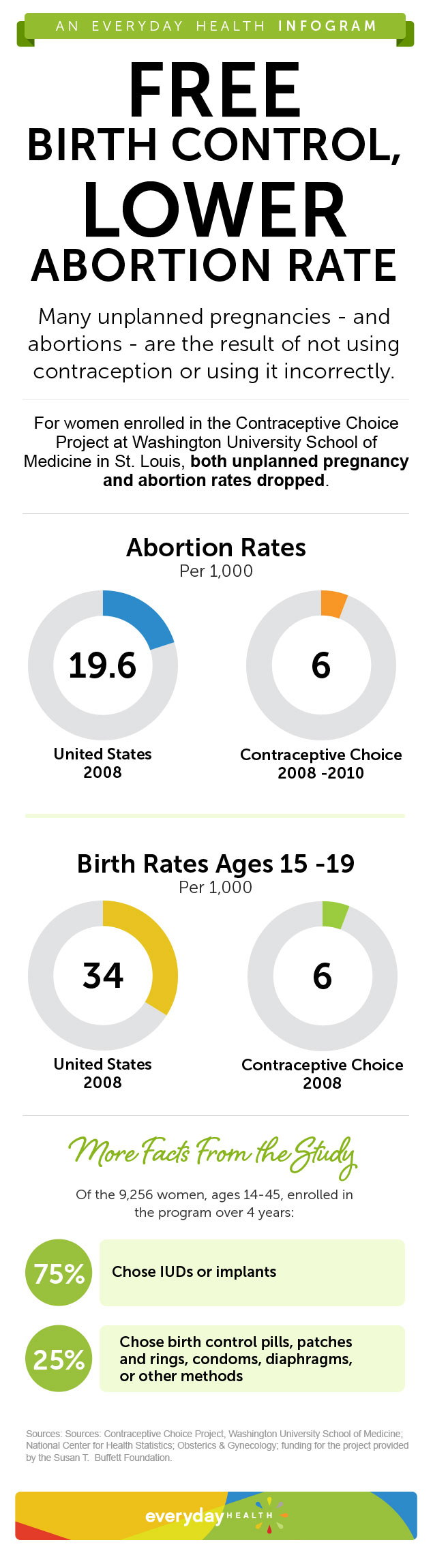
everydayhealth.com-124via Everyday Health.  The infogram at left used data from the four-year Contraceptive CHOICE Project, a study by researchers at Washington University School of Medicine in St. Louis. This study followed more  than 7500 participants who were free to choose, with all costs covered, from a range of contraceptives. The researchers then examined the contraceptive failure rates of various methods.  The key findings were that  “Women who used birth-control pills, the patch or vaginal ring were 20 times more likely to have an unintended pregnancy than those who used longer-acting forms such as an intrauterine device (IUD) or implant.” The difference in effectiveness was even more marked for women under 21 who used  the pill, patch or ring. Their risk for unintended pregnancy with these methods, as compared with long-acting reversible contraceptives (LARCs), was almost twice as high as for older women.

The results of the study showed a substantial drop in the abortion rate compared to the national average, and a drop in birth rates among young women.

Hopefully this will tip things in favor of insurance coverage for contraception.

Script-doctoring Lincoln: Women’s History Edition

via We Are Respectable Negroes, which quotes from historian Kate Masur’s doctoring of the Lincoln script in The Chronicle of Higher Education.  Masur wrote this in response to criticism of an op-ed she wrote for the New York Times in which she “pointed out the passivity and generic nature of the black characters in the film. I argued that the filmmakers’ “imagination” (to quote Spielberg) was one in which white men gave the gift of freedom to African-Americans.” In response to” those who insist that it would have required a PBS miniseries or a wholly different feature film to portray black characters with more complexity and to suggest that African-Americans played a role in their own liberation,”  Masur offers  the following “dreams and fantasies of my own.

Thaddeus Stevens could have talked about politics at home with his common-law wife, Lydia Smith, who was African-American. They might have discussed the tension between Stevens’s idealism and the president’s pragmatism; Smith could have given Stevens advice about how to handle himself during the House debate over the 13th amendment.

Robert Lincoln, strolling around Washington and mulling his conflict with his parents, could have come across a meeting of black activists who, under leadership of the editor Robert Hamilton of New York, had assembled in the capital to lobby Congress for emancipation and equal rights. Some of these men could have been among the group of African-Americans who filed into the House chamber to witness the amendment’s passage.

Keckley, in an effort to get the First Lady out of the house, could have taken Mary Lincoln to a meeting of her relief organization at 15th Street Presbyterian Church, the city’s most prestigious black church, where Slade was also a member.

A Northern black activist or two could have visited the White House to lobby for the amendment or to discuss which Democratic representatives could be persuaded to back the amendment. For that matter, Lincoln could have been shown discussing his dilemma with Slade.
Instead of showing Lincoln interacting with (passive) photographic images of slaves, the film could have shown him meeting actual fugitive slaves who had come into the city.

An escaped slave might have described her decision to leave home, her calculus of the risks versus the potential rewards, and her understanding of the war itself. The interaction might have been shown to touch Lincoln emotionally. (As it stands, Spielberg imagines that Lincoln decided to prioritize the amendment over peace talks, not because anyone or any thing persuaded him, but because he meditated on a Euclidean equation.)”

We Are Respectable Negroes concludes by asking those of us who have seen Lincoln “what changes would you make? Alternatively, are there any other historical docudramas which you are particularly fond of that did not live up to their potential? How would you play script doctor with them?”

Well, my first suggestion would be to have a scene where prominent female abolitionists visit President Lincoln and remind him that the 13th amendment was their idea.  Elizabeth Cady Stanton and Susan B. Anthony  founded the Women’s Loyal National League calling for the total abolition of slavery (which the Emancipation Proclamation had failed to do).  Here’s a petition they circulated in early 1864:

women of republic doc_large_2

Transcript
Office of the Women’s Loyal National League
Room No. 20, Cooper Institute.
New York, January 25, 1864.
THE WOMEN’S LOYAL NATIONAL LEAGUE,

TO THE WOMEN OF THE REPUBLIC:

We ask you to sign and circulate this petition for the ENTIRE ABOLITION OF SLAVERY. We have now ONE HUNDRED THOUSAND signatures, but we want a MILLION before Congress adjourns. Remember the President’s Proclamation reaches only the Slaves of Rebels. The jails of LOYAL Kentucky are to-day “crammed” with Georgia, Mississippi and Alabama slaves, advertised to be sold for their jail fees “According to LAW,” precisely as before the war!!! While slavery exists ANYWHERE there can be freedom NOWHERE. THERE MUST BE A LAW ABOLISHING SLAVERY. We have undertaken to canvass the Nation for freedom. Women, you cannot vote or fight for your country. Your only way to be a power in the Government is through the exercise of this one, sacred, Constitutional “RIGHT OF PETITION;” and we ask you to use it now to the utmost. Go to the rich, the poor, the high, the low, the soldier, the civilian, the white, the black gather up the names of all who hate slavery all who love LIBERTY, and would have it the LAW of the land and lay them at the feet of Congress, your silent but potent vote for human freedom guarded by the law.

You have shown true courage and self-sacrifice from the beginning of the war. You have been angels of mercy to our sick and dying soldiers in camp and hospital, and on the battle-field. But let it not be said that the women of the Republic, absorbed in ministering to the outward alone, saw not the philosophy of the revolution through which they passed; understood not the moral struggle that convulsed the nation — the irrepressible conflict between liberty and slavery. Remember the angels of mercy and justice are twin sisters, and ever walk hand in hand. While you give yourselves so generously to the Sanitary and Freedmen’s Commissions, forget not to hold up the eternal principles on which our Republic rests. Slavery once abolished, our brothers, husbands and sons will never again, for ITS SAKE, be called on to die on the battle field, starve in rebel prisons, our return to us crippled for life; but our country free from the one blot that has always marred its fair escutcheon, will be an example to all the world that “RIGHTEOUSNESS EXALTETH A NATION.”

THE GOD OF JUSTICE IS WITH US, AND OUR WORD, OUR WORK — OUR PRAYER FOR FREEDOM WILL NOT, CANNOT BE IN VAIN.

E. CADY STANTON
President.
SUSAN B. ANTHONY,
Secretary W.L.N. League,
Room 20, Cooper Institute,
New York.”

How about you readers?  What would you add?

Signal Boost: Barbara Sicherman on the Persistence of Little Women

littlewomen1994-300x225

Louisa_May_Alcott

via UNC Press Blog

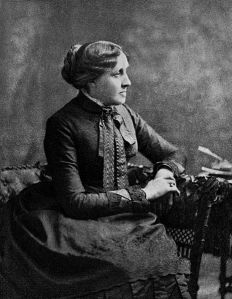
November 29th was the 180th anniversary of Louisa May Alcott’s birth.  In honor of this occasion, UNC asked Barbara Sicherman, William R. Kenan Jr. Professor of American Institutions and Values Emerita at Trinity College and author ofWell-Read Lives: How Books Inspired a Generation of American Women, to write a guest post on how Little Women has influenced other women writers since its publication. Sicherman begins, “What do Simone de Beauvoir, Cynthia Ozick, Ann Petry, and Patti Smith have in common? The French existentialist, Jewish American author, African American novelist, and punk rock star are all celebrated writers. Beyond this, each woman has acknowledged the importance of Little Women, and its heroine Jo March, in their imaginative lives and their identities as artists and intellectuals. They are not alone.

Numerous women, some famous, most not, have vouched for the novel’s appeal since its appearance in 1868-69 (initially in two parts). As early as 1875, fifteen-year-old Jane Addams, future settlement leader and Nobel Peace prize winner, anticipated the formulaic pattern of rereadings when she observed: “I have read and reread ‘Little Women’ and it never seems to grow old.” Even friends growing up in the 1940s and 1950s claim they read the novel yearly when they were young and returned to it periodically as adults.”

I was one of those who grew up reading and loving Alcott, identified totally with Jo, and was thrilled when my grandmother took me and my sisters to visit Orchard House.  I’ve continued my fascination with Alcott into adulthood.  For those interested in finding out more, I highly recommend Eve LaPlante’s new books on Alcott and her mother, as well the book and film, Louisa May Alcott: The Woman Behind Little Women.

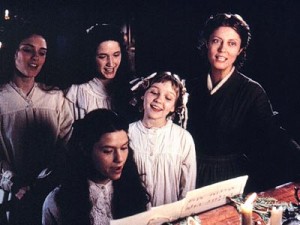
I asked my women’s history students if they had read and/or seen any film adaptations of Little Women.  Alas, most had not.  So, I showed the opening of the 1994 film version and walked through the first two chapters with them in class.  They also read Alcott’s riveting account of her work as a Civil War nurse, Hospital Sketches.

Many agreed with Sicherman’s suggestion that “Alcott, who modeled Jo in her own image, created a character that continues to appeal. As J.K. Rowling, author of the Harry Potter books and herself a “Jo,” observed: ‘It is hard to overstate what she meant to a small, plain girl called Jo, who had a bad temper and a burning ambition to be a writer.'” Nearly all of the students were familiar with the Harry Potter books and films and could easily see how Jo helped inspire Rowling to create the brainy tomboy Hermione Granger.

Historiann asked her readers to give their thoughts and recollections of Little Women, so I invite my readers to do the same.

Day of Action on Emergency Contraception #ECOTC

Last year, I wrote of my disappointment that HHS Secretary Kathleen Sibelius overruled the FDA’s decision to make emergency contraception available over-the-counter with no age restrictions.

The Reproductive Health Technologies Project has started a campaign to convince Secretary Sibelius to reconsider her decision.  Their goal is to deliver a petition with at least 50,000 signatures to Secretary Sibelius on December 7th.  The petition reads:

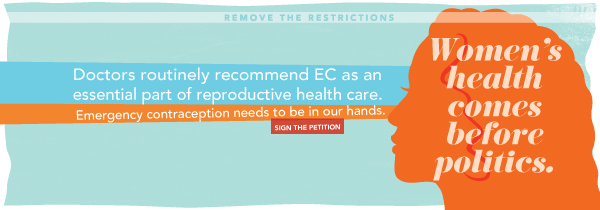
“Women’s health, including the ability to determine the timing and spacing of pregnancies, should not be subject to politics. After more than a decade of medical research, the Food and Drug Administration (FDA) determined emergency contraception (EC) is effective and safe enough for access without restriction. Doctors recognize EC as an important component of reproductive health care, allowing women a second chance to prevent pregnancy when a primary contraceptive method fails. In December 2011, Health and Human Services (HHS) Secretary Kathleen Sebelius overruled the FDA and restricted access to EC. We urge Secretary Sebelius to revisit the evidence and remove the restrictions, placing women’s reproductive health above politics.”

If you agree, sign the petition.