 Dear Readers,
As you know, I was on a panel discussing Griswold v. Connecticut on Action Speaks Radio two weeks ago. The recording is now available online. Go here to listen!
You can also read my scholar essay on the AS website.
Dear Readers,
As you know, I was on a panel discussing Griswold v. Connecticut on Action Speaks Radio two weeks ago. The recording is now available online. Go here to listen!
You can also read my scholar essay on the AS website.
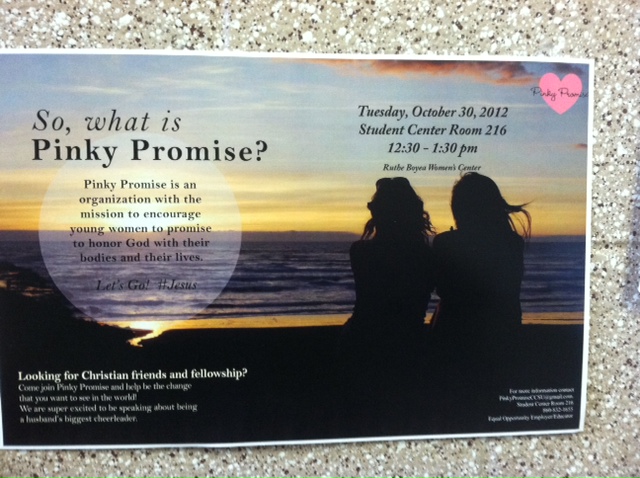
On my way into the office today I saw the poster at left on the wall in my building. One of my students notified me that she has seen a similar poster in her dormitory.
Since I didn’t know much about the organization, I consulted their website:
Pinky Promise is…
A promise to honor God with your body and your life. To refuse to give your body to anyone that hasn’t paid the price for you called marriage. It’s a promise to stay pure before God in EVERY single way. It’s a promise that says, I won’t test the boundaries in my relationship to see how far I can push it sexually–but instead–I want God to have my heart.It’s a promise to God that you will honor your marriage convenant [sic]. It’s saying that I promise not to step outside of my marriage, cheat on my spouse and that I’ll work through every issue.Thanks for joining Pinky Promise. Find a group or start a group in your area, and lets encourage each other and build a bond between sisters in Christ.Here’s my dilemma: I understand the desire to reach out to all women, regardless of faith traditions. However, I also share a lot of the concerns raised in this post by
“On the surface it seems to be teaching good values: value yourself, don’t cheat, love God. Yet, I don’t know where to begin. The program seems to be teaching abstinence only sex education focused around the purity myth. According to this, you can love and value yourself, but only on the basis of your virginity. This extends not only to how you view your own self worth, but how your family views you (as you are making a promise to your father-or other male relative) and worst of all how God sees you. Tying this organization into religion is what stuns me. I do not believe religion is an evil and even if I did this would not be the place to insert my own religious views. I bring religion into this dialogue because in this instance religion is being used as a means of control to oppress women.
The religious aspect of virginity is all part of a power game by the male dominated religious leaders who read and interpret religious texts through an oppressive lens and then let their interpretations trickle down to those of their faith as the word of God.
At its core though, the Pinky Promise movement is just another way to deny women the right to own their sexuality. For a woman, sex is for making babies not for pleasure. For men it is just the opposite. Which brings me to the point that Pinky Promise is not against sex: if they were they would have both men and women pledge to be chaste. Instead this is just for women. Women having sex is apparently a scary thing. It is, according to such abstinence only pledges, the woman’s role to keep both her own desires under control (because she obviously has a lower sex drive than a man-not in fact true) and control the man’s desires as well. From this flawed logic, it is her fault if she has sex, or is raped because it is her worth on the line and her responsibility to keep herself pure until marriage. Why this purity matters and why virginity is being used as a test of morality is never explained.
In addition, the entire organization only accounts for straight Christian girls. What about bisexuals? lesbians? If the logic is that women must be pure until marriage, what about those who can’t legally get married and where sex is considered to be something different than male-female intercourse? What about asexuals? By these ideas are we just eternally moral or is there a point where we become to old to stay the chaste virgin? What about Jews? Muslims? Buddhists? Hindus? Are we not all women and therefore all under this umbrella of purity?
There are too many unanswered questions. In addition Pinky Promise has a limited scope and is not fostering communication with God as they claim. They are instead communicating with the patriarchy to keep women uninformed about their sexuality and using the principles of Christianity to enforce this control.
I have written to Pinky Promise but they have not gotten back to me. I will write again. I’ll talk to the organization’s leaders on campus and open up a dialogue. I only ask that you speak out as well. Be informed and be proud of your sexuality. Women are not less sexual than men, no matter what lies we are told to keep us quiet and chaste.”
Opening up a dialogue sounds like a good idea. The meeting was scheduled to be held at our campus Women’s Center but was cancelled because of Hurricane Sandy. My student wrote to our Women’s Center director about this but hasn’t heard back yet. Meanwhile, what do others think of this organization?
Update from Women’s Center Director:
“Please know the Center does not discriminate against women, the various views of women, we welcome all men and women to the Center. We encourage dialogue of opposing views and would be happy to engage you in dialogue with the facilitate for Pinky Promise. We support and defend the Mission of the Center. We support and defend ” Our Doors are Open’ statement.
Mission
The Ruthe Boyea Women’s Center exists to provide resources, to advocate, to inform, and to support personal development. The Center offers a variety of services for and about women. We sponsor educational and cultural programs designed to promote gender equity, knowledge of women’s rights issues, leadership, and independence. We encourage understanding and cooperation among women of varied socio-economic groups, cultures, ethnic backgrounds, races and sexual orientations. We welcome all women and men who enter our doors.
Our Doors Are Open
The Center is open to all of CCSU’s community, men and women. The Women’s Center values and celebrates the multiplicity of women’s lives; recognizes the intersections of gender, race, sexual orientation, economic status, and other significant aspects of individual and cultural identity; accepts responsibility for opposing injustice; and commits itself to service to the University and larger communities.
Women of all backgrounds can drop in and help one another grow towards personal effectiveness and independence. We encourage understanding and coming together of women of varied cultures, races and ethnicities, as well as different sexual orientations, socio-economic groups and ages. Our Center is for and about women so that both women and men are welcome to drop in and use our resources, attend activities or just hang out.”
via Chronicle of Higher Education, in which Marc Bousquet mansplains what’s wrong with academic feminism. The article starts out well by outlining the “normalization and feminization” of contigent faculty in higher education. Whose to blame for this? Why the feminists of course!
“What’s mainstream academic feminism’s response to this situation? A cry for “comparable worth” evaluation of paychecks across disciplines, so that faculty positions with similar responsibilities, qualifications, and skill sets are similarly paid? No, most academic feminism subscribes to a version of the pipeline thesis.
Well, is academic feminism at least burning with outraged solidarity at all of the women shunted disproportionately into contingent positions? Again, no: Most female contingent-faculty leaders I know are bitter at the hilariously narrow version of women’s solidarity practiced by tenured feminists. “Why should I make common cause with beaker cleaners?” one lecturer quoted a tenured female scientist as saying when asked to support fair evaluation for contract renewal of Ph.D.-holding female lecturers on her campus. Female lecturers teaching lower-division required courses are commonly the targets of sexist evaluation by students and experience discriminatory employment outcomes as a result. According to many female lecturers, all too often the tenured feminists have nothing to say. At nearly every college I’ve ever visited, the women’s faculty group was a more comfortable home for female administrators than for female faculty serving contingently.
In some ways, of course, the influx of women into higher education is a feminist achievement to be celebrated. It is obviously better to have lots of women in college rather than, say, prison. But in the steadily more gendered exploitation of graduate assistants, undergraduate workers, outsourcing, debt peonage, and so on, higher education is deserving of critical scrutiny.
In an increasingly authoritarian national, corporate, and educational culture—producing ever more feminized workplace cultures and ever more masculinized leadership cultures—what sort of leadership should we ask from academic feminists?
On the one hand, there’s nothing wrong with the fact that many academic feminists hope to place more women in campus administration. It is common for organizational-sociology studies to find that more women in senior administration tends to have a modest impact on gender equity, particularly in terms of hiring more female assistant professors.
On the other hand, it may be even more urgent to remedy the low involvement of academic feminists in AAUP, the labor movement, academic unionism, and solidarity movements with female faculty (not to mention female staff). ”
Christ on a cracker — what planet does this guy live on? There are plenty of feminists involved in AAUP and other campus organizations dedicated to gender equity and other social justice issues. Doesn’t he at least read the Chronicle’s own Tenured Radical? Grr, this makes steam come out of my ears!
As many of you have heard, Republican Senate candidate Linda McMahon has tried to fudge her pro-choice position by stating that Catholic hospitals should not have to give out emergency contraception as mandated by a state law passed in 2007. (In a related Akin-esque moment, she also introduced the bizarre term “emergency rape“).
So, in this sense, she’s no different than the Senator she aims to replace, Joe Lieberman, who when the emergency contraception bill was being discussed in 2006, said that rape victims could just “talk a short ride” to another hospital.
Prochoice groups in the state are getting out the word that Linda is no friend of reproductive rights. “Pro-choice candidates don’t compromise the health and safety of rape victims especially when receiving time sensitive medication,” said Christian Miron, executive director of NARAL Pro-Choice Connecticut. “There is no shortage of evidence proving that Linda McMahon is neither pro-choice nor independent,” said Murphy campaign spokesman Ben Marter. “McMahon’s extreme policy for rape victims and her support for the Blunt Amendment makes it clear that she would vote in lockstep with Washington Republicans that want to erase decades of progress for women.”
I’m hoping that this will earn a win for Chris Murphy. (oh if you out-of-staters would like to help, please give to his campaign).
Dear Readers,
I’ve joined the editorial staff at the blog Nursing Clio. My first entry, on last night’s debate, is now available for your viewing. Enjoy!
via History News Network, which quotes the best line in Michelle Obama’s speech at the DNC convention: “When you’ve worked hard, and done well, and walked through that doorway of opportunity, you do not slam it shut behind you. You reach back, and you give other folks the same chances that helped you succeed.”
HNN traces this view to the Progressive Era, which spread the message that “Lack of success was a sign of failure not by the individual but by societal structures and institutions that limited the individual’s opportunities, no matter how hard he or she worked. . . in the Progressives’ view, the helping hand had to be extended by the body politic as a whole. And the obvious agent of the body politic is government.”
Excellent points. Furthermore, I think the First Lady’s remarks harken back to a specific organization that originated in the Progressive era and continues today — the National Association of Colored Women’s Clubs. The organization’s motto — “Lifting As We Climb” — reflected their belief that their work didn’t end with self-improvement: they had a duty to uplift their communities as well as themselves.
Now, Michelle Obama didn’t mention race in her speech. Perhaps, as Sophia Nelson has argued, she didn’t need to. Still, it’s worth placing her words within a longer tradition of black women’s activism.
via the New York Times Magazine, cover story by Hanna Rosin, “Who Wears the Pants in This Economy?”
Earlier this year, Bryce Covert at Next New Deal declared the end of the so-called “mancession” — i.e. the gap between male and female unemployment. First a definition:
“he term itself was coined by AEI scholar Mark Perry. He was the first to give a name to a striking phenomenon during the recession (officially from 2007-2009): not only did employment tank in male-heavy industries, and not only did they therefore have elevated unemployment rates, but the gap between their unemployment rate and women’s was the largest in post-War record-keeping. This was particularly striking because before the recession — in the months from 2004 to 2007 — unemployment rates were about equal for the two sexes, and women’s even rose higher than men’s for some months. This gap between the two rates hit a peak in August of 2009 at 2.7 percent — men at that point had an 11 percent jobless rate, and women had 8.3. (The gap started closing after that point even as male unemployment rose — women just started catching up with them in the unemployment department.) To sum up, as Perry puts it, “the impact of job losses was considerably greater for men, since almost 6 million men lost their jobs, compared to only 2.64 million job losses for women. More than two out of every three jobs lost in 2008 and 2009 were held by men (68.5%), or alternatively it was also the case that 217 men lost their jobs for every 100 women who became unemployed in 2008 and 2009.”
He points out that much of this was related to the industries most affected by the recession. Construction and manufacturing went into freefall. He calculates that the largest job losses during the recession were in manufacturing — down by 14 percent — and construction — down by 20.2 percent. Men make up 71.2 and 87.5 percent of those industries, respectively. On the other hand, some industries where women dominate were doing well. Education and health services was up 4 percent, 74 percent female, and government jobs were up 2.25 percent, 57 percent female.”
In March of this year, an analysis by the National Women’s Law Center showed “men and women are now on par for unemployment rates, both standing at 7.7 percent. Mark it: the gender gap that had Perry, the media, and manhood so worried has completely evaporated.
On top of that, the supposedly recession proof, female-dominated industries are not faring as well. And the male dominated ones are starting to show signs of life. Construction is up 2.1 percent; manufacturing is up 2. Yet government jobs are down 1.2 percent, and that’s across the board — 1.5 percent at the federal level, 1.4 at state level, and 1.1 at the local level. Those government job losses are driving our current womancession. Job losses, which skewed male, have now turned into skewed job gains. Men had lost 6 million jobs to women’s 2.64 million during the recession, but now women have gained just eight percent of the 1.9 million jobs added in the recovery.
This painful economic period, even if it’s showing signs of improvement, is likely far from over. Men and women are both still hurting in huge numbers. But at least one thing has changed: we can stop calling this a mancession.”
Yet, one would never know this from the Times magazine article, which examines the town of Madison, Alabama, where male-dominated manufacturing jobs have all but disappeared, and historically “female” jobs in health, education, and social services have expanded.
The result: “a nascent middle-class matriarchy,” in which women “pay the mortgage and the cable bills while the men try to find their place.”
I’m about to teach my first session of a course on the New Deal, so I’ve heard this tale of men “emasculated” by hard economic times. At that time, Norman Cousins had the immodest proposal that the way the end the Depression was to fire all the women, “who shouldn’t be working anyway,” and hire men in their place. Some places of employment actually followed that advice: for example, the majority of public schools refused to hire married women as teachers, and many had a policy of firing women who married. Yet, at that time, men were even more reluctant and/or unprepared to take on “women’s work” — which was even more poorly compensated than it is today.
One would think that times have changed enough that men in the 21st would be secure enough in their masculinity to seek work in the expanding “female” fields. According one man who was interviewed, one reason they don’t is because these jobs pay far less than they were accustomed to earning. A more important reason, though, was “We’re in the South . . .A man needs a strong, macho job. He’s not going to be a schoolteacher or a legal secretary or some beauty-shop queen. He’s got to be a man.”
Since the article only covered white, married, heterosexual couples I’m wondering how representative this is of the South, let alone the rest of the country. Perhaps Rosin’s forthcoming book will look at a more diverse sample of the American people. Meanwhile, read Covert’s excellent response to Rosin’s other articles.
Update: Here is what the Foundation sent out to supporters of the program:
We are sorry to have to report that, as a consequence of the larger economic downtown, the endowment for the Women’s Studies Dissertation Fellowship has generated insufficient funds to cover program costs over the past several years. The Woodrow Wilson Foundation has thus decided to suspend the competition for the 2012-2013 year while we explore options to ensure that the program will continue to flourish in the future. During the coming year we will engage in a careful review of the Fellowship’s goals and structure, with a view toward achieving greater financial stability and success in the future.
In its thirty-seven-year history, during which we have awarded over five hundred Women’s Studies Fellowships, the Women’s Studies Program has made a significant contribution to the field. We take great pride in the Fellowship’s accomplishments, and we will proceed thoughtfully as we undertake this review.
We are grateful for your dedication to and support of this program and will keep you informed as we move forward.
The Woodrow Wilson Foundation has suspended its Women’s Studies Dissertation Fellowships program. For twenty-five years this program enabled women’s studies scholars to do the work that enriched so many disciplines and reshaped the curriculum of in secondary schools, colleges and universities. Suspending this program is a terrible blow to scholars and students. It reflects very poorly on the foundation. Why was this decision made? Why weren’t members of the final selection committee, the past recipients, and leaders in the women’s studies community consulted? Surely they could have worked together to find ways to keep this magnificent program alive. The foundation claims there have been insufficient endowment funds for the past three years. If that is the case, why wasn’t a full public effort made to address the problem and garner support? More critically, what is the plan of action going forward? What steps are underway to build the endowment and get the program back up and running? We ask the foundation to reach out to us—we are ready to help.
Let’s start by making our voices heard. If you care about Women’s Studies you can write to the President of the Woodrow Wilson Foundation, Arthur Levine (Levine@woodrow.org) and tell him why the program is so vital and ask that immediate steps be taken to ensure its continued existence. Please also sign this petition at Change.org
via National Women’s History Project who reminds how recently women received the right to vote in the U.S. Don’t take it for granted!
Presidential Proclamation – Women’s Equality Day, 2012
BY THE PRESIDENT OF THE UNITED STATES OF AMERICA
A PROCLAMATION
On Women’s Equality Day, we mark the anniversary of our Constitution’s 19th Amendment, which secured the right to vote for America’s women. The product of profound struggle and fierce hope, the 19th Amendment reaffirmed what we have always known: that America is a place where anything is possible and where each of us is entitled to the full pursuit of our own happiness. We also know that the defiant, can-do spirit that moved millions to seek suffrage is what runs through the veins of American history. It remains the wellspring of all our progress. And nearly a century after the battle for women’s franchise was won, a new generation of young women stands ready to carry that spirit forward and bring us closer to a world where there are no limits on how big our children can dream or how high they can reach.
To keep our Nation moving ahead, all Americans — men and women — must be able to help provide for their families and contribute fully to our economy. That is why I have made supporting the needs and aspirations of women and girls a top priority for my Administration. From signing the Lilly Ledbetter Fair Pay Act into law and creating the White House Council on Women and Girls to combatting sexual assault and promoting women’s economic and political empowerment at home and abroad, we have worked to ensure women have the opportunities they need and deserve at every stage of their lives. As women around the world continue to fight for their seat at the table, my Administration will keep their interests at the core of our policy decisions — and we will join them every step of the way.
Today, women are nearly 50 percent of our workforce, the majority of students in our colleges and graduate schools, and a growing number of breadwinners in their families. From business to medicine to our military, women are leading the fields that were closed off to them only decades ago. We owe that legacy of progress to our mothers and aunts, grandmothers and great-grandmothers — women who proved not only that opportunity and equality do not come without a fight, but also that they are possible. Even with the gains we have made, we still have work to do. As we mark this 92nd anniversary of the 19th Amendment, let us reflect on how far we have come toward fully realizing the basic freedoms enshrined in our founding documents, rededicate ourselves to closing the gaps that remain, and continue to widen the doors of opportunity for all of our daughters and sons.
NOW, THEREFORE, I, BARACK OBAMA, President of the United States of America, by virtue of the authority vested in me by the Constitution and the laws of the United States, do hereby proclaim August 26, 2012, as Women’s Equality Day. I call upon the people of the United States to celebrate the achievements of women and recommit to realizing gender equality in this country.
IN WITNESS WHEREOF, I have hereunto set my hand this twenty-fourth day of August, in the year of our Lord two thousand twelve, and of the Independence of the United States of America the two hundred and thirty-seventh.BARACK OBAMA
The fall semester starts next week, and I’m bracing myself for the question, “so, did you have a productive summer”? Well, it depends on what you mean by “productive.” By the usual academic metrics (e.g. number of pages written, chapters completed, etc.) the answer would be “no.” I wrote a couple of book reviews, reviewed a couple of manuscripts, but didn’t make much progress on any of my writing projects, other than to submit an article, have it rejected by one journal, and send it off to another without revising it.
Now, I wasn’t exactly idle — see the above bit about the book and manuscript reviews. I also attended ThatCamp which you’ve all read about in my series of posts. I did a bunch of background reading for my new project and for classes I’m teaching in the upcoming semester. In other words, I was busily engaged in professional development (to use academic jargon).
However, I also took the summer to recharge and try some new things. I tried out stand-up paddle boarding (including a yoga class on the boards, aka SUP Yoga). I did a mountain bike skills clinic. I grew some awesome vegetables and built a new flower garden out of a section of dead lawn. I took a cooking class celebrating Julia Child’s 100th birthday. And, of course, I did a lot of knitting.
I was having a few twinges of regret until this past Sunday, when I read this article in the New York Times, written by Jason Fried from 37signals. Fried writes, “Change is important. When we were growing up, we got summers off from school. Summer vacation was change. It was something to look forward to. A few months of something different really meant a lot. We grow out of a lot as we grow up. One of the most unfortunate things we leave behind is a regular dose of change. Nowhere is this more evident than at work.” I couldn’t agree more. so, to get back into this groove, the company “tried something new. We decided to give everyone the month of June to work on whatever they wanted. It wasn’t vacation, but it was vacation from whatever work was already scheduled. We invited everyone to shelve their nonessential work and to use the time to explore their own ideas.” Fried found “June-on-your-own experiment led to the greatest burst of creativity I’ve seen from our 34-member staff. It was fun, and it was a big morale booster.”
What a relief! I’m hoping that my choice to embrace change this summer will reap benefits this semester, not just in terms of productivity but also overall mental and physical well-being. I’m already feeling less stressed out thank I usually do at this time of year. Here’s to “unproductivity”!
It is a truth universally acknowledged that a single woman must be in want of a drink
Orientalism and Yoga in the 21st Century
is a Vice Provost, Dean, and Professor at Northeastern University
History for the Future
By Norse code
Follow me on twitter: @jmedwards29
Why Do You Write Like You're Running Out Of Time?
A site to think about my academic work the same way I do everything: by overthinking it.
Blog for History 511: Digital History
History in the Digital Age
History Happens
A Group Blog on Early American History
A journal of New England cultural, literary, political, and social history
The latest news on WordPress.com and the WordPress community.
 Knitting Clio