#EmergencyContraception Past, Present, and Future

Rutgers University Press book exhibit at 2012 American Association for the History of Medicine annual meeting

via RH Reality Check and my book pictured at left. Actually, the title of the RHRC post has the name of a specific emergency contraceptive product and shows a video produced by NARAL ProChoice NY for their Champions of Choice 2012 awards luncheon. The organization, “honored the visionaries behind Plan B. From Sharon Camp, who pioneered this emergency contraceptive product and even founded a pharmaceutical company to bring it to market, to Teva Women’s Health, which not only stands behind the current product but has pushed the FDA to increase access by making it available over-the-counter for all ages.”

This is an excellent video but because it celebrates a particular product it has its limits.  First, it’s not true that no pharmaceutical company was interested in creating an emergency contraceptive for the U.S. market — Roderick Mackenzie created the now defunct company Gynetics specifically for that purpose and got the no longer produced drug Preven approved by FDA first.  Second, the story is framed rather narrowly by the ongoing culture wars over contraception and reproductive rights — e.g. in the repeated use of the phrase “politics trumping science.”  Although important, this framework ignores the ways in which the public shapes what “counts” as scientific knowledge. It also overlooks the specific historical circumstances that lead to the production of new knowledge, especially when this involves a politically controversial health topic such as birth control. Most importantly, this claim treats “the public” as though it were a homogenous entity, ignoring the multiple constituencies who have contributed to reproductive health policy in the United States and the ways in which their positions have changed over time.

Okay, now that I’ve addressed the past and the present (sort of), what about the future?  Well, historians aren’t in that business but I’ll offer some thoughts based on my book’s conclusions. Since the early 1990s, emergency contraception has served as a bridge issue that brought together former adversaries, including feminist health organizations, population and family planning
people, and groups representing women of color who were the main targets of attempts to control the so-called “population crisis” in the United States. In order to bring more radical groups onboard, mainstream population organizations and reproductive health professionals had to overcome much bad faith generated by sexism in the medical profession and the often coercive policies of the population movement during the first half of the twentieth century. A narrow focus on purely technological solutions to
the complex social problem of pregnancy prevention tends to dissolve this fragile alliance. Therefore, as experts and activists develop policies on making new contraceptive options available to all women; it is imperative that the language of rights
and reproductive choice continue to remain at the forefront of these deliberations.

Stressing quality over quantity, or why I’m not worried I haven’t blogged in awhile

via Dan Cohen’s Digital Humanities Blog

Cohen has just redesigned his blog.  Here’s why:

“the thinking behind this redesign goes back to the beginning of this blog, when I struggled, in a series called “Creating a Blog from Scratch,” with how best to highlight the most important feature of the site: the writing. As I wrote in “Creating a Blog from Scratch, Part I: What is a Blog, Anyway?” I wanted to author my own blogging software so I could “emphasize, above all, the subject matter and the content of each post.” The existing blogging packages I had considered had other priorities apparent in their design, such as a prominent calendar showing how frequently you posted. I wanted to stress quality over quantity.”

Unlike Cohen, I’m not planning on writing my own blogging software (or any software for that matter).  But, I do like the idea of waiting until I have something meaningful to say rather than accumulating posts for the sake of doing so.

I will be attending THATCamp CHNM 2012 (aka ThatCamp Prime) where I hope to learn and/or polish some useful things for my teaching and research.  So, I might write about that.  Or not.  We’ll see how the summer goes.


2012 National Back Up Your Birth Control Day of Action

via Back Up Your Birth Control and RH Reality Check

Today is the 11th annual Back Up Your Birth Control Day of Action sponsored by the the National Institute for Reproductive Health.  So, once again I’m helping them spread the word by blogging about emergency contraception.  This year the campaign has asked us to combat the misinformation about emergency contraception that misleadingly equates emergency contraception with mifepristone (aka RU-486) which is used to induce medical abortion.  To combat this misinformation, this year’s theme is EC=BC, “emphasizing that EC is a form of contraception that prevents pregnancy even though it’s taken after sex.”

Misinformation about the mechanism of action of EC dates back to the origins of this birth control technology in the 1960s.  Two of the researchers who developed the first oral contraceptive pill — Gregory Pincus and Min Chueh Chang — first described their work on what they called a postcoital contraceptive in 1966.  Yet the third “father” of the pill — physician John Rock, a devout Catholic — falsely claimed that this “morning-after pill” was an abortifacient.  This erroneous statement has stuck despite efforts by Pincus, Change, other scientists and activists to set the record straight.

[for more on this fascinating history, see my book,  The Morning After: A History of Emergency Contraception in the United States.  You can find out more about it at the Rutgers University Press  website,]

Here are other ways you can join the Day of Action:

  • Share the images on our EC = BC tumblr with your networks! We posted many more new images today. Follow and reblog on tumblr, post our images on Facebook, and tweet or mention them on Twitter!
  • Get creative and submit your own images to the EC = BC tumblr! We’ll circulate your images on social media throughout the day.
  • Get an EC coupon for Plan B One-Step® and ella® on the Back Up Your Birth Control website! Use them to purchase EC for yourself, send them to your friends, and let others know they can buy it in advance so that they are always prepared.
  • Blog for EC! Help us dispel the misinformation by clarifying that emergency contraception is a safe and effective form of birth control that prevents pregnancy after sex, but only works if you are not pregnant.
  • Follow us on Twitter at @NIRHealth and @ProChoiceNY, retweet our #ECfacts, and spread the word about EC using the #ECBC hashtag!
Visit the Back Up Your Birth Control website for more information. If you have questions about the campaign, contact Nicole Grafilo at ngrafilo@nirhealth.org.

Review of Leslie Reagan, Dangerous Pregnancies: Mothers, Disabilities, and Abortion in Modern America

via H-Disability

Leslie J. Reagan. Dangerous Pregnancies: Mothers, Disabilities, and Abortion in Modern America. Berkeley: University of California Press, 2010. xv + 372 pp. $27.50 (cloth), ISBN 978-0-520-25903-4.

Reviewed by Heather Munro Prescott (Central Connecticut State University)
Published on H-Disability (March, 2012)
Commissioned by Iain C. Hutchison

Prescott on Reagan

This book continues the compelling story of the history of abortion in the United States that Reagan began in her award-winning book, When Abortion Was a Crime (1998). The title Dangerous Pregnancies refers not to pregnancies that were dangerous to the lives or health of mothers, but to the “dangers” to home, family, and society posed by the birth of “defective” babies. Focusing on the responses to the German measles epidemic in the United States during the early 1960s, Reagan shows how fears of disability helped lend legitimacy to the abortion rights movement.

Reagan goes beyond her earlier work by linking the history of reproductive rights to two other fields of scholarship: the history of epidemics and infectious disease; and the history of representations of people with disabilities. She shows that in marked contrast to earlier epidemics, the German measles outbreak did not single out nonwhite or other stigmatized groups as sources of infection. Nevertheless, race was at the center of media representations of the disease. Responses to the epidemic highlighted how the birth of a disabled child wrecked havoc on the status of white, middle-class, heterosexual, nuclear families. The epidemic came closely after alarming reports about severe birth defects in infants born to women who had taken the sleeping pill thalidomide while pregnant. Although the U.S. Food and Drug Administration had not approved the drug, some American women were able to obtain the drug from overseas. The story of Sherri Finkbine’s efforts to obtain an abortion after she discovered she had taken thalidomide while pregnant with her fifth child, helped transform attitudes towards abortion in the United States. During the pronatalist 1940s and 1950s, media coverage emphasized the deviant nature of abortion and of the women who sought these procedures. Finkbine’s story, along with that of other white, middle-class mothers who had contracted German measles while pregnant, transformed the image of abortion “from a shameful, thoughtless, and sick action to an ethical and responsible one” that protected families from the “burden” of raising a severely disabled child (p. 104).

Despite these changing attitudes towards abortion, significant barriers remained even for those who sought to terminate “dangerous pregnancies.” Reagan contrasts the cases of Barbara Stewart and Sandra Gleitman, who with their husbands filed “wrongful birth” cases against the hospitals that refused to provide abortions after the women had been exposed to German measles while pregnant. Both cases showed that hospital abortion committees were fickle and arbitrary. For the Stewarts, an African American couple, race posed an additional hurdle. While they had private health insurance, racial discrimination denied them access to physicians who had connections to hospital abortion review committees. By demonstrating the central role that race played in these deliberations, Reagan answers Chris Bell’s suggestion that disability studies scholars need to pay more attention to the experiences of “people of color.”

Reagan is less successful in showing how the German measles epidemic contributed to the emerging disability rights movement. She describes the work of “rubella parents”–most of whom were white and middle class–who fought for and won the right to public education for children with physical, sensory, and intellectual impairments. These parents were successful largely because rubella and its effects were not confined to the poor or to “people of color,” and because their arguments focused on the core middle-class value of access to education. Reagan also periodically mentions persons with congenital rubella syndrome and other disabilities, including those who objected to the “humane” and “merciful” reforms that made it easier for women to abort fetuses with birth defects. Reagan claims that even the suits filed by the Stewarts and Gleitmans reflected an aspect of this rights movement, since their aim was to get resources for their children. Yet Reagan underestimates the countervailing power of terms like “therapeutic abortion” and “wrongful birth” to reinforce prevailing beliefs that disability is a fate worse than death. Rubella immunization campaigns weakened the disability rights perspective even further. They used sentimental images of “pathetic” rubella children and played into popular notions of disability as a “tragedy” that could be prevented through universal vaccination against German measles.

Reagan shows how the rhetoric about “dangerous pregnancies” backfired during the 1980s and 1990s. Opponents of vaccination have seized on these same fears by alleging that vaccines cause autism, and that by refusing to vaccinate their children, they are saving themselves from the “heartbreak” of raising a disabled child. The discovery of fetal alcohol syndrome and other defects caused by environmental factors “erased” the history of women fighting for accurate information about potential threats to their babies and the right to abort “defective babies.” Public health campaigns by the March of Dimes and other organizations recast pregnant women themselves as risks to the unborn. Reagan rightly concludes that German measles acted as a “crucible for change” by prompting dialogue about reproductive rights, civil rights, and disability rights, but this change was incomplete. Abortion rights are increasingly under assault, and stigmatizing language about disability and misconceptions about persons with disabilities remain with us today.

If there is additional discussion of this review, you may access it through the list discussion logs at: http://h-net.msu.edu/cgi-bin/logbrowse.pl.

Citation: Heather Munro Prescott. Review of Reagan, Leslie J., Dangerous Pregnancies: Mothers, Disabilities, and Abortion in Modern America. H-Disability, H-Net Reviews. March, 2012.
URL: http://www.h-net.org/reviews/showrev.php?id=33916

This work is licensed under a Creative Commons Attribution-Noncommercial-No Derivative Works 3.0 United States License.

Blog for International Women’s Day 2012: the Girl Scouts have always had a feminist agenda

via Gender Across Borders.  The theme for 2012 is“Connecting Girls, Inspiring Futures” and Gender Across Borders asks us to address one or both of the following points:

  • How can we, as a culture and as members of the global community, involve, educate, and inspire girls in a positive way?
  • Describe a particular organization, person, group or moment in history that helped to inspire a positive future and impact the minds and aspirations for girls.

Since it’s the 100th anniversary of Girls Scouts of America, I’ve decided to use this organization as the focus of my post.

By now most of you have heard of the  accusations by Rep. Bob Morris (R-Indiana) and other conservatives that the Girl Scouts have a “radical feminist lesbian agenda” (and if you haven’t, here’s an article that summarizes the issue, and Stephen Colbert’s hilarious commentary)

Those of us who remember our days in the Girl Scouts are naturally puzzled by this statement — seriously, what’s radical about selling cookies or singing songs by the campfire?

However, it is true that since it’s beginnings the Girl Scouts of America in 1912, the organization has promoted a feminist ideology for girls, although the term “feminism” needs to be placed in historical context. According to Rebekah Revzin, Juliette Gordon Low founded the Girl Scouts of America during a time of significant change in women’s social and political roles. Low’s life was a microcosm of the southern women’s movement: raised to be a good southern belle, her disastrous marriage impressed upon Low the necessity of training girls and women to be self-sufficient.  Furthermore, Low’s disability (she was deaf in one ear) ensured that the Girls Scouts were ahead of their time for promoting inclusion for girls with disabilities.  The organization welcomed girls from various racial, ethnic, and religious backgrounds as well.  Revzin observes that while a significant portion of Girl Scout literature focused on traditional notions of femininity, the literature also contained “a significant amount of material that challenges the more conventional feminine doctrine espoused at the time.” The most persistent theme that runs throughout Girl Scout literature is the notion of self-sufficiency: “Because traditional view of women, particularly in the South, implied that dependent or weak women were more desirable, the Girl Scout emphasis on female self-sufficiency appear particularly progressive” Revzin argues.  Providing for oneself included “cultivation of the body through physical activities that further empowered girls by giving them a sense of strong physical ability.” This support for physical fitness, says Revzin, “attributes a ‘natural’ desire for outdoor exercise to young girls, an innovative idea for its time.”  In order to ensure that girls would be economically as well as physically self-sufficient, the Girls Scouts “advocated professional careers for women.” The Career section of the handbook advised girls to pursue occupations that traditionally been reserved for men — physician, stock broker, managers, accountants, architects, even fire chief!  Revzin concludes that the Girl Scouts was more than a social club for girls: the leaders and participants aspired to go beyond “true womanhood.” Many of the “new women” of the early twentieth century “began their path toward social activity and political participation under the guiding influence of the Girl Scouts of America. These young women desired a forum in which they could express their independence, take part in outdoor activities, and provide help to others.”  Although the GSUSA never explicitly endorsed feminism, the organization “did advance women’s place in the public arena and their right to lead strong independent lives.”

Today, the Girl Scouts continues to empower girls — see its latest campaign, To Get Her There. In honor of its 100th birthday, Girl Scouts is also “setting out to raise $1 billion to achieve, in five years, a generational leap in opportunities for girls. This initiative will ensure that every girl in this generation will have the opportunity and the tools and the access she needs to reach her fullest potential. That is our promise. Together, we can make 2012 the Year of the Girl.”

Yet another reason to buy some cookies. . .

Toddlers have bad teeth so let’s blame Mom

via Tenured Radical,who riffs on an article from today’s New York Times reporting on a “Rise in Preschool Cavities

TR writes:

“Just when you thought that middle-class parents had reached the limits of ignorance, the New York Times reports today that children under the age of five are showing up at the dentist’s office with a dozen or so cavities.  Some need the kind of extensive repair that is usually characteristic of people my age. One little darling featured in the story had 22 cavities, and was due for a root canal — at the age of two and a half years.  Go read it here.

My first thought was, well, these are probably parents working 3-5 jobs between them: things like toothbrushing just fall through the cracks as Mom and Dad pass each other in the hall like ghosts between day shift, night shift and swing shift.  But apparently not. The kid with the root canal?  Mom is described as a homemaker and Dad is in IT. Homemaker is not an easy career, I’ll grant you, which is a reason I checked the “historian” box after college instead of “baby machine.” But isn’t part of the job description of the stay-at-home-Mom “Take care of the kids?”

Commentators at TR’s blog have rightly called her (and the NYT article) out for putting all the blame on mothers.  I’m going to put in my two cents as a historian of child and adolescent health. Over a decade ago I participated in a Surgeon General’s Conference on Children and Oral Health, so this problem was not news to me. My paper was entitled “From Oral Health to Perfect Smiles: Advertising and Children’s Oral Health.”  You can read the whole thing at the conference website, but here are the main points:

During the Progressive Era (1890-1920), toothpaste advertisements reinforced the dental profession’s claim that good oral hygiene was essential to good overall health. Poor dental hygiene was seen as the root of other diseases, and cultivation of health teeth was an integral part of this period’s larger public health agenda.  You can see this in advertisements for toothpaste.  many physicians and dentists at this time believed that “without good teeth, perfect health is not possible.” Not only did poor teeth spoil one’s appearance, bad oral hygiene caused serious health ailments both in children and later in life. Public schools were the most common vehicle for teaching children good health habits. Teachers gave lessons on personal hygiene in the classroom, and distributed health “report cards” to children, who could earn points for brushing their teeth, and other good health habits such as hand-washing before meals, drinking milk, and getting plenty of sleep.

During the 1920s and 1930s, the link between oral health and the health of the rest of the body gradually disappeared from public health messages disseminated to lay audiences through advertising, and was replaced by a growing emphasis on creating “perfect smiles.” This focus on the appearance of the teeth rather than oral hygiene was fed by two trends: the growing popularity of motion pictures, and psychological theories about the link between physical appearance and self-esteem. Movie stars embodied high standards of physical attractiveness, and endorsed specific personal hygiene products that promised to impart beauty and glamour to the masses. The psychologist Alfred Adler popularized the idea of the inferiority complex, the notion that those who did not appear “normal” suffered from intense feelings of inferiority and low self-esteem. Advertisements for personal hygiene products capitalized on this concept, and warned consumers that even the most minor physical imperfection could interfere with a person’s success in life. The link between physical appearance and success became even stronger during the 1930s, as jobs became scarce, and employers preferred to hire workers who were young, healthy and fit.

During the 1940s and 1950s, this emphasis on perfect smiles continued. At the same time, advances in dental science reduced the incidence of dental hygiene problems. Before World War II, the exact cause of dental caries was not known, and it was common for even well- off Americans to lose many of their teeth by middle-age. By the late 1940s, scientists had identified the bacteria that caused tooth decay and gum disease, and demonstrated that regular dental visits and fluoridation of public water supplies could dramatically reduce the incidence of cavities and other dental hygiene problems. The reduction in oral disease led to an even greater emphasis on the appearance of the teeth and mouth.

Dental health professionals did continue to promote messages of good dental hygiene, but it was advertisers’ association of “perfect smiles” with personal success that made the most impression on lay audiences. Indeed, even dentists found themselves emphasizing how healthy teeth contributed to self-esteem and physical attractiveness. This strategy was double-edged: on the one hand, it helped sell regular dental check-ups and good oral hygiene to a middle-class public obsessed with physical appearance and its link with popularity and professional success. On the other hand, the emphasis on self-esteem and appearance made regular dental care appear to be a “luxury,” that did not need to be covered by private or public health insurance, nor did it need to be a priority for those concerned with bettering the public health. This has had made it difficult to justify federal programs that would give access to dental care to all Americans regardless of the ability to pay. Those who wish to improve the face of the child need to take a lesson from the past, and promote the idea that oral health is not just a route to a perfect smile, but to perfect health as well.


Presidential Proclamation for National Women’s History Month 2012

via National Women’s History Project:


WOMEN’S HISTORY MONTH, 2012

– – – – – – –

BY THE PRESIDENT OF THE UNITED STATES OF AMERICA

A PROCLAMATION

As Americans, ours is a legacy of bold independence and passionate belief in fairness and justice for all. For generations, this intrepid spirit has driven women pioneers to challenge injustices and shatter ceilings in pursuit of full and enduring equality. During Women’s History Month, we commemorate their struggles, celebrate centuries of progress, and reaffirm our steadfast commitment to the rights, security, and dignity of women in America and around the world.

We see the arc of the American story in the dynamic women who shaped our present and the groundbreaking girls who will steer our future. Forty-one years ago, when former First Lady Eleanor Roosevelt confronted President John F. Kennedy about the lack of women in government, he appointed her the head of a commission to address the status of women in America and the discrimination they routinely faced. Though the former First Lady passed away before the commission finished its work, its report would spur action across our country and galvanize a movement toward true gender parity. Our Nation stands stronger for that righteous struggle, and last March my Administration was proud to release the first comprehensive Federal report on the status of American women since President Kennedy’s commission in 1963. Today, women serve as leaders throughout industry, civil society, and government, and their outstanding achievements affirm to our daughters and sons that no dream is beyond their reach.

While we have made great strides toward equality, we cannot rest until our mothers, sisters, and daughters assume their rightful place as full participants in a secure, prosperous, and just society. With the leadership of the White House Council on Women and Girls, my Administration is advancing gender equality by promoting workplace flexibility, striving to bring more women into math and science professions, and fighting for equal pay for equal work. We are combating violence against women by revising an antiquated definition of rape and harnessing the latest technology to prevent dating violence, domestic violence, and sexual assault. From securing women’s health and safety to leveling the playing field and ensuring women have full and fair access to opportunity in the 21st century, we are making deep and lasting investments in the future of all Americans.

Because the peace and security of nations around the globe depend upon the education and advancement of women and girls, my Administration has placed their perspectives and needs at the heart of our foreign policy. Last December, I released the first United States National Action Plan on Women, Peace, and Security to help ensure women play an equal role in peace-building worldwide. By fully integrating women’s voices into peace processes and our work to prevent conflict, protect civilians, and deliver humanitarian assistance, the United States is bringing effective support to women in areas of conflict and improving the chances for lasting peace. In the months ahead, my Administration will continue to collaborate with domestic and international partners on new initiatives to bring economic and political opportunity to women at home and abroad.

During Women’s History Month, we recall that the pioneering legacy of our grandmothers and great-grandmothers is revealed not only in our museums and history books, but also in the fierce determination and limitless potential of our daughters and granddaughters. As we make headway on the crucial issues of our time, let the courageous vision championed by women of past generations inspire us to defend the dreams and opportunities of those to come.

NOW, THEREFORE, I, BARACK OBAMA, President of the United States of America, by virtue of the authority vested in me by the Constitution and the laws of the United States, do hereby proclaim March 2012 as Women’s History Month. I call upon all Americans to observe this month and to celebrate International Women’s Day on March 8, 2012, with appropriate programs, ceremonies, and activities that honor the history, accomplishments, and contributions of American women. I also invite all Americans to visit www.WomensHistoryMonth.gov to learn more about the generations of women who have shaped our history.

IN WITNESS WHEREOF, I have hereunto set my hand this first day of March, in the year of our Lord two thousand twelve, and of the Independence of the United States of America the two hundred and thirty-sixth.

BARACK OBAMA

Once upon a time #Republicans supported #birthcontrol

via New Deal 2.0, [and NPR] where Ellen Chesler provides some great historical insights into the current culture war being waged against birth control access.  Among the most surprising facts is “that conservative avatar [Barry] Goldwater was in his day an outspoken supporter of women’s reproductive freedom — a freethinker who voted his conscience over the protests of Catholic bishops and all others who tried to claim these matters as questions of conscientious liberty and not sensible social policy.” Following in Goldwater’s steps, “Obama sees a clear opening for skeptics wary of the extremism that has captured Republican hopefuls in thrall to the fundamentalist base that controls the GOP presidential primary today. Holding firm on family planning — even if it means taking on the Catholic hierarchy and other naysayers by offering a technical fix that would have insurers cover costs instead of the churches themselves — is a calculated political strategy by the Obama campaign, not a blunder as it has been characterized by many high powered pundits, including progressives like Mark Shields of PBS and E.J. Dionne of the Washington Post.”

So, why have modern conservatives strayed so far from Goldwater’s tolerance and/or support for limited government when it comes to the privacy of the bedroom?  Chesler says:

“A bit of history going all the way back to Franklin Roosevelt’s New Deal is instructive. Back then, birth control was still illegal in this country, still defined as obscene under federal statutes that remained as a legacy of the Victorian era, even though many states had reformed local laws and were allowing physicians to prescribe contraception to married women with broadly defined “medical” reasons to plan and space their childbearing.

The movement’s pioneer, Margaret Sanger, went to Washington during the Great Depression, anticipating that Franklin Roosevelt, whose wife Eleanor was her friend and neighbor in New York, would address the problem and incorporate a public subsidy of contraception for poor women into the safety net the New Deal was constructing. What Sanger failed to anticipate, however, was the force of the opposition this idea would continue to generate from the coalition of religious conservatives, including urban Catholics and rural fundamentalist Protestants who held Roosevelt Democrats captive, much as they have today captured the GOP. It was Catholic priests, and not the still slightly scandalous friend of the First Lady, who wound up having tea at the Roosevelt White House.”

Chesler observes that “The U.S. government would not overcome moral and religious objections until the Supreme Court protected contraceptive use under the privacy doctrine created in 1965 under Griswold v. Connecticut. That freed President Lyndon Johnson to incorporate family planning programs into the country’s international development programs and into anti-poverty efforts at home. As a Democrat still especially dependent on Catholic votes, however, Johnson only agreed to act once he had the strong bipartisan support of his arch rival Barry Goldwater’s endorsement and also the intense loyalty and deft maneuvering of Republican moderates like Robert Packwood of Oregon in Congress. Packwood, in turn, worked alongside Ohio’s Robert Taft, Jr. in the House and a newcomer from Texas by the name of George H. W. Bush. ”

In other words, support for contraception was a bi-partisan issue.  However, it’s important to recognize that family planning programs were as much if not more about curbing the number of dependent children on welfare rolls as it was about women’s rights to reproductive freedom.  It took a movement led by Loretta Ross and other women of color to challenge the assumptions of mainstream family planning organizations.

Equally important was the “sacred work” of  clergy who allied with Planned Parenthood during the 1960s to make contraception more widely available, especially to young unmarried women (keep in mind that Griswold only concerned marital privacy).

During the 1980s, this bipartisan support fell apart: “Bush would remain a staunch advocate of reproductive freedom for women until political considerations during the 1980 presidential elections, when he was on the ticket with Ronald Reagan, accounted for one of the most dramatic and cynical public policy reversals in modern American politics. Reagan had supported California’s liberal policies on contraception and abortion as governor, and Bush as Richard Nixon’s Ambassador to the United Nations had helped shape the UN’s population programs. But Republican operatives in 1980 saw a potential fissure in the traditional New Deal coalition among Catholics uncomfortable with the new legitimacy given to abortion after Roe v. Wade and white southern Christians being lured away from the Democrats around the issue of affirmative action and other racial preferences. Opposition to abortion instantly became a GOP litmus test, and both presidential hopefuls officially changed stripes.”

So, are conservative Republicans overreaching?  Well, there are signs that moderate Republican women who support easy access to birth control are starting to grumble (although senators Olympia Snowe and Susan Collins, who have supported legislation requiring insurance companies to provide birth control coverage aren’t among them).  The Hartford Courant had an excellent editorial on “Catholic women must speak out about birth control” where Maura Casey observes that the majority of Catholic women use birth control and “would consider themselves irresponsible mothers” if they didn’t tell their children about contraception.  She says that Catholic women need to stop whispering among themselves and publicly take a stand on this issue.  “Silence is a luxury we can no longer afford,” she concludes.

I think moderate GOP women need to speak out too — and remind their party that they use birth control and they vote.

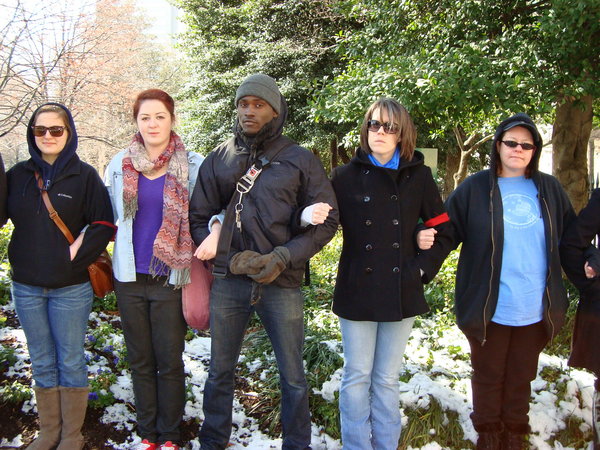
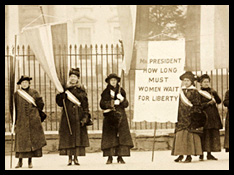
Silent Sentinels Past and Present

via Maddow Blog.  Here are photos of demonstrators outside the Virginia state capitol earlier this week. They are protesting a bill that would require women seeking an abortion to first undergo a medically unnecessary transvaginal ultrasound.

According to their Facebook page:

The Capitol ground rules say that we cannot assemble, hold signs, chant, yell or protest. We think silence in the face of this struggle and their unconstitutional rules presents the strongest response to their assault on women. Please come out and stand up for our rights and for the rights of all women in VA to choose the best reproductive route for themselves. These people are used to signs, yelling, chanting etc. It is not new. They are not used to silently being stared at and having to look us in the eye. It gives us the power.

I’m about to do my annual screening of the HBO film “Iron-Jawed Angels” that describes the actions of the “silent sentinels” by the radical women’s suffrage organization the National Women’s Party:


Help Save Rutgers-Camden

Dear Readers,

This post is by my friend Janet Golden at Rutgers University Camden.  Please help save her campus and sign the petition.

———————

My life as a historian scholar-teacher came to an abrupt end last week when New Jersey Governor Chris Christie announced that he was going to amputate my university Rutgers Camden and hand it over to Rowan a comprehensive university 20 miles away.  At that moment I became the historian-activist-scholar-teacher and began working 14-hour days to save my University alongside my wonderful colleagues and students, our staff, our proud alums and the many residents of Camden, one of America’s poorest cities, that we serve and assist in so many ways.  My union Rutgers AAUP-AFT has stood up for us, and people from around the world have signed our petition

http://www.change.org/petitions/governor-of-new-jersey-stop-the-rutgers-camden-to-rowan-merger

and I hope you will and will pass it along.

My colleagues have written editorials, given interviews, called the Governor and all our legislators and legislative leaders.  Our students have spoken up, organized, and as I write are preparing to go to Trenton to witness the hearings on the issue that begin on Monday.

Severing Rutgers Camden from Rutgers will weaken the Rutgers University system, it will cost the taxpayers millions and it will deprive the residents of Southern New Jersey the opportunity to get an education from a top quality university that carries a name is known around the world.  More information can be found on our website

http://www.r2rmerge.com/

Please help us by signing the petition and sharing it with everyone you know

http://www.change.org/petitions/governor-of-new-jersey-stop-the-rutgers-camden-to-rowan-merger

If you live in NJ please contact elected officials using the following information

http://www.r2rmerge.com/contact.html

And, if you are a blogger and fellow scholar, please post this blog so others will know about what we are facing and how they can help.

Janet Golden, Ph.D.

Professor of History

Activist