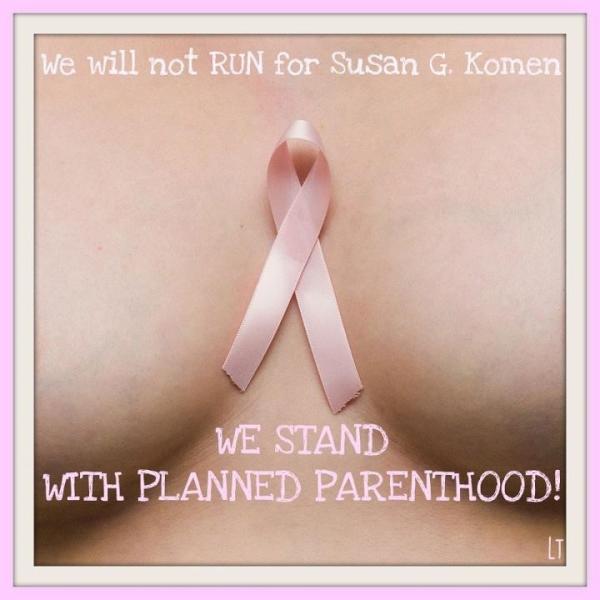
#Komen sucks, support @BCAction

Posted by Lorraine Tipton on Susan G. #Komen Facebook page: http://pic.twitter.com/rHfK54KK

via Huffington Post

As you all saw in my Twitter feed, I’m mighty upset with the Komen Foundation for their decision to no longer provide funding to Planned Parenthood for preventive cancer exams for low income women.

I’ve been a Komen “grumbler” for years but usually bite my tongue and shell out money when folks ask me to contribute “for the cure.”   My gripes include Komen’s support companies that “pinkwash” — i.e. sell products that have been linked to breast and other cancers and save face by selling pink stuff.  They spend a lot of the money they raise on administrative costs (e.g. the VP who pulled the plug on Planned Parenthood funding makes a six-figure salary), and there are doubts about whether the organization “raising awareness” really does anything to improve the survival rate of women with breast cancer.

So, if you really want to support an organization that truly cares about women’s health and is far more effective in fighting the breast cancer epidemic, then give your money to Breast Cancer Action (and Planned Parenthood because they need it.)

Blog for Choice Day 2012

via NARAL Pro-Choice America

Today is the 39th anniversary of Roe v. Wade  and the seventh annual Blog for Choice day. This year we’re being asked to give our thoughts on the following question: What will you do to help elect pro-choice candidates in 2012?

One of the main things I plan to do is to try to overcome my students’ complacency on this issue. The talk I just gave at the Dittrick Museum was very well-received and there were a lot of students in the audience (there is an active Planned Parenthood campus affiliate at Case Western). I reminded them that the ground is shifting beneath them and anti-choice groups are chipping away at reproductive rights by going after the most vulnerable groups (e.g. adolescents, the poor, i.e. folks who don’t or can’t vote). I plan to do the same with my students this semester.

I was relieved that HHS Secretary Kathleen Sibelius, along with President Obama, finally showed some back bone and required insurance companies to cover contraception without mandating co-pays, just like any other preventive service. Of course, this has angered Catholic leaders, and Fox News, among others.  They haven’t quite redeemed themselves in my book, but they certainly are better than any of the Republican candidates.

Related note — I went to the Rock and Roll Hall of Fame while in Cleveland.  The Women Who Rock exhibit wound up being rather one-dimensional, i.e. lame, (does every exhibit about women have to be pink?!)  Still it was worth it to see Joan Jett’s black leather jacket with all the pro-choice and anti-rape buttons on it (where can I find one that says “Pro Fucking Choice”).  So, I guess another thing I’ll do to help pro-choice candidates get elected, I’ll ask myself whenever I see some anti-choice b.s. come my way, What Would Joan Jett do?

Happy (belated) New Year, Off to Plug the Book

Happy belated New Year to everyone!  After traveling hither and yon for the holidays, I’m about to head to Cleveland to give a talk on my book at the Dittrick Medical History Center.  If you’re in town and have nothing better to do, come and check it out.

The talk is basically done — but I’m still trying to figure out how to work this story about a CVS in Texas that refused to sell emergency contraception to a man who was getting it for his wife.

Knitting Clio is now on Tumblr

Hi readers,

As if I didn’t have enough social media accounts, I’ve set up a Tumblr account as a gallery for my actually knitting projects.  It shows my latest RFO (recently finished object).  It’s called the Sublime vest because it’s made with Sublime organic merino wool.

#HERVotes Blog Carnival: Extend Unemployment Insurance!

via HERVotes.

Why extend benefits, you might ask?  Isn’t the unemployment rate down? Well, yes the overall unemployment rate decreased from 9.9 percent to 8.6 percent.  However, according to the Bureau of Labor Statistics and the National Women’s Law Center, the unemployment rate for single mothers was 12.4 percent, up from 12.3 percent in October 2011 and 11.7 percent in June 2009. And African-American women’s unemployment rate in November was12.9 percent, up from 12.6 percent in October 2011 and 11.7 percent in June 2009.   In addition, among women age 20 or over, 5.1 million were officially unemployed and another 2.8 million were not in the labor force but wanted work.  So if there ever was a “mancession” it appears to be over — and the recovery is clearly favoring men.

Now, some of you might be asking — why don’t those single mothers just go on welfare?  Well, let me remind you about the Personal Responsibility and Work Opportunity Reconciliation Act that was passed during President Clinton’s administration.

Debates about welfare “reform”exposed gender discrepancies in our country’s economic safety net.  As historian Linda Gordon observes in her book Pitied but Not Entitled, unemployment insurance was set up within the Social Security act as an entitlement program for (mostly) male workers.  The assumption was that men had to support their families, so they needed the income security that unemployment benefits provided. Initially, larger categories of employment — e.g. domestic service, agricultural jobs — were excluded from the social security and unemployment systems.  These of course were occupations where women and men of color tended to be clustered.

The Social Security Act framed women as objects of pity who needed to have their domestic roles protected.  What later became Aid to Families with Dependent Children (AFDC) started out as “widows pensions” so that women who lost their husbands could support their children without having to work outside the home.  Female recipients were frequently subjected to “morals tests” to ensure they were sufficiently worthy of relief. Later these benefits were extended to divorced and never-married women (and not surprisingly, what was already a controversial program became even more unpopular).

Because of reforms in the 1990s, there is no “welfare” anymore: the program is called Temporary Assistance for Needy Families, with the emphasis on “temporary” — There is a maximum of 60 months of benefits within one’s lifetime, although some states have instituted shorter periods.  How many of these single mothers have already run through the 5 year lifetime limit? What happens when their unemployment benefits run out as well?  The answer isn’t pretty — see the other reports in the #HERvotes Blog Carnival.

Thought Science Would Trump Politics under President Obama? Think Again.

via Reproductive Health Technologies Project, which just sent around the following disappointing news:

“Statement from FDA Commissioner Margaret Hamburg, M.D. on Plan B One-Step

The U.S. Food and Drug Administration (FDA) has been carefully evaluating for over a decade whether emergency contraceptives containing levonorgestrel, such as Plan B One-Step, are safe and effective for nonprescription use to reduce the chance of pregnancy after unprotected sexual intercourse.

Plan B One-Step is a single-dose pill (1.5 mg levonorgestrel tablet) which is effective in decreasing the chance of pregnancy if taken within 3 days after unprotected sexual intercourse.  The product contains higher levels of a hormone found in some types of daily use oral hormonal contraceptive pills and works in a similar way to birth control pills.

Plan B One-Step was originally approved in July 2009 for use without a prescription for females age 17 and older and as a prescription-only option for females younger than age 17.  In February 2011, Teva Women’s Health Inc. submitted a supplemental application seeking to remove the prescription-only status for females younger than age 17 and to make Plan B One-Step nonprescription for all females of child-bearing potential.

The Center for Drug Evaluation and Research (CDER) completed its review of the Plan B One-Step application and laid out its scientific determination. CDER carefully considered whether younger females were able to understand how to use Plan B One-Step.  Based on the information submitted to the agency, CDER determined that the product was safe and effective in adolescent females, that adolescent females understood the product was not for routine use, and that the product would not protect them against sexually transmitted diseases. Additionally, the data supported a finding that adolescent females could use Plan B One-Step properly without the intervention of a healthcare provider.

It is our responsibility at FDA to approve drugs that are safe and effective for their intended use based on the scientific evidence.  The review process used by CDER to analyze the data applied a risk/benefit assessment consistent with its standard drug review process.  Our decision-making reflects a body of scientific findings, input from external scientific advisory committees, and data contained in the application that included studies designed specifically to address the regulatory standards for nonprescription drugs.  CDER experts, including obstetrician/gynecologists and pediatricians, reviewed the totality of the data and agreed that it met the regulatory standard for a nonprescription drug and that Plan B One-Step should be approved for all females of child-bearing potential.

I reviewed and thoughtfully considered the data, clinical information, and analysis provided by CDER, and I agree with the Center that there is adequate and reasonable, well-supported, and science-based evidence that Plan B One-Step is safe and effective and should be approved for nonprescription use for all females of child-bearing potential.

However, this morning I received a memorandum from the Secretary of Health and Human Services invoking her authority under the Federal Food, Drug, and Cosmetic Act to execute its provisions and stating that she does not agree with the Agency’s decision to allow the marketing of Plan B One-Step nonprescription for all females of child-bearing potential.   Because of her disagreement with FDA’s determination, the Secretary has directed me to issue a complete response letter, which means that the supplement for nonprescription use in females under the age of 17 is not approved.  Following Secretary Sebelius’s direction, FDA sent the complete response letter to Teva today.  Plan B One-Step will remain on the market and will remain available for all ages, but a prescription will continue to be required for females under the age of 17.”

Kirsten Moore, President and CEO of RHTP, told Ms. Magazine:  “We are outraged that this Administration has let politics trump science. There is no rationale for this move. This is unprecedented as evidenced by the Commissioner’s own letter. Unbelievable.” In the same story, Dr. Susan Wood, who resigned from the FDA over the Bush Administration’s decision to Plan B and is currently the former FDA Assistant Commissioner for Women’s Health and associate professor of Health Policy and Director of the Jacobs Institute at the GW School of Public Health and Health Services, issued the following statement: “This decision is stunning. I had come to believe that the FDA would be allowed to make decisions based on science and the public’s health. Sadly, once again, FDA has been over-ruled and not allowed to do its job. I cannot understand why Secretary Sebelius would reach in and overturn the FDA’s decision to allow timely access for all those who need safe and effective emergency contraception.”

In her letter to FDA Commissioner, Secretary Sibelius said that there were “significant cognitive differences” between older adolescents and younger ones So, if Teva’s application were approved, then the drug would be available without prescription or other point of sale restrictions for even the youngest girls of reproductive age (the average age of menarche in the U.S. is 11.1 years). Never mind that only 1% of all 11 year old’s have been sexually active (and for those, “sexually active” usually means rape or incest).

According to what I’ve read and heard from others in the EC world, this is an unprecedented move by an HHS secretary — i.e. none of her predecessors has ever overruled the FDA on a drug application.   (during the George W. Bush administration, the problem was the FDA Commissioner).  Is Secretary Sibelius acting on her own, or is she fronting for someone else? We’ll see.

Update:  If you want to take action on this issue, please sign the petitions at


In addition, here is a statement from Catholics for Choice:

For Immediate Release
December 7, 2011
Media Contact: Adrianne Burke
+1 202 986 6093

Obama Administration Rejects Scientific Evidence and FDA Advice in Maintaining Restrictions on Emergency Contraception

Continues Barriers for Women Seeking to Prevent Unplanned Pregnancy


In a stunning setback for women’s access to healthcare services, President Obama’s Department of Health and Human Services (HHS) has ignored the advice of the Food and Drug Administration (FDA) to ease the restrictions on the sales of Plan B, a method of emergency, or after-sex, contraception. In a rare sign of public dissent within the administration, the FDA commissioner, Margaret Hamburg MD, wrote, “I reviewed and thoughtfully considered the data, clinical information, and analysis provided by CDER, and I agree with the Center that there is adequate and reasonable, well-supported, and science-based evidence that Plan B One-Step is safe and effective and should be approved for nonprescription use for all females of child-bearing potential.” The HHS decision to override this recommendation means that the proposal to remove the pills from over-the-counter status, and permit pharmacies to place them on shelves like other safe and effective oral medications, cannot now take place.


The president of Catholics for Choice, Jon O’Brien, said, “We know that conservative pharmacists around the country have treated women condescendingly, expressed contempt and even denied them access to a safe and legal contraceptive for no medical reason. Now, the HHS has overruled the scientifically and medically sound advice from the FDA that it was perfectly OK to move these pills to OTC status for all women. This is a deeply disappointing decision from an administration that promised us it would follow science and sound medical information in making policy decisions. Increasingly, on issues that women care deeply about, the Obama administration seems intent on taking us back to the future.”
On the #PearlHarbor Anniversary, Remember the Women Who Served

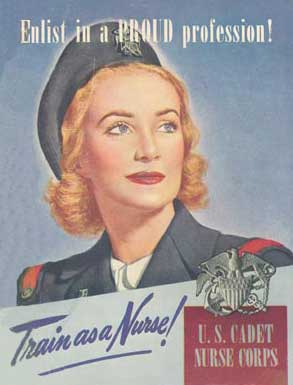
via AAUW, which is requesting that we all  ask our members of Congress to sponsor the U.S. Cadet Nurse Corps Equity Act.  Here’s more from the AAUW website:

“During World War II, the U.S. faced a domestic nursing shortage when many American nurses went overseas to assist with the war. The members of the Cadet Nurse Corps answered our country’s call and signed up to meet the needs of hospitals nationwide and abroad. Despite their sacrifice, the 180,000 women who served in the Corps are not recognized as veterans.

Today, as we remember Pearl Harbor, let us also remember our mothers and grandmothers who saw America’s desperate need for nurses and filled it. Thousands of nurse cadets still live, and they and the families of those no longer with us deserve the honor and recognition of veteran status.

To send a message asking your member of Congress to cosponsor the United States Cadet Nurse Corps Equity Act (H.R. 1718), simply click the “Take Action” link or visit AAUW’s Two-Minute Activist page.”

Now, some of you may be wondering, why are women who served during WWII being denied veterans’ benefits?  Well, because the U.S. Cadet Nurse Corps was not linked with any of the U.S. military service branches.  Here’s more information from a digital exhibit at Rochester General Hospital:

he United States Cadet Nurse Corps was a program established by the Federal government in 1943. Its primary purpose was to ensure that the United States had enough nurses to care for the needs of its citizens on both the home and war fronts. The results of the Cadet Nurse Corps included a dramatic rise in the number of nursing students, a greater public recognition of nurses, and changes in the manner in which nurses were educated and trained.

When the United States entered World War II and defense production had begun, it became clear that there was a dramatic shortage of nurses in the country. Nursing registries were established and an inventory was conducted in 1941. While there were double the nurses available than at the time of World War I, the impending war and defense industry buildup raised many questions regarding the effect of the war effort on both the military and civilian communities. These questions became more pressing as more and more doctors and nurses joined the war effort.

A bill was introduced by Congresswoman Frances P. Bolton (R-Ohio) on March 29, 1943, calling for the establishment of a government program to provide grants to schools of nursing to facilitate the training of nurses to serve in the armed forces, government and civilian hospitals, health agencies, and in war related industries. The Bolton Act was passed unanimously by both houses of Congress and became law on July 1, 1943.

The Division of Nurse Education was established in the United States Public Health Service to supervise the Cadet Nurse Corps and was answerable to US Surgeon General Thomas Parran. Surgeon General Parran appointed Lucille Petry, RN as the head of the Corps.”

In short, nurses in the Cadet Nurse Corps served in the U.S. Public Health Service.  Therefore, unlike nurses who served in the Army or Navy, these women have been denied veterans’ benefits, although they served tours of duty in foreign theaters of war and encountered the same dangers as military nurses.  The same thing happened to Women Air Service Pilots who risked their lives flying military airplanes to war zones (38 of them died in action) but were not “official” members of the military and therefore ineligible for pensions and the G.I. Bill.  Then of course the “hidden army” of women war workers didn’t receive any compensation for their service either.

The Cadet Nurse Corps has been fighting for veterans’ benefits for decades.  The Department of Defense turned down their first request in 1979, and denied subsequent requests in the 1990s.  In an interview for the New York Timesin 2000,  Marjorie Patak complained bitterly about how the nurses’ sacrifices were ignored, excluded from history books, and even turned down for a postage stamp in 1997 after sending hundreds of letters to the Citizens’ Stamp Advisory Committee in Washington.

”They said we didn’t have historical significance,” Mrs. Patak said. ”I was so angry. My grandson told me they even have Bugs Bunny on stamps.”

So, tell your members of Congress that these women’s service WAS significant and deserve the same benefits as men who served.  Remember the women!

On the Second Day of #Advent @myHNN gave me a mea culpa and an offer re: #Adventcalendar

Hello readers,

After my smart-assed post yesterday, David Walsh, aka @myHNN sent me the following message on Twitter in reply to me asking why no fighting women:

@hmprescott Call it a brain fart. I was thinking of Time’s 1950 person of the year, “America’s Fighting-Men,” when I came up w/ the title.

I replied:

@myHNN I’m all too familiar with brain farts, especially this time of year!

He replied:

@hmprescott Actually, I’d love a little help on this. How about a collaboration to find some women’s photos, not from Iraq/Afg–that’s done!

to which I replied:

@myHNN it’s a deal! I’ll post an update on my blog.

So, follow our joint venture at History News Network.


On the First Day of Advent, History News Network Gives Women’s History Bupkiss

via History News Network, where editor David Walsh has decided to “revive an old childhood tradition (suitably modified for the Internet) and bring you the HNN’s 2011 Advent Calendar, this year focusing on America’s fighting men. Every day from now until Christmas, we will feature a new image of American soldiers celebrating (or campaigning) around Christmastime. Follow our updates on Facebook or on Twitter at @myHNN. Happy holidays!”

So, as a corrective, I’m going to start my own damn Advent Hanukkah Kwanzaa Festivus Solstice [insert whatever winter holiday you like here] Calendar of America’s fighting women.  [BTW, Advent started last Sunday, November 27, so Walsh is also late out of the gate on getting that started].  Here’s my first entry:  Deborah Sampson, who “rebelled against the British and society by dressing as a man and fighting in the Revolutionary War for eighteen months under the guise of “Robert Shurtlif” of “Shirtlieff.”

Fellow women’s historians, please do join me in this endeavor.  Seasons greetings!

Blog Carnival: #HERVotes against the Bishops

via Feminist Majority Foundation Blog.  Today the FMF is launching their sixth #HERVotes Blog Carnival to combat efforts by Catholic Bishops to convince President Obama and HHS Secretary Sibelius to expand the refusal clause “to allow some institutions to refuse, under the Affordable Care Act, birth control coverage without co-pays to students and employees of  hospitals, universities, and other institutions, or other religious affiliated or connected institutions such as Catholic Charities.”  This exemption would mean that at least six million women with health insurance will lose their contraceptive coverage benefit simply because of where they work or go to school.

Lest anyone misconstrue this Blog Carnival as “Catholic bashing“, let’s keep in mind that the vast majority of American Catholics support birth control despite the official church position.    In other words, many Catholics believe that reproductive rights are human rights —  like their counterparts mainline Protestant churches (e.g. the  Episcopal Church of the USA) and Jewish congregations, are engaged in the “sacred work” of securing reproductive justice for women.  (this work has a long history — One of the “fathers” of the birth control pill, John Rock, was a devout Catholic; protestant chaplains, and even a few Catholic ones, helped college students gain access to birth control on campuses).

So, take action and help spread the word:  no way to birth control co-pays!