Finally: My report from #SHCY2011

Last month I attended the bi-annual meeting of the Society for the History of Childhood and Youth.  After that, I was fully conferenced out and the thought of writing yet another report was too exhausting to contemplate. So, here at last are some of the highlights — but I’m going to be brief otherwise this will never get done!

My session on Children, School, and Health went well and was well-attended despite being the first panel slot on the first day.  It was also nice to get my paper done and out of the way early.  If you attended and liked (or disliked) what you heard, feel free to comment here.

Later that afternoon, Judith Warner gave the keynote address entitled “The Construction of the Medicated Child” based on her best-selling book, We’ve Got Issues: Children and Parents in the Age of Medication.  As in the book, she deflated the myth that children and adolescents are overdiagnosed and overmedicated for mental health problems.  In reality, many children with mental health issues — especially those who lack health insurance — don’t get good care or worse, get no care at all.  She also reiterated what many scholars in childhood studies have noted about earlier “panics” over issues affecting children (e.g. early motion pictures, television, comic books, and most recently, video games) — that children serve as lighting rods for adult anxieties and social problems that affect the larger culture.

Another important “take-away” came from the discussion following the panel on Childhood in the 1970s.  Lori Rotskoff presented on her work on feminist childrearing in the 1970s and observed that even though feminists were challenging established sexist norms they were still children what was “right” — where is the children’s liberation within women’s liberation, she asked.

I spent most of the conference listening (and knitting) and didn’t take very extensive notes unfortunately.  I also must confess that I skipped the last day so I could attend the Alexander McQueen exhibit at the Metropolitan Museum and see a matinee of “The Normal Heart.” (which was great, but I didn’t like it as much as “Jerusalem” which I saw the night before).

Lesson here — don’t attend so many conferences in so short a span of time!  What was I thinking?

More highlights from #Berks2011

Now that I’ve unpacked and recovered from a full weekend, I’m now ready to fill you in on the rest of my conference highlights:

Friday:

I went to the DuBois Library to check out the University’s Digital History Lab.  I was very impressed by the lay out and state-of-the art equipment in the lab itself but the staff didn’t seem prepared for the open house and just showed us the website.  I could have done that on my own!  Nevertheless, the website is a great introduction to the field.  I then checked out the book exhibit, where I collected a bunch of discount flyers and plan to order way more books than I need or can possibly read!  Then it was off to lunch with my fellow panelists for the first of my Saturday afternoon session (more on that later). In the afternoon, I attended an excellent session, #55 on “Racialized Childhood and Youth: Gendered Visions of the Coming Generation in Transnational Perspective.” A The most useful paper for my work was Zora Simic’s “What Sort of ‘Problem’ is Teenage Pregnancy.”  One of the most interesting points I got out of her talk was the ways in which the “epidemic” of teenage pregnancy described in the 1970s conflicted with the female timetable and aspirations for girls set by liberal Second Wave feminists.  I mentioned a post on Ms. Magazine blog complaining about Forever 21’s maternity line.  The post complained that “With 65 percent of their clientele under the age of 24, the real issue here is the normalization of teen pregnancy.”  Many of the commentators rightly clobbered Ms for that one — some observed that 20-somethings are not teens, some said they would have loved to have fashionable and affordable clothes when they were pregnant at age 19/20, and argued that the whole article did nothing more than shame pregnant teens.  Finally, one teenager observed:  ” As a 16 year old girl, I don’t walk into a store see maternity clothes and think ‘I guess it’s time to get pregnant” or “I suppose it’s alright to get pregnant because they’re selling clothes for pregnant women in a store targeted at my age group.’ Just saying.”

fter that, I attended part of session #72, “Researching and Interpreting Feminist Activism of the 1960s and 1970s: an Intergenerational Roundtable.”  The session was packed and a bit uncomfortable because it was in an un-airconditioned room in 80 degree heat.  I only had my iPod with me, so only got out a couple of tweets:

Problems of writing recent history and getting corrected by those who were there #Berks2011

Sheila Rowbotham women’s hist not just great rev moments need to look at stuff in between #Berks2011

It was a good thing I was monitoring the Twitter backchannel, because I almost missed the poster session.  This is the first time the Berkshire Conference has offered this option.  There were lots of great posters, but I also kept running into people I knew, or who wanted to introduce themselves to me, so I didn’t really get to look at any of them in depth.  Tenured Radical has a brief clip of one of the presenters. Next time I hope the conference organizers have more than one day or at least a longer time period than two hours that doesn’t overlap with other sessions.

The highpoint of the day was the blogger meet-up in the graduate student lounge (aka bar)– here’s Tenured Radical at left presiding.  After that, I went to the Green Street Cafe in Northampton for another great restaurant week meal.

Saturday was very busy — I did check out session #82, “Performing the Body,” where Lori Rotskoff’s paper “From ‘Daughters of Maybelline’ to ‘Sisters of Freedom’: Second Wave Feminism, Girls’ Activism and the Politics of Appearance in the United States” made me nostalgic for “Free to Be You and Me” and other feminist children’s programming of the 1970s.

I then took the morning and lunchtime to fine-tune my presentation for session 150, “The Transgressive Body: Young Women as Objects and Agents of Desire”; and my comments for session 154 “In and Out of the Doctor’s Office: Medicine, Health Policy, and Gendered Expectations.”  After that, I was pretty well spent, so met up with some friends to knit and drink in the graduate student lounge followed by another restaurant week dinner at Sierra Grille.

Overall this was an excellent conference — the campus hotel was comfortable, quiet, and affordable.  The conference staff were helpful and friendly and the quality of the sessions I attended were very high.    If you attended the conference, submit your comments at the section of the conference blog called “Think/Learn/Teach/Do,”  If you didn’t attend, I encourage you to attend the next one in Toronto, Ontario in 2014 — this will be the first time the Berkshire conference will be held in Canada.

For other reports, see the ones by the aforementioned Tenured Radical, “Classy Claude” at Historiann (who was unable to attend herself because of a last minute family emergency), and Another Damned Medievalist who calls on future Berkshire organizers to include more pre-16th century sessions.

#BigBerks #Berks2011 First day highlights

Hi folks,

Thought I would post a quick update before heading off to a busy day of sessions and workshops.  I arrived around 2pm.  The campus center and hotel was easy to find but there was no elevator in the parking garage — huh?  How does UMass get around ADA on that one?!

Fortunately, things went splendidly after that.  Got checked into the hotel and conference very quickly (it helps to arrive early!)  Then I attended the session, “Using the Past to Shape the Future: Interpretation at Historic Sites and Museums.”  The major theme of this session was community engagement — i.e. how to be more in touch with the local community and expand civic role by encouraging people in the surrounding area through programming that uses the collections to illuminate contemporary issues. For example, Lisa Junkin from the Jane Addams Hull House Museum said that the site is both a traditional house museum and a place that looks at the “unfinished business” of the settlement movement, such as “what happened to the Progressive era origins and intentions of the juvenile justice system.”  Junkin also cracked that it was easier than expected to start a Sex positive film series at the museum because her director acknowledged that Hull House was “one of the queerest sites in Chicago!”  (e.g. the partnership between Jane Addams and her life-long companion Ellen Starr Jordan).  Rosa Cabrera talked about the Field Museum’s work on collecting stories from immigrant communities in Chicago and how these personal accounts reflect these individual’s environmental values.  For the stories, see their blog.  Vivien Rose from the Women’s Rights National Historical Park also emphasized that women’s history sites, as they have become part of the “establishment” are in danger of becoming too static and need to be more creative about finding ways to connect to their communities (at least I think this was her point — I’m not an expect in museum studies!)

I had to meet some knitting friends for an outing to WEBS (for those who are not fiber freaks this is the famous yarn store in Northampton) so I left towards the end of Dawn Adiletta’s presentation on the Salons at the Harriet Beecher Stowe Center— so by way of apology, I’ll give a big plug for these programs and make an effort to finally attend one myself!

After the trip to WEBS where I used the gift card I received for Christmas, we went to downtown Northampton for dinner where we discovered it’s restaurant week.  We had a huge three course meal at Spoleto for only $21.95.    Now I’ve got to decide which one to go to tonight.

Today I’m planning to go to the Digital History Lab at the library so I can find out what the folks here at UMass are doing, and then copy it for my courses this fall!

Getting Ready for #BigBerks aka #Berks2011

Hi folks,

Like many historians of women I’m getting ready to head off to the Fifteenth Berkshire Conference on the History of Women  at the University of Massachusetts in Amherst on June 9-12.  (See the program here).  Note:  this is a conference on the history of women, not a conference just for female historians — men, both cis and trans, are welcome as well (as are, of course, trans-women).

If you want to meet other women’s historians who blog, come to the  meet-up organized by Historiann.  This will be held Friday afternoon from 5:30-6:30  in the Grad Lounge of the Lincoln Campus. If you consult the campus map on page 27 of the program, you’ll see that the Lincoln Campus Center is also the conference hotel, and is right across the street from Worcester Dining, where you can find your dinner after the meetup.In addition to yours truly, you can meet Tenured RadicalClio Bluestocking, Another Damned Medievalist, Janice Liedl

Now, why am I using this “#” thing in the title of this blog post?  Well, because I’ve set up this blog so that my posts are automatically sent to my Twitter feed (see column at left.  My Twitter name is @hmprescott).  You can follow the Berkshire Conference feed using @Berksconference.  But that’s only part of the Twitter experience.  If you want to find out what other Twitter users are saying, use #BigBerks and/or #Berks2011.

I’m one of the few people who was allowed to appear more than once on the program because a session commentator dropped out.  This is quite an honor — but I can’t help expressing a minor gripe to the conference organizers:  did you have to put both my panels back to back, on opposite sides of campus?!  Otherwise, great job at putting together an impressive program.

Yesterday, I got an important question from Cliotropic, aka Shane Landrum via Twitter (@Cliotropic).   Shane will be attending his first Berkshire Conference and wanted to know what to wear.  He said in a direct message: “Since you’ve attended the Berks before & I haven’t: how dressed-up is it? I’m assuming “tie, no jacket” for presenting but want to be sure.”  To which I replied, ” The Berks are supposed to be casual and I’m fighting those who want to turn it into the AHA. So, shorts, no tie!”  I then tweeted:  “recommended dress code for #BigBerks aka #Berks2011 — casual please! #nottheAHA”

Seriously, the first time I attended the Berkshire Conference, at Douglass College, Rutgers University, in 1990, it was like a summer camp.  Most of the attendees wore shorts and t-shirts — the most dressed up had on sun dresses and casual skirts.  Then I noticed a disturbing trend, starting with the 1993 conference at Vassar — folks were dressing to impress.  There were power suits!  Fancy dresses.  Oh no, we’re becoming the AHA.  Not good!

So, I’m making a plea to all of you who are packing to head off to Western Massachusetts — please think casual casual.  Dress for comfort.  In particular, keep in mind that we are going to have record heat — mid-90s — for the first day or two of the conference, with high humidity.  Unlike other areas of the country, air conditioning is not a standard feature of college and university buildings in the Northeast.  So, don’t assume that the room you’ve been assigned will be cooled to perfection (or beyond — seriously, why do you folks in warm climates set the thermostat at or below 60 degrees — isn’t that considered winter where you are?)  This being New England, the weather will go in the other direction — it cool off by Saturday with showers during the day and perhaps downright chilly evenings.

Okay, enough advice.  Got to finish the comments for my second panel.  Hope to see some of you soon!

Celebrating the anniversary of Griswold v. Connecticut

via Ms Magazine blog. On June 7, 1965, the U.S. Supreme Court issued the decision, Griswold v. Connecticut [PDF] which struck down an 1879 state law “that prohibited the use of contraceptives and made it illegal to assist, abet or counsel someone about contraceptives. Griswold established a constitutional right to marital privacy that, in the words of Justice William O. Douglas, would no longer allow ‘the police to search the sacred precincts of marital bedrooms for telltale signs of the use of contraceptives.'”

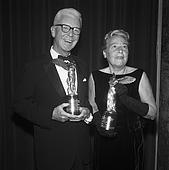
At left is a photo from Corbis.  The image is from an awards ceremony on October 19, 1965.  

Original caption: Dr. C. Lee Buxton (Left) and Mrs. Estelle T. Griswold are shown with planned Parenthood awards they received on October 19, at the annual dinner of Planned Parenthood at the Waldorf Astoria Hotel here. Along with the gold statuettes each gets a scroll and they share the 2,500 Albert Lasker Award of Planned Parenthood-World population.
Now, I’ve always wondered why Dr. Buxton seldom if ever gets mentioned in the commemoration of this event.  I reckon it’s because he was a male doctor, and that just doesn’t fit with the over-simplified narrative of the women’s health movement of women combatting the “evil,” mostly male medical profession.
I don’t want to overdo it and give Buxton too much credit — but what I’ve heard from the residents who worked under him at Yale-New Haven Hospital  is admiration for his willingness to put his reputation and career on the line to fight the state’s restrictions on contraception.  This acknowledgement came even from Virginia Stuermer,  who said that while Buxton was very progressive on issues of birth control and abortion, he was not”so hospitably disposed toward young women who wished to become resident physicians in our department. At a time when the government was scrutinizing the hiring practices of universities which received federal grants(vis-a-vis women and minority groups),our chairman still felt he could ask women residency candidates if they would forego childbearing for the duration of the four-year program. Needless to say,fewwomen became residents during that chairman’s tenure.Today, a preponderance of residents in our department is female. This fact has certainly brought a sea of change in the attitudes of physicians in my field in this community.”  Nevertheless, Stuermer acknowledged that Buxton’s work along with Griswold’s, was “paramount” in the struggle against Connecticut laws banning birth control.  Buxton also was willing to enlist Stuermer and another junior faculty member as clinicians at the New Haven Planned Parenthood clinic.  After the Griswold decision was handed down, Stuermer replaced Buxton as medical director at Planned Parenthood, and abortion became the “next battleground” in the Nutmeg state’s history of reproductive rights.  At the forefront of these efforts were female physicians and law students at Yale.
This “sea change” among women professionals in medicine and the law deserves more attention,.  For a start, see  the essays by Sandra Morgen and Naomi Rogers in Women Physicians and the Cultures of Medicine, edited by Ellen S. More, Elizabeth Fee, and Manon Perry (Johns Hopkins, 2009).

What I Would Want from a History Web Conference

via ArchivesNext.  Those who read my blog know that I’ve been to a couple of conferences lately and have yet to write reports.  I’m about to go off to another next week, and yet another at the end of June.

In an effort to get caught up on what I’m getting out of all this conferencing, I’m replying to questions posed at Archivesnext about “the possibilities of using the popular Museums and the Web conference as a model for something like a History & the Web conference. The concept would be to connect organizations with historical collections and the people who use them to make the web a better place for studying and expanding our knowledge about history. Possible participants and stakeholders could include:

  • organizations like archives, museums, special collections, historical societies, and libraries who have historical collections and build tools to access them, and the people who work in such organizations
  • scholars and researchers who have used materials available on the web in innovative ways or who have built their own tools to promote access to historical collections
  • scholars and researchers who study how historical materials are used
  • educators at all levels who use historical materials available on the Web in their teaching
  • people or organizations from other fields who have projects that can be used as models for the history community (such as the citizen science efforts)
  • students and educators in archival science, library science, museum studies, public history, and history who are studying the use of the web for the study of history

One question that being asked is what would people most like to get out of a conference like this?”

I thought this post was great because I attended Museums and the Web this year and while I thought it was great was very overwhelmed.  It also seemed like there weren’t many participants from history museums and other heritage organizations, and hardly any from history departments with public history programs.  So, I think there is definitely a need for a separate place to address the interests of this subgroup.  Here’s my reply to the query at Archivesnext:

“The short answer is yes, there needs to be something like this and I think NCPH would be the best venue for this. I also think that in order to get more involved in the field there needs to be some concrete, hands-on training in technical skills. Although I teach a graduate course in digital history, I’m largely self-taught and my skills are way behind those who attend and present at THATCamp and Museums and the Web. I attended the latter this past April and while I enjoyed it I also felt overwhelmed at how little I know how to do, and how poorly I know how to do that.”

There is now a follow-up post at Archivesnext to ask for more concrete suggestions:

  • The objectives or goals for a History & the Web conference should be . . .
  • I think we need a new conference because . . .
  • The audience for a History & the Web conference would be . . .
  • I want to see these activities at a History & the Web conference . . .
  • I would like a History & the Web conference to achieve these outcomes . . .
  • I think the most important thing for the planners to keep in mind is that the event  . . . (for example, be affordable, have an online virtual component, attract international participation, attract diverse participation, have opportunities for informal collaboration, attract as many participants as possible, be small and regional, etc.)

They wanted these all by the end of May, but I was buried in exams and, of course, getting ready for my upcoming conferences!  They only received two replies so far so maybe it’s not too late to join the conversation.

Also, my colleagues at Trinity College is soliciting comments and ideas for Writing History in the Digital Age, an born digital, open-review volume under contract with University of Michigan press.

Two Invitations from Judy Norsigian of Our Bodies Ourselves

Yesterday I got an exciting email from Judy Norsigian, asking me if I’d finished my book on the history of emergency contraception (yes!) and even more thrilling, whether I’d like to guest blog on the history of EC for Our Bodies, Our Blog.  My reply was — you betcha!  (Okay, that’s not exactly what I said but that’s what I meant).  So, here I have an opportunity to plug my work to a larger audience than the dozen or so folks who read Knitting Clio.

The second invitation was to a 40th anniversary celebration of Our Bodies, Ourselves that will be held in Cambridge on October 1st.  Unfortunately I have a prior commitment that day but said I’d spread the word about it.  So, for more information, go here.

Think Before you Knit-a-Boob for Breast Cancer Awareness

via Bust Magazine blog, which announces that on May 6th, Oak Knit Studio (OKS), “a learning and making space devoted to textile arts in Brooklyn, NY, announces the first-ever “Knit-a-Boob” special event in partnership with Breastcancer.org. Knitters of all levels from novice to expert will gather on Friday, May 6th, to knit actual, wearable prosthetic breasts for patients and survivors of breast cancer, who have lost their breasts to the disease.

Breastcancer.org, the world’s leading online resource for breast health and breast cancer information, will lead live information sessions throughout the day, briefing participants on the latest in breast cancer treatment and prevention.  The organization will also be accepting the knitted prostheses, and will distribute the handcrafted boobs to those in need.”  The pattern for the boobs “was inspired by Beryl Tsang, a knitter who developed the pattern for herself while undergoing her own treatment. Beryl found her knitted prosthesis to be a much more comforting, and light-hearted alternative to other prostheses that she was offered, and it later inspired her to start the website www.titbits.ca, which offers custom knitted breasts.”

When I first saw the link to this on the Ms. Magazine blog I was all over it — I’m a knitter, I like nice yarn, I’m a feminist, I have boobs, what’s not to like?  If I hadn’t already planned to go up to Vermont to visit my Mom for Mother’s Day I’d be tempted to go (except that I also have piles of papers to grade — I hate it when work gets in the way of my hobbies!)

I still think this a worthwhile event since the boobs will be donated to survivors, but let’s reflect on what kind of “awareness” is being raised.  In a guest post at Breast Cancer Action‘s campaign  Think Before You Pink™, Anna Rachnel describes “The Dark Side of Pink Awareness”:

The color pink and the pink ribbon have become the ubiquitous and saleable trademarks of breast cancer awareness and the associated pink fundraising machine.

Through canny marketing, cutesy slogans, pink imagery, and campaign after campaign, we hear the pink awareness messages loud and clear.

Early detection saves lives.

Education saves lives.

Pink ribbons save lives.

BREAST CANCER AWARENESS SAVES LIVES.

But what is breast cancer awareness?

According to Wikipedia, breast cancer awareness is defined as

“an effort to raise awareness of breast cancer and reduce the disease’s stigma by educating people about its symptoms and treatment options. Supporters hope that greater knowledge will lead to earlier detection of breast cancer, which is associated with higher long-term survival rates, and that money raised for breast cancer will produce a reliable, permanent cure.”

Rachnel asks, “Is this the definition of breast cancer awareness the public learns about through pink ribbon awareness campaigns? ” Her reply is a resounding “no”:


Women and men with Stage IV breast cancer are not the happy-happy-joy-joy-Sheroic survivor stories portrayed in the popular pink culture.  As a community we continue to fight; not only for our lives, but for official recognition by a mainstream breast cancer movement caught in a dangerous rut of pink unawareness. We are tired of our deaths being used by marketers to sell emotionally charged displays of pink, designed to generate both fundraising dollars and profits. Fundraising that the metastatic breast cancer community continues NOT to benefit from.

Breast Cancer AWARENESS? I think not.”

She points out that “this nation’s largest breast cancer fundraising organization, which was largely responsible for the instigation and rise of the pink awareness machine, contributed less than 19% of its total resources to actual breast cancer research in 2010.”

I don’t know much about Breastcancer.org but if you click on their corporate sponsors link, you will find a long list of drug companies and shopping sites where you can buy pink stuff.   How much of the profits raised from pink consumption do these companies donate to breast cancer research?  Can a website so heavily supported by drug company marketing be considered a neutral source of information?  These are the questions we should be asking ourselves.

Meanwhile, I’ve got a bunch of prayer and comfort shawls I need to finish.


Invigorated and Exhausted from American Association for the History of Medicine meeting

I got back from the annual meeting of the American Association for the History of Medicine meeting yesterday as as usual am bursting with ideas and buried in work.  So, this will be quickie overview with more reflection and analysis at a later date.

First, I’d like to report that my forthcoming book  (cover photo at left) is moving much closer to actually being out.  I received the page proofs about a week ago and am working on getting them back ASAP.  Unfortunately the editor decided not to have them available at the meeting because they aren’t corrected — but there’s always next year.  Hopefully they will be available at the Berkshire Conference of Women Historians next month.

Meanwhile, I got an opportunity to plug my book and establish myself as an authority on the “morning after pill” in an interview for a documentary by Caryn Hunt, President of the Philadelphia chapter of the National Organization for Women.  It was a lot of fun and I wasn’t as nervous as I expected.  Also, I got a new suggestion for a doppelganger. Thanks,  I agree!

My presentation on The Pill at 50: Scientific Commemoration and the Politics of American Memory went very well and I had a substantial audience (at least 30) despite it being on first thing on the last day of the conference.  The reaction was enthusiastic (especially from this leading authority on the history of the Pill) so I’m planning to expand this and submit it to the Bulletin of the History of Medicine.

Since I’m teaching in a public history graduate program, and living in Connecticut, my “commemorative mania” will continue with some kind of commemorative event celebrating the 50th anniversary of Griswold v. Connecticut in 1965 (which follows soon after my own half-century mark).  Not sure what this will be but the folks at Yale and Planned Parenthood are keen so looks like it will happen.  I also told the editor at Rutgers that I’m interested in doing a narrative history (as opposed to a legal history that uses Griswold as a lead-up to Roe v. Wade rather than an event in it’s own right).  As it turns out, a very distinguished senior historian of medicine and public health was one of the witnesses who testified.  It seems that the New Haven police was willing to shut down the clinic so that birth control advocates in the state could use this as a test case, but they needed evidence that the clinic was dispensing birth control.  This historian was a graduate student at Yale and was one of Dr. Buxton’s patients.  She volunteered to get the evidence (a tube of contraceptive jelly) and then went straight to the police department to turn in the incriminating evidence and give a statement.  When she blurted out that contraception was “women’s right”, the Irish cop asked her, “don’t you mean a married woman’s right?” What a story!

I heard lots a great papers and connect with all my history of medicine buddies.  However, work awaits so I’ll have to continue these conference report later (most likely much later since research papers and finals will be landing on my desk shortly).

Walgreens doesn’t do pap smears but maybe they should

via Gawker, who links to  Stephen Colbert’s hilarious send up of Fox and Friend’s mansplanation about we don’t need Planned Parenthood:

That’s right, because the ladies can get their pap smears, breast exam, and other lady-business care at Walgreens! Colbert advises, “I’m pretty sure they’re between the Swiffer refills and the cat food.  Ladies, just look for the stirrups!”

But seriously, folks, why not let Walgreens (and CVS and other retail drugstores) expand their “minute clinics” and such to include, at the very least, pelvic exams and blood pressure screenings?  That way, women don’t have to make a doctor’s appointment to get a prescription for oral contraceptives.  [hmm, perhaps I should bring this up with the OCs OTCs Working Group] One stop shopping, right? After all, Kmart offers aneurysm screenings, so why not?

Update 4/15/2011: Ms. Magazine blog reports that tomorrow, “women will be taking Doocy and Kilmeade’s advice, and visiting Walgreens in search of pap smears. Planned informally by a group of friends, the Flash Mob event hopes to ‘raise awareness about the absurd and dangerous attempts to deny access to critical health services to women across the country,’ says organizer Courtney Berner. The event is not, Berner emphasizes, an attack on Walgreens or its employees, and she urges participants to “be respectful of all Walgreens employees.” Of course, Flash Mobbers should also understand that the answer to their pap-smear requests will probably be “no.” Indeed, the Walgreens health-care clinics’ spokeswoman, Lauren Nestler, told Media Matters earlier this week that “Neither Walgreens, nor its in-store health-care clinics, Take Care Clinics, offer pap smears or breast exams.” However if Congress plans to defund Planned Parenthood, Fox & Friends says Walgreens is our best bet.”

Ms. Magazine says that “to participate in the Saturday event, find a Walgreens near you and show up on Saturday at noon with a video camera. Ask politely for your pap smear and see/film what happens.Videos can be submitted to the YouTube channel WalgreensPapSmear or emailed to walgreenspapsmear@gmail.com. Tweet your mission using the hashtag #papsmearplease. If Fox & Friends is right, you should be set up in stirrups in no time.”