Bunnies take on the FDA over emergency contraception

via Center for Reproductive Rights.

One year ago, on March 23, 2009, a federal court ruled that the U.S. Food and Drug Administration must reevaluate its decision to limit access to emergency contraception to women age 17 and older.

In its decision in Tummino v. von Eschenback,  the Court found that the FDA “acted in bad faith and in response to political pressure” and ordered the agency to reconsider the age and behind-the-counter restrictions to emergency contraception.

According to the Center for Reproductive Rights:

“These intrusive restrictions, unprecedented for drugs with over-the-counter status, make it harder and more stigmatizing for consumers to get the contraception during its most effective window.”

Here’s how the bunnies put it:

Just a side note — this video is rather interesting in terms of the history of girls and the material culture of contraception (which I’ve been asked to write about for a edited volume on girls and material culture entitled Material Girls.)

Tell the FDA to respect the scientific evidence and move quickly to end restrictions on emergency contraception!

Take Action!

Share the video through Vimeo or YouTube >

Scarleteen Founder Conducting Survey on Casual Sex | Our Bodies Our Blog

via Our Bodies Our Blog.  At the request of Judy Norsigian (whose visit to CCSU this week was fabulous)  I’m posting this announcement:

Heather Corinna, founder and editor of Scarleteen and author of S.E.X.: The All-You-Need-to-Know-Progressive Sexuality Guide to Get You Through High School and College, is doing a large study on multigenerational experiences with and attitudes about casual sex. The data will ideally be used for publication, but answers are completely anonymous and will only be used anonymously.

In contrast to a lot of the hype and stereotypes about “hooking up,” Corinna is looking for what’s real, both in sexual attitudes and experiences among a diverse array of ages, genders and sexual identities, races and sexual ideologies/constructions. The only requirements for participating in this study are being over the age of 16, and having had some kind of sexual partnership before, even if none has been casual. The study takes around twenty minutes.

Corinna would like the study to show as diverse an array of people as possible, especially since so often media representations or cultural conversations about casual sex are usually only about heterosexual white women or about gay men. She particularly wants to be sure LGBT people, people of color, those over 45 and social conservatives are adequately represented, so please share this link with your networks after you take the survey yourself, especially if your networks include people in any or all of those groups.

To take the survey, visit http://www.surveymonkey.com/s/S97WR6H.

Blog for International Women’s Day

Today is International Women’s Day, and this is my blog post for Gender Across Borders’ Blog for IWD.  This year’s theme, set by the United Nations, is Equal rights, equal opportunity: Progress for all.”  In answer to the questions posed by GAB:

What does “equal rights for all” mean to you?

For me, equal rights means equal economic rights — equal pay, the ability to have a decent standard of living, affordable and accessible health care, including contraception and abortion.  However, it  DOESN’T mean a marketing opportunity to sell stuff to the “ladies”.  From Susan Campbell’s blog for her book, Dating Jesus:

“similar to Washington’s Birthday (where car sellers honor our first president by saying things like “I cannot tell a lie: This is the lowest price you’ll find.”), IWD has become a special window through which to hawk products.

Check out Feminist Peace Network’s wall of shame here. Note particularly the special deals on Hot Russian Brides, in honor of the day, March 8.”

Describe a particular organization, person, or moment in history that helped to mobilize a meaningful change in equal rights for all.

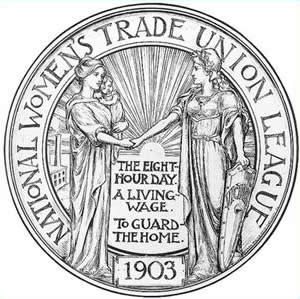
There are so many — how does one choose?   In my introductory remarks for our annual women’s history month celebrations, I point out that International Women’s Day began as a day to honor and promote the rights of working women.  So, I choose the Women’s Trade Union League as my example of promoting economic rights for all.  This organization demonstrated the emerging political awareness and activism of working women during this time. It was also an example of cross-class cooperation between women in the early twentieth century, a time of social and political reform tied to Progressive movement and the campaign for women’s suffrage.  The annual May Day celebrations by labor leaders served as a model for IWD.  Historically May Day (May 1st) celebrated the arrival of spring.  In the 1880s, labor leaders adopted May 1st to promote the rights of workers — and most of the time this meant the rights of men to earn a “family wage” so that their women did not have to work to support their families.  Male labor leaders criticized the women’s suffrage movement as a “bourgeois” agenda to consolidate the power of the middle and upper-classes (and given the elitism and nativism of some suffrage leaders, this claim was not unfounded).

However, it’s important to recognize the ways in which middle-class suffrage leaders recruited working-class women to the cause of suffrage and how both fought together for better wages and hours for working women.  Here’s their symbol:

The Socialist party in the U.S. created a Women’s National Committee to Campaign for the Suffrage, which held their first mass meeting on March 8, 1908.   Middle-class women participated in strikes and other protests by working women.  For example, during the Uprising of 20,000 in 1909, college girls who wore shirtwaists and the striking garment workers who made them walked arm in arm down Fifth Avenue to protest for working women’s rights.   The success of women labor leaders and their supporters led to the creation of International Women’s Day in 1911.

Unfortunately, the Red Scare of the 1920s, and later McCarthyism in the 1950s, targeted leftist women’s groups in the United States.  While other countries continued to celebrate International Women’s Day, the United States didn’t until Second Wave feminists in the 1960s revived the event.   Radical Women, an organization that emerged in Seattle, Washington, are a prime example of how some women’s organizations in the U.S. revived this link between women’s rights and economic and social justice for all women.  Here is Radical Women’s statement for this year’s IWD celebration:

“Women now, just as they did one hundred years ago, hold a unique economic and social position in society – oppressed in the home and super-exploited in the workplace. Women suffer more frequently from poverty; they labor long hours at home, raising the young and nursing the aged and sick; and they often also perform double-duty outside the home, working for lower wages than their male counterparts. This harsh reality makes women the best and toughest leaders of movements fighting for social and economic justice. In other words, women always have everything to gain and little to lose by organizing for a better world. As the South African song proclaims, “When you strike a woman, you strike a rock!”

Rebellion by women against an unjust global economic order is very much alive. In Iran, women are revolting against a thoroughly bankrupt, oppressive regime; in Gaza and the West Bank, Palestinian women are organizing an international boycott of Israel; in Italy, France and Spain, immigrant women went on strike against xenophobic racism; in Australia, feminists convened a national conference to coordinate and re-energize the abortion rights movement; in Mexico, women staunchly defend striking mine workers who fight for basic labor and human rights.

In the United States, queers and their allies are agitating for equality in all aspects of life. On university and college campuses, young women are organizing strikes and conferences in answer to the draconian cuts and tuition hikes that politicians of both parties are implementing to balance shrinking state budgets.

Radical Women in the U.S. and Australia is in the thick of these fights. Over the past year, members have also campaigned for fully-funded health care and other human services; helped pass laws to tax the rich and corporate profits; defended clinics and protested for reproductive freedom; organized to stop raids by Immigration and Customs Enforcement (ICE); raised money for our sisters and brothers in Haiti, who are rebuilding their homeland; and much more.

On this 100th anniversary of the declaration of IWD, the issues may have changed, but the nature of the struggle remains the same. Like the socialist women who founded IWD, Radical Women believes the movements for social and economic justice must be independent and anti-capitalist to realize their full potential. Independent because it doesn’t matter which political party holds power if they aren’t accountable to the workingclass majority. If women are ever to achieve equality, we must cut the ties to politicians who demand our votes and hard-earned money, but give little, if anything, in return.

Our movements must also be anti-capitalist and tackle head-on the bankrupt economic system that pits nations and peoples against each other in a dog-eat-dog race to the bottom so that a tiny minority can exploit the earth’s resources and human labor for private gain. The day the world’s peoples turn this “free” market pyramid upside down will be a great advance along the path of achieving full equality and quality of life for all of humanity.

So, on this March 8, Radical Women unites in solidarity with all our sisters and brothers around the world who are marching, protesting, and raising their voices to win a socialist future where all people have not only bread, but roses too!

Margaret Viggiani
Radical Women
National Executive Committee
www.RadicalWomen.org

National Radical Women
625 Larkin St. Ste 202, San Francisco, CA 94109
Phone 415-864-1278 ● Fax 415-864-0778
RadicalWomenUS@gmail.com
Disability oppression: Disabled African University of Florida graduate student shot by university police

via Gainesville.com.  I’m very disturbed by this case, but not for the same reason as University Diaries, who  includes this with other cases of “delusional” students.  Here are the facts of the case that UD reports:

“Police first met with [Kofi] Adu-Brempong [an international student from Ghana] on Monday to check on him after a report of possible emotional problems. Geography professor Peter Waylen had contacted police to say Adu-Brempong had sent an e-mail with troubling statements, which were redacted in the police report. Waylen told police Adu-Brempong had been having delusional thoughts for at least a year and that he previously had received help from a UF counselor because he believed the U.S. government was not going to renew his student visa, the report stated. … Waylen and an officer spoke Monday with Adu-Brempong at his apartment. “I asked Adu-Brempong if he had any concerns that I could help with. Adu-Brempong advised that he was fine and did not need anyone’s help,” Officer Gene Rogers wrote in the report. “I advised him that Waylen and I were concerned for his safety and were there to assist him any way we could.” The report states Adu-Brempong refused help from a counselor and stated several times that he was fine.”

My first reaction was — why is it “delusional” for an international student to fear that he would lose his student visa?  Seems like a pretty reasonable fear to me.

Other facts not included in UD’s excerpt:  the student is 5′ 8″, 150 pounds, and because of a childhood bought with polio, needs a cane to walk.   According to the local papers, the student had called 911 because he didn’t believe that the men outside his door were really police officers (keep in mind that in some foreign countries distrust of police is justified).

In other words, it appears that the U of Florida campus police used deadly force against an African man who, in addition to being in a disturbed mental state, was no physical match for five police officers.

I agree with this op-ed from the Independent Florida Alligator.  This is  a clear case of disability oppression, and a racist one at that.

Update:  The student’s brother, Dr. Kwame Obeng, contends that this is a case of police brutality.  Students at UF held a protest rally on Friday.

Oh, by the way, it’s women’s history month

via Tenured Radical, who announces that one of my former profs., Mary Beth Norton, Mary Donlan Alger Professor of History at Cornell University, and distinguished member of he Berkshire Conference of Women Historians, will appear on the new NBC series, “Who Do You Think You Are?”  this Friday, March 5, at 8pm EST.  Norton is the author of In the Devil’s Snare: The Salem Witchcraft Crisis of 1692 (Knopf, 2002) and will tell Sarah Jessica Parker of Sex and the City fame about her Salem witch ancestor.  Norton is also descended from a Salem witch.   Can’t wait to see how this turns out.   MB is a real hoot — this should be very entertaining.

It’s not just in our heads, or the reality of mental illness

During the past week, I’ve read several articles discussing the alleged excesses of the psychiatric profession.  One of the most annoying is this one by Edward Shorter in the Wall Street Journal.   Although I agree with Shorter’s critique of the shady practices of some pharmaceutical companies, he goes too far in claiming that anti-depressants are nothing more than placebos (Irving Kirsch makes the same argument in The Emperor’s New Drugs).  As I said in my comments over at University Diaries, I’d really like to see Shorter’s evidence for all these claims [especially the dubious one that benzodiazapenes are not addictive]. While there may be some truth to the argument that psychiatric disorders are overdiagnosed, he hasn’t presented very solid evidence that this is the case. Readers should also know that he’s a strong proponent of electroconvulsive therapy — which may have its uses in intractable cases but has serious side effects of its own.  How is the direct-to-consumer advertising for anti-depressants any different from those for other drugs? I’m a critic of Big Pharma too — but Shorter throws out the good with the bad. I really don’t appreciate Shorter’s implication that I’m a fool for taking SSRIs. If Shorter had made this argument about treatments for arthritis or diabetes, would anyone take him seriously?

Shorter is not a scientist: like me, he’s a historian of medicine. He has no experience treating patients with mental illness. He’s made similar claims for patients with fibromyalgia and chronic fatigue syndrome — basically saying that these diseases are not real but all in the heads of the patients (a large percentage of whom are women — in other words, women are stupid.  For an excellent feminist critique of this view, see FWD/Forward).   There needs to be a middle ground between critiquing the pharmaceutical industry and acknowledging the reality of mental illness. Unfortunately this is not a sexy enough topic to attract the attention of the mainstream media.

NAMI Stigmabusters Alert: The Crazies and Shutter Island

NAMI StigmaBuster Alert: February 25, 2010

Different Movies, Different Strategies

Last weekend, Shutter Island was released. This week it’s The Crazies. They are two very different movies. Different movies require different strategies. In a previous alert, we asked for ideas.

The Crazies

It’s a science fiction horror film and remake of a 1960s cult classic. It has nothing to do with mental illness in the real world, but links an extremely stigmatizing title to an extremely stigmatizing plot. A town’s water supply is infected by a mysterious toxin turning people “insane” and violent. Those who are unaffected have to fight their way out or die from “the plague or the military.”

Language + stereotype = stigma. The plot is so extreme and disgusting that many people won’t take it seriously. Protest may seem ridiculous or only help sell tickets by giving the film more publicity-except it is an example of the most outrageous kind of stigma.

What’s sad is that Chris Albrecht, president & CEO of Starz Entertainment, which owns Overture Films, the studio that produced the movie, is “a long time advocate” for homelessness and children’s health. He has raised funds for Los Angeles’ Shelter Partnership and co-chaired a $250 million fundraising campaign for Children’s Hospital in Los Angeles.

Send Them a Message

Please contact Mr. Albrecht to express disappointment that he is even remotely associated with a movie that undermines everything he stands for. Please send a copy to Los Angeles’ Children’s Hospital.

Mr. Chris Albrecht
President & CEO
Starz LLC
8900 Liberty Circle
Englewood, CO 80112
Feedback e-address

Gail L. Margolis, Esq.
Vice President, Government, Business & Community Relations
Los Angeles Children’s Hospital
4650 Sunset Boulevard
Los Angeles, CA 90027
Hospital feedback e-address

Tell Overture Films that the film’s title and linkage of violence to the buzzword “insanity” stigmatizes people with mental illness. The U.S. Surgeon General has warned that stigma and stereotypes, like the ones they have generated, are a barrier to people getting help when they need it. The company now needs to help set the record straight by funding public education on mental illness.

Mr. Chris McGurk, CEO
Overture Films
9242 Beverly Blvd, Suite 200
Beverly Hills, CA 90210
(424) 204-4000
E-mail address for comments

Shutter Island

This one is a serious film with megastars, but its significance may be lost in too many dark or disturbing images. StigmaBusters have hated the promotional advertising, but those who have actually seen the film are split.

The story is about a 1950’s “asylum for the criminally insane” (authentic language from that era), a struggle for recovery and conflict between competing methods of psychiatry at a critical point in history- surgery, medication, and intense psychotherapy. The novel on which the movie is based credits Boston’s McLean Hospital and the book Mad in America, which NAMI NYC Metro once honored, for providing background.

Ask the Company for Help

Ask Phoenix Pictures, which produced the film, to help fight the stigma that surrounds mental illness in 2010 by donating some of the film’s profits to community mental health services in your community. Express disappointment that advertising around the film has been so extreme. If you have seen the film, offer your comments (pro and con).

Arnold Messer
President & CEO
Phoenix Pictures. Inc.
9415 Culver Boulevard
Culver, City, CA 90232
(424) 298-2788
E-mail address for comments

Use Them as a Teaching Moment

Use the publicity that has surrounded both movies to create a teaching moment in your community.

  • Call news editors and feature editors of local newspapers and news directors of local television stations
  • Shutter Island is about 1952. Local newspapers and television have run advertising about the movies. They should also run a story-or a series-about treatment and recovery in 2010.
  • Offer to help arrange interviews with individuals and families affected by mental illness.
  • Write letters to the editor, offer comments on local newspaper and television station Web sites and share short messages through social media like Facebook. Recommend NAMI’s Web site for up- to-date information about mental illness.
  • Remind them that the Surgeon General has reported that most people living with mental illness are not violent. Instead, they are 10 times more likely to be victims of violence.
  • The Crazies is pure stigma. Forget poison water supplies, insanity and violence. Movies like it create a real public health hazard-stigma-that the Surgeon General has warned against.

Out of the Inbox

Because of the large number of StigmaBuster messages received, they cannot all be answered individually; however, we appreciate every e-mail and do review every stigma report and prioritize them for action.

We also appreciate receiving copies of responses. They are important in helping to coordinate strategy and pursue genuine dialogue. You are our eyes and ears! Your help makes a difference!

Please send reports of stigma to the StigmaBusters E-mail address.

Our Bodies, Ourselves Author Coming to CCSU

Hey folks,

One of my women’s history heroines is coming to my campus.  Since this year’s theme is “Writing Women Back Into History,” it’s fitting that we have booked a noted woman author.  Here’s more information:

The Ruthe Boyea Women’s Center and the Committee on the Concerns of Women invites you to purchase your ticket to attend….

The 2010 Women’s History Month Luncheon

Keynote Speaker

Judy Norsigian

co-author of Our Bodies, Ourselves

“Women’s Health and the Media: Sorting Fact from Fiction”

Tuesday, March 9, 2010

12pm

Memorial Hall, Connecticut Room

Ticket Cost: $20.00. To purchase your ticket, contact CENTix at 860- 832-1989.

Meal choices: Beef Tenderloin Gratin, Pan Seared Salmon, Chicken Francais or Vegetarian Tart

__________________________________________________

2pm

Lecture, Free and Open to the Public

Memorial Hall, Constitution Room

Speaker: Judy Norsigian

The Women’s Health Movement: Accurate, Accessible Information on Health, Sexuality, and Reproduction”

Booksigning after lecture. Books can be purchased at the CCSU Bookstore or at the event.

___________________________

Judy Norsigian Bio: Co-founder of the BWHBC and co-author of all editions of Our Bodies, Ourselves, Judy is a graduate of Radcliffe College and an internationally renowned speaker and writer on a wide range of women’s health concerns.  Her interests include national health care reform, tobacco and women, midwifery advocacy, reproductive health, genetic technologies, and contraceptive research.  She has appeared on numerous television and radio programs including Oprah, Donahue, The Today Show, Good Morning America, and NBC Nightly News with Tom Brokaw.

The Myth of Madness and Brilliance

As historian David Gerber observes in an article on the Blind Veterans Association, “positive stereotypes can be as big a burden as negative ones.” Gerber uses the example of the “cliche that the blind are capable of deeper wisdom than the sighted.” Blind disability activists, he writes, “denounce this flattering stereotype, just as they denounce negative stereotypes of the blind as helpless or doomed to live in existential or cognitive darkness.” [New Disability History, p. 313].

I’d like to do the same for the mythical link between  “madness” and “brilliance” that have emerged in discussions of the shootings at University of Alabama. This article from ABC news quotes a number of psychiatric experts who claim that the “insular lives” of professors — especially those in the sciences — makes it easier to hide a mental illness.  For example, according to Dr. Igor Galynker, associate chairman for the department of psychiatry and behavioral science at psychiatry at Beth Israel Medical Center in New York City and professor of psychiatry at Albert Einstein college of Medicine,

“They [scientists] work in solitude and they don’t need to interact in complex social situations and can be paranoid for a long time without someone realizing.”  Using the example of John Nash, the Nobel-winning economist from Princeton, portrayed in “A Beautiful Mind,” [pictured above], Galynker states, “”Brilliant scientists are supposed to be crazy.” Even the Chronicle of Higher Education reinforces these stereotype of the “nutty” genius, declaring academia  a “home to oddballs” and a “petri dish for madness”  because of a “high tolerance for eccentricity.”

I really wish these articles would actually talk to professors in the sciences instead of administrators and folks in HR.  Not only is it a myth that scientists work in isolation — collaborative work is the norm in the sciences — but severe mental illness is more often a hindrance  than an asset to productive work.

I would say the same about Kay Jamison’s “evidence” of  link between the artistic temperament and manic-depressive illness.  While I admire Jamison’s skills as a clinician and her courage in sharing her first-hand experience with bipolar disorder, as a historian I just have to groan at these “pathographies” or retrospective diagnoses of historical figures.

White Privilege and Amy Bishop

via Jack and Jill Politics, who suggest  that the best way to prevent violence in the workplace is not to focus on the weird people, but to treat  privileged white people the same as people of color.  Margaret Soltan has a roundup of Bishop’s violent past.  Would a black female professor have received probation after  punching another woman in the head at an IHOP? Not bloody likely.