Book Club: Unaccustomed Earth

This month’s selection was the critically-acclaimed Unaccustomed Earth by Jhumpa Lahiri. I didn’t like The Namesake as much as I liked Interpreter of Maladies, but a Pulitzer prize winning book is tough to follow-up. So, I was hopeful that the return to short story form would fulfill the earlier promise and I certainly was not disappointed. In fact, I think I like UE better. Although I would agree that she returns to characters of the same background (Bengali, transplants to Massachusetts or thereabouts) this isn’t necessarily a flaw. After all, isn’t this true of Philip Roth, Norman Mailer, or other modern, white, male, middle-class, American-born authors? Or white, female authors like Margaret Atwood or Alice Munro (both of whom I love but who seldom venture far beyond their native Toronto or Vancouver — except into future dystopias in the case of Atwood).

The new book tends to lean more towards the experience of the second generation immigrants than the first two books. Consequently, the themes covered balance between those that are in many ways universal (e.g. relationships between aging parents and adult children, between siblings, husband/wife) and those that are peculiar to the immigrant experience, e.g. assimilation vs. cultural identity — although I would not say these are unique to South Asian immigrants. All the stories were superb — elegantly written and engaging — my favorite was “A Choice of Accommodations” about a married couple (the husband is second-generation Bengali, the wife is white American), who attend a wedding at the husband’s alma mater, where they find their own marriage has, as the husband puts it, “disappeared” as each partner became absorbed in childrearing and the dailyness of their professional and personal lives. This remark, of course, infuriates another wedding guest who leaves their table in disgust. I wonder if this is common, especially in marriages where the focus is so much on the children that the relationship between partners gets buried.

In short, Lahiri just keeps getting better — highly recommended for a summer read or anytime.

Knitting at the Berks

Eleanor Knits

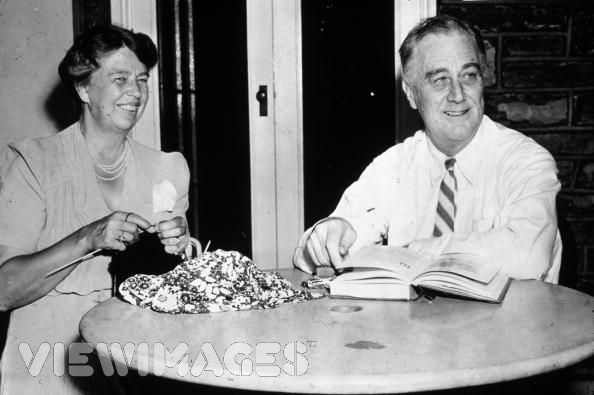
Those of you who attended this year’s Berkshire Conference may have noticed a small cadre of us knitting while listening to sessions. I had intended to bring my digital camera to capture all the creativity that was going on around me, but since I’m an air-head, on Lamictal which makes me more of an air-head, I forgot to bring it with me. So, I’ve substituted the photo above from an American Experience documentary. Apparently, ER used to knit in UN meetings, not just in the privacy of the White House. So, the next time someone gives me a hard time for knitting in Senate or some other faculty meeting, I’ll dig out this key fact.

Knitting at the Berks

Eleanor knits

Some of you who attended the Berkshire conference noticed that there are a few of us, including yours truly, who like to knit during sessions.  I was overjoyed to see that the number of fiber freaks is steadily growing. I had intended to bring my digital camera so that I could capture some of us in action.  However, I’m a forgetful one so, I’ve substituted the one above — apparently the lady herself knitted during U.N. meetings, not just in the privacy of the White House.  So, the next time someone flips me sh*t for knitting in a meeting, I’ll show them this photo.

Berkshire Post-mortem

After I got transferred to a suite at the Holiday Inn, my conference experience got much better! I got to meet Historiann in person — very nice outfits, H! I would agree with her post that the sessions I attended emphasized a need to return to the archives to capture women’s lived experience, not just representations/discourse. Here are some summaries of the sessions I attended:

Session 23: Childhood as Useful Category of Historical Analysis

I led a session similar to this one at the 2002 Berks but this one was much better! Rebecca de Schweinitz argued that the movement for racial equality in the twentieth century was linked with changing ideals about childhood. She discussed the Children’s Charter passed in the 1930s, which extended the notion of a right to childhood beyond the white, middle-classes. This laid the groundwork for the legal arguments in the Brown V. Board of Education decision.

Leslie Paris discussed how the term “girl” became a pejorative term during Second Wave feminism, used by leftie men to trivialize women’s demands for equality. This in turn, she argues, led women historians who came of age during the Second Wave to ignore or underplay the role and place of girls — i.e. non-adult women — throughout history. For example, both Mary Beth Norton’s _Liberties Daughters_ and Kathy Peiss _Cheap Amusements_ prominently feature adolescent females (indeed, Peiss’ subjects are almost exclusively in their mid to late teens) yet their “girlness” and the ways in which their experience differs from that of adult women remains unanalyzed. She also mentioned that the role of girls in Second Wave feminism needs to be more fully explored. Finally, she gave a plug for an edited collection on girlhood that will be published by University of Illinois in Fall 2009.

Martha Saxton argued that the history of childhood has been a “silent partner” in historical scholarship, lurking beneath the surface but seldom analyzed as such. She also stated that historians could benefit from examining relationships between siblings, not just parent-child relationships.

Virginia Ott examined the lives of young women in the Confederate south, looking at the role they played in the construction of Confederate nationalism, as well as the impact of the war on their lives. Her key argument is that young women, like men, sought to preserve rather than challenge the Southern tradition of male chivalry and white ladyhood. At the same time, the war experiences did compel young women to expand the notion of what it meant to be female and Southern.

I found Tamara Myers’ paper on “Space, Place, and Bodies” to be the most useful for my work on the history of the body and sexuality. She looked at the ways in which the evolution of juvenile justice was embodied. What was surprising to me was that in the case of males, the focus was on preadolescent “waifs and strays,” young boys who were “stunted” by poverty and disease — images that inspired sympathy and compassion from the courts and the general public. During the discussion, I pointed out the connections between these images and disability history.

Session 63: Sexual Science Revisited: A Roundtable discussion with Cynthia Eagle Russett

This was the session I was most enthusiastic about attending, since my own work (like others who attended grad school in STS in the late 1980s and early 1990s) was strongly shaped by Russett’s book, which won the Berkshire book prize in 1989. All of the papers examined the ways in which feminists used evolutionary theory for their own purposes, to create what Carla Bittel called a “science” of women’s rights. They also acknowledged the dangers and pitfalls of this tactic — by and large, this was largely a white, middle-class phenomenon (with a few exceptions among the black middle-class), one that reinforced notions of white supremacy and fears of race suicide. Also, by rooting feminist principles in nature and the body, these ideas perpetuated an essentialist view of women with which we are still grappling in the 21st century.

Session 82: Transforming Health Care from Below

This was another fabulous session but by this point I was spending more time listening (and knitting) than taking notes! Jennifer Nelson had the awkward job of talking about leading feminist reproductive rights activist Loretta Ross while Ross herself was in the audience. All of the papers reminded us that theory and activism were connected, especially for women of color — i.e. that feminist perspectives emerged from lived organizing experiences.

Session 131 — Teaching about Health and Contraception outside the classroom

This was the only public history session I attended and I’m glad I did because it was extremely useful. Mary Melcher’s paper on using the Arizona women’s heritage trail to teach about birth control gave me some ideas about how to interpret and present birth control in the state — in fact, should tell the folks at Connecticut Women’s Hall of Fame that birth control and reproductive rights needs to be included in the CT Women’s Heritage Trail. I found Sarah Payne’s paper on “contraceptives on display” most helpful for my (possible) online exhibit on emergency contraception which I hope to get going once I master Omeka.

Finally, there was my Sunday seminar on “What is the History of the Body.” I was pleased to see so many people in the audience — over a dozen, or twice the number on the panel. It was also great to reconnect with Patty Stokes, a former classmate from Cornell — who blogs as Kitty Wampus. The main theme of the session, which is really a microcosm of the conference, is the need to move beyond the “linguistic turn,” to look at the physical experience of living in the body, not just discourse and representations of women’s bodies.

That’s it for now — got to get unpacked, start doing laundry and get back on track with various projects.
Off to a Bad Start

Well, everything was going so well — my flight was on time, got my bag right away, got to the hotel quickly, saw lots of friends, nice dinner. I’m staying in the Holiday Inn for the Berkshire Conference since the U. is paying for the trip and because it’s quieter — except for last night! Some very unfriendly person turned on her TV very loudly after she arrived at 1:30pm, to some Christian show (could hear the preacher praising Jesus through the wall). I’ve had scary encounters when I’ve confronted folks myself, so I called the night manager to ask her to turn down the TV. My instincts turned out to be right, since she proceeded to scream at the manager that it was her right to watch TV, she was paying for the room, yadda, yadda, yadda. After threats to call security she finally shut up and turned off the TV. I was so rattled by the incident that I never got back to sleep. So, now I’m off to the gym. I can suppose I can take a nap this afternoon (although not during anyone’s talk — ha, ha!)

Unfortunately, the Inn is fully booked and I don’t want to sacrifice convenience for some really selfish, for lack of a better word, bitch. I hope she’s not with the conference — but she probably is since everyone else here seems to be. Looks like I’ll be dodging her in the hallway unless I can find another room

P.S.  The hotel upgraded me to a suite at the same price — it helped having Priority Club.  The first day of the conference went very well too, will write more about that tomorrow.

Off to the Berks, with an advance contract

I’m all packed and ready to go to Minneapolis for the Berkshire Conference on the History of Women. Too bad my flight isn’t for another 3 1/2 hours! Historiann has a nice post that gives a brief history of the organization. Tenured Radical wrote some interesting recollections of the recent history of the Berks while waiting for her flight at Bradley, delayed three hours (hope that doesn’t happen to me!) She not only wrote about the “Big Berks” i.e. the major international conference held every three years, but also the “Little Berks” held every year.

Despite living near the Berkshire area, I have never made it to one of these, partly due to schedule, but also partly due to the fact that information about the Little Berks is hard to come by. It’s nice to see that the website is now up to date and gives information about the upcoming one, but I seldom get mailings about this, snail or electronic — shouldn’t this be a benefit of membership? I have a retired colleague, with whom I had dinner last week, who said she received no information about this year’s Big Berks until it was too late to make plans to attend. Anyway, looks like my schedule is free that weekend, I just hope it doesn’t cost a fortune since it’s at the Lakeville Inn in expensive Litchfield County — oh well, at least it’s reasonable driving distance.

I just received great news that Rutgers University Press will be giving me an advance contract for the history of emergency contraception book. Something to celebrate when I get to Minneapolis!

Sticking up for OBOS

Fellow women’s history blogger, Historiann, has had a couple of recent posts on C-sections on her blog. Since those who read Knitting Clio may or may not read this one as well, I’m bringing the discussion over here. Also, I know some of you are members of the Women in the History of Medicine group within AAHM so are well-positioned to offer comments. Historiann’s first brief post on the subject was in response to a report regarding women who had C-sections being denied insurance coverage. I pointed out that the enormous rise in C-sections over the past half-century has really not improved maternal/child health and is really more a product of malpractice litigation and physician convenience than it is medical science. I also pointed to an entry on Our Bodies, Our Blog about the controversy over whether to allow women to deliver vaginally if they had a C-section during a previous delivery. I felt that Historiann was being unfair to OBOS by suggesting that they, as well as other feminist health activists, have “fetishized” natural childbirth while condemning C-sections. I pointed out that OBOS was among the first were among the first to argue that the benefits of C-sections and other birth interventions were overstated at best, and the risks underreported. Sure, not every woman can deliver vaginally, but the risks of infection during C-section (as with any surgery) are not insignificant.

OBOS’ policy statements are consistent with those in Reproductive Health Reality Check and the World Health Organization. Both point out that the United States has the highest percentage of C-sections (nearly 1/3 of all births), yet the worst maternal and infant mortality and morbidity rates in the developed world.

After going back and re-reading OBOS at my suggestion, Historiann wrote another post yesterday, stating that OBOS was more balanced on the issue than she previously thought, but she still thinks their position on anesthesia and pain medication during childbirth is too “ideological.”

I continued to stick up for OBOS, stating that historically and today, the Boston Women’s Health Collective has sought to empower women by providing them with comprehensive information about the pros and cons of various medical procedures and technologies. This was pretty important in an era when doctors — nearly all (93%) of whom were male, even in ob/gyn — were extremely paternalistic and told women (and men) to follow orders for their own good.

Scientific consensus on particular procedures changes over time as well, and OBOS reflects that as well in it periodic updates. I’m not a historian of anesthesiology but I think that warning women of the possible complications of anesthesia for a fetus, however rare, is in keeping with sound medical practice and informed consent. The position of OBOS on anesthesia during delivery has changed with new evidence. Now, the editors of OBOS favor use of nitrous oxide during delivery.

Also, just want to remind you all of Wendy Kline’s article, “Please Put this in Your Book: Readers Respond to Our Bodies Ourselves,” in Bulletin of the History of Medicine, 2005, 79: 81–110. Kline reminds us that the motto of the Boston Women’s Health Book Collective was “knowledge is power,” and by responding to the editors of OBOS, these ordinary women helped shape the feminist health movement — something women continue to do through the blog.

New Bike Club Member

Friday mornings, I usually go for a long bike ride with friends from Eastern Bloc Cycling Club.  Yesterday was a gorgeous day, and two-thirds of the way through our 40 mile ride, we stopped at the Planted Feather Farm and Bakery for some fresh-baked goodies.  Here, we got to meet Ruby the Sow, whom we think would make an excellent club Mascot:  Just don’t “hog” all the energy bars!

Planted Feather Farm and Bakery

School is not an episode of “Survivor”

There are a number of disability blogs discussing this outrageous report of a kindergarten teacher in Florida named Wendy Portillo, who let her class humiliate a five-year-old boy with Asperger’s syndrome. Here’s the brief version:

“After each classmate was allowed to say what they didn’t like about Barton’s 5-year-old son, Alex, his Morningside Elementary teacher Wendy Portillo said they were going to take a vote, Barton said.

By a 14 to 2 margin, the students voted Alex — who is in the process of being diagnosed with autism — out of the class.”

The mother has filed a complaint with the school resource officer and the Florida Department of Children and Families.

Bullying of disabled children by classmates is well known — bullying by teachers is outrageous and unacceptable. If you find this as disturbing as I do, take action and contact the administration at Morningside Kindergarten.

As per Historiann’s request, here is the teacher’s side of the story.   Doesn’t really make her look any better, in my opinion.