via The Trouble with Spikol. There’s a donut shop in Northern California that uses mental illness and an insane asylum as it’s theme. Here’s a sampling of news stories from Fox News, AOL, and ABC News. In addition to naming donuts after various mental illnesses and brain conditions (e.g. “bipolar donut” and “massive head trauma,” the latter of which has incensed veterans groups), the store also has a “padded cell” and “group therapy room” where one can consume the donuts, and offers customers the chance to be photographed in a straightjacket. What fun (not)!
What annoys me the most is that the company calls itself “progressive” — sorry, if you don’t get why persons with mental illness and mental health advocates are offended, you’re not progressive. Would you have a donut called “little black Sambo”? I don’t think so.
Liz argues that there are more important things to be concerned about than donuts. But isn’t battling stigma and fighting for better health care, legal rights, and so forth all part of the same movement? Here’s an excellent article from Stigmanet that puts this is in the context of campus mental health issues.
So, q’est-ce que c’est? (what is it) — offensive marketing campaign or not?
Like others, I’m way behind in my Mad Men viewing — the first disk of Season Two just arrived and I’ve watched the first two episodes. There’s no way I’ll get through this before the season 3 premiere on the 15th so I’ll probably remain a season behind. Hey, I’m a historian, so living the past is what I do best.
The trend of making Mad Men avatars has been on Facebook for a couple of weeks now, but since not all of you have FB accounts, I’m posting mine here as well. [thanks to Historiann for reminding me to do this]. I’ve chosen this scene in celebration of the fact that it’s finally summer in the northeast — i.e. it’s not raining and is relatively warm!
In my own private Mad Men world, this avatar discovers The Feminine Mystique and organizes a consciousness raising group. She then goes back to graduate school and becomes a women’s history prof. Do you think the show will buy it?
I was out of the country during the shit stormnational discussion on race that ensued over the arrest of Harvard University Prof. Henry Louis Gates. The only reason I was aware of it at all is that CNN was the only English channel I could access in most hotels (some had BBC as well), so I caught President Obama’s press conference live. Otherbloggers have written eloquently about this issue so I wasn’t planning to say anything more than “amen.” [Just a note — the BBC anchor who reported on the “Beer Summit” could barely contain his laughter — I thought I was watching a British version of “The Daily Show” until I confirmed from other sources that this indeed was a real event).
This article by my colleague, poet Ravi Shankar, brings the issue close to home. Ravi describes being arrested by NYPD officers for driving home from a poetry event in NYC while being non-white (the arresting officer referred to Shankar as a “sand nigger”). Looks like the Cambridge police officers who arrested Gates are not the only ones who acted stupidly are in need of a Beer Summit at the White House.
On a lighter note — I suggest that we all continue this national discussion on race by hosting our own local beer summits. What brew would you choose? Since I just returned from Eastern Europe, I would pick the Special Lager from the Strahov Monastic Brewery in Prague (although I’m not sure I can find it in the states).
Just returned from an awesome bike trip from Prague to Budapest with Czech Active tours — this was one of the best organized trips I’ve done. The tour leaders are very friendly and laid back. I’d recommend this to anyone who likes to ride and enjoy nice scenery and good food.
Before the trip, we spent a few extra days in Prague. One of my favorite sites was the Toy and Barbie Museum. I hope my buddy Historiann will enjoy looking at the website on the Barbie exhibition, in honor of the doll’s 50th anniversary. Highly recommended for toy enthusiasts and/or fans of Barbie.
Still working on the first day of sessions — here is a companion website for the roundtable on “Entering into the Fray: Historians of Childhood and Public Policy.” I thought Julia Grant’s presentation was especially useful complement to Tenured Radical’s smackdown of Christian Hoff Sommers. The short version — there is a boy problem, but it’s not new and it’s not caused by feminism. Yeah!
Yesterday was the opening day of the Society of the History of Childhood and Youth biennial conference. My panel, Perspectives on Youth and Activism: Authority, Agency, and Activism in 1960s and 1970s went very well. [unfortunately the third presenter on the program could not afford to attend, and her replacement didn’t show and gave no advance notice]. Here’s an overview with my comments on the papers.
“Little Women’s Libbers: Children, Feminism, and Social Change in the United States, 1969-1979” Lori Rotskoff, Barnard Center for Research on Women
Prof. Rotskoff nicely pulls together history of childhood and history of the twentieth-century women’s movement, exploring how children became part of “complex cultural history” of second wave feminism. She has drawn on a rich collection of letters written by girls to Ms. Magazine to illustrate how girls negotiated messages about feminism in the media and sexism in their own lives.
In a longer version of the paper, she gives some caveats about these sources that I think are important to mention here. Like Peter Stearns, she argues that it is difficult to find sources that are completely untainted by adulthood, and that the Ms. letters might have been influenced by adult encouragement and/or adult assistance in getting the letter in the mail.
Her paper centers around three key points: children played an instrumental role in the development and dissemination of second-wave feminism, as feminists used childrearing as an arena in which to construct their egalitarian goals; that children themselves helped spread feminism beyond the organizations and communities within which the women’s movement originated; and finally, the Ms. letters show how the liberal wing of the women’s movement overshadowed radical feminism.
Because I was the same age as some of her correspondents at the time, I thought her discussion of the impact of the “Brady Bunch” episode, “The Liberation of Marcia Brady,” was right on target. I suggest that she look at how shows aimed primarily at adults might have influenced girls at this time – e.g. I remember quite clearly the “Gloria Discovers Women’s Lib” episode of “All in the Family,” in which Gloria gives her mother Edith a copy of the Feminine Mystique and encourages her mother to stand up to Archie. And then there’s the spinoff series Maude, with a catchy theme song comparing its heroine to historical women who shook things up Lady Godiva, Joan of Arc, Isadora Duncan, and Betsy Ross.
A few months ago, I posted an entry on my blog asking what happened to this feminist programming? My guess is that once “women’s lib” was no longer new or exciting, broadcasters moved on to other things.
I also think that “women’s lib” episodes, perhaps intentionally, presented an image of feminism that was slightly ridiculous. Although some of the goals of liberal feminism – especially equality in girls education – did win out, it was at the expense of a more radical challenge to gender roles and assumptions about femininity (and masculinity). This is why we still have a range of consumer products aimed at either boys or girls.
This doesn’t mean that girls (or boys) passively accept these products. Female students in my WGSS class, when asked to name their favorite toys, were as apt to name Power Rangers or Ninja Turtles as they were Cabbage Patch kids.
The gender revolution that Rotskoff hopes for at the end of her paper is definitely happening on the Web. A good centralized source for this revolution is the book Girls Make Media, by Mary Celeste Kearney, which also has a companion blog. In addition to online sources, both Barnard and Duke have huge collections of “zines” produced by girls and women who identified with Third Wave feminism in the 1990s. Despite the growth of the web, girls and women continue to produce these zines, as a form of “DIY feminism.”
“Mass Student Insurrection” or What Happened When Long-Haired High School Students Challenged Authority, 1964-1969”
Gayle V. Fischer, Salem State University
Prof. Fischer’s paper also contributes to our understanding of how children and youth experienced and contributed to social movements of this period. She describes how boys challenged school regulations that prohibited long hair styles. This is another excellent example of how children and youth participated in the cultural phenomena of the “sixties.”
I think it would be helpful to include some background on student struggles for freedom of expression more generally to get an understanding of where this vocabulary of “kids rights” originated. In particular, in what ways did the Tinker v. Des Moines decision in 1969, which declared that constitutional rights to free speech “did not end at the schoolhouse gate” provide the foundation for student cases regarding hair and dress codes?
I would also like to get a clearer understanding of what Fischer refers to as the “1960s definition of masculinity” and why long hair in particular was a threat to that. Conversely, how/why did some argue that long hair epitomized masculinity? I think more was at work here than the boundary between male/female – was there also an element of homophobia her as well? In asserting that masculinity and long hair were compatible, were proponents of long hair for heterosexual men distinguishing themselves from gay men?
Also, in what ways did the older sisters of the “little women’s libbers” described in Rotskoff’s essay help shape this debate about long hair? Were “feminine-looking” men all the more threatening because women too were challenging gender norms, e.g. by wearing jeans to school? Were girls more successful in challenging dress codes, and if so, why? Did long-haired men use any of the vocabulary from the feminist movement – e.g. the personal is political – to justify their right to wear their hair the way they wished?
Fischer may already be doing this in her longer work – but what role did the “peer culture” of mass media play in the popularization of long hair for boys? The “Brady Bunch” first season, broadcast 1969-1970 – Mike Brady and the boys all have relatively short hair. By the second season, all the boys have long hair, and by season three even Mike has longish hair and sideburns. The “Partridge Family” (1970-74) which was even more popular than “The Brady Bunch” also featured comparatively “wholesome” TV characters with long hair. Shampoo, styling gel, and other hair products were also being aggressively sold in magazines aimed at boys and young men. Children’s programming like the Marlo Thomas album and TV special “Free to Be You and Me” not only promoted egalitarian messages for girls, but also encouraged boys to get in touch with their softer side – e.g. football hero Rosie Greer telling boys “It’s alright to cry” and another song about a boy who wanted a doll.
Finally, Fischer could consider some of the points raised by Gael Graham, “Flaunting the Freak Flag: Karr v. Schmidt and the Great Hair Debate in American High Schools, 1965-1975,”which focuses on a lawsuit filed by Chesley Karr in El Paso Texas. Graham shows how the long hair debate needs to be understood within the larger context of the “rights revolution” of this era. She further argues that long hair had distinctive racial meanings. African-American boys and men grew long Afros to free themselves from earlier cultural imperatives to “whiten” their hairstyles. Native American and Chicano men grew their hair to reclaim an ancestral heritage they believed had been destroyed by whites.
Thoughts on Children, Youth, and the Sixties
As a high school student in the late 1970s, I read Joyce Maynard’s memoir, Looking Back (an expansion of her 1972 article for the New York Times magazine), in which she described how she “missed out” on most of the 1960s. “We inherited a previous generation’s hand-me-downs and took in the seams, turned up the hems, to make our new fashions. We took drugs from the college kids and made them a high-school commonplace. We got the Beatles, but not those lovable look-alikes in matching suits with barber cuts and songs that made you want to cry.
They came to us like a bad joke–aged, bearded, discordant. And we inherited the Vietnam War just after the crest of the wave–too late to burn draft cards and too early not to be drafted. . . So where are we now? Generalizing is dangerous.”
I would say that generalizing is even more problematic when describing children and the “sixties” – which many historians have described as a “long decade” stretching from the late 1950s to the early 1970s. Fifteen years ago, the journal Lingua Franca published an article called “Who Owns the Sixties”? This article described a “generation gap” in sixties scholarship, between older baby boomers who had been college students in the mid to late 1960s; and those at the tail end of the boom whose memories of the decade were those of young children and adolescents. One historian quoted in the article, Thomas Sugrue of the University of Pennsylvania, said his most powerful memory of the sixties was not the usual stock footage of Woodstock, but of watching National Guard tanks roll down the riot-torn streets of his Detroit neighborhood in the late 1960s; he was five years old at the time. How many other stories like this are out there but have been neglected because children are considered peripheral to the “movement”?
Historians of childhood and youth have done much to reconsider how our understanding of major historical events – such as world wars – change when viewed through children’s eyes. These papers presented at this session do a great job of doing the same for the complex cultural transformations of the 1960s and 1970s.
————-
In the discussion that followed, Lori reminded us of a number from “Free to Be You and Me” featuring Michael Jackson and Roberta Flack that I had forgotten. Here’s a clip. How ironic in light of the various body modifications Jackson made as an adult. Too bad Brooke Shields couldn’t convince him to love his body.
More sexist crapola from faux-gressive blogs. After I posted my last message on this topic, a friend of mine on Facebook asked if Palin’s resignation and the ensuing blowback has set back women in politics. My answer was that because Palin is a mass of contradictions it may not matter that much. My mistake — Echidne’s tour de sewer clearly shows this is a sign of much deeper misogyny towards female politicians.
Another insightful post from Tenured Radical — I guess my nagging about the word “crazy” worked!
It’s amazing to me why wealthy liberal arts colleges like Zenith have fewer resources for students with disabilities than state universities. Is this an extension of benefits offered in public K-12 schools? Or veterans benefits (we are seeing a number of returning veterans of wars in Iraq and Afghanistan)?
Speaking of K-12 education, here’s a story from today’s Wall Street Journal about efforts to ban use of restraint in public schools, after the GAO found hundreds of allegations of death and abuse since 1990. Who would have thought a student with disabilities would be safter in a locked psychiatric facility than a public school?
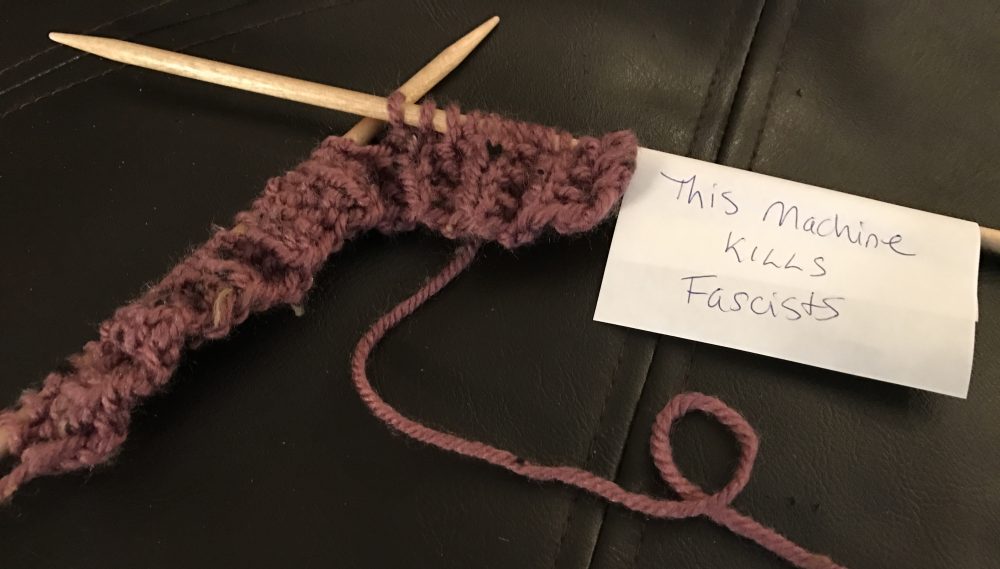
 via The Trouble with Spikol. There’s a donut shop in Northern California that uses mental illness and an insane asylum as it’s theme. Here’s a sampling of news stories from Fox News, AOL, and ABC News. In addition to naming donuts after various mental illnesses and brain conditions (e.g. “bipolar donut” and “massive head trauma,” the latter of which has incensed veterans groups), the store also has a “padded cell” and “group therapy room” where one can consume the donuts, and offers customers the chance to be photographed in a straightjacket. What fun (not)!
 Like
Like  Just returned from an awesome bike trip from Prague to Budapest with
  Knitting Clio