Very twisted — warning, not for children (or some adults either).

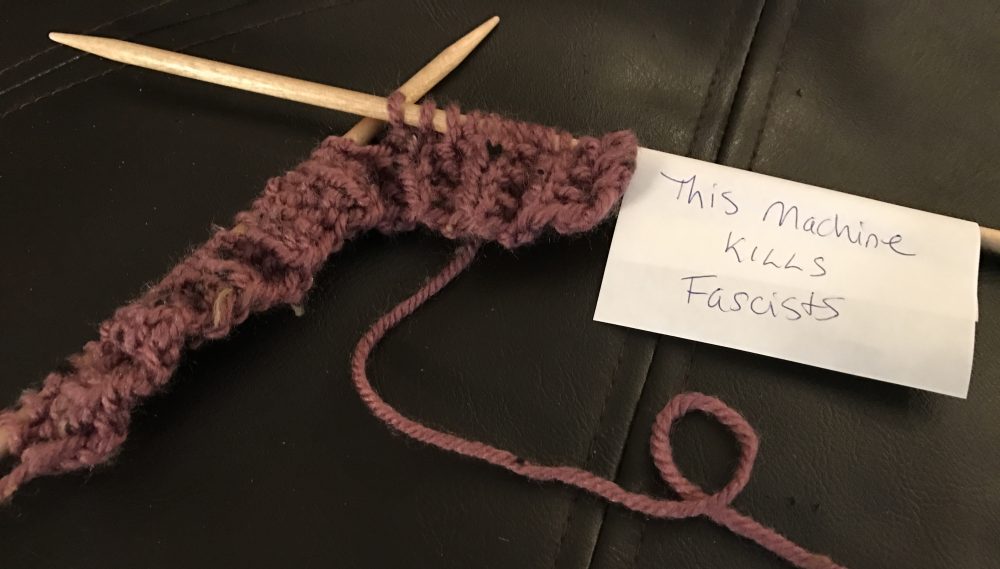
Very twisted — warning, not for children (or some adults either).
 Things have been quite frantic in Knitting Clio land, so I plumb forgot to write a blog post yesterday. Here is a round up of on-time posts from Diary of a Goldfish.
My contributions will be brief. I’m excited about NAMI-CT’s Keep the Promise blog. This Tuesday, May 5th, is Mental Health Awareness Day at the CT state capital. The event is from 10 a.m. – 2 p.m.
Legislative Office Building (room 1E) in Hartford
Please join Representative Walker, Fellowship Place and Keep the Promise Coalition (KTP) at an advocacy event to support expanded housing and health care options, and true community integration for people living with mental illnesses.
Finally, I’ve answered Lizzie Simon‘s call for interview subjects for a WebMD series on bipolar disorder. They’re calling me on Tuesday so may not make it to the capital. I’ll be there in spirit though.
This is my first post on this past weekend’s AAHM meeting, and I’m starting with the pre-meeting of the Sigerist Circle. The topic of this year was the PBS documentary, “Forgotten Ellis Island.” This is a very engaging documentary and I intend to use it when I teach my history of medicine/public health course in the fall.
There were some shortcomings, though. As panelists Alexandra Stern and Emily Abel pointed out, the film doesn’t discuss the millions of immigrants who arrived through the West coast. Also, I think that while the documentary is right to stress that hospital personnel were trying to help those who were treated there, it ends up underplaying the racism and cultural elitism that underlay the whole project.
As one might expect, the hot topic of conversation at this weekend’s meeting of the AAHM was the current swine flu epidemic. As I watched CNN and read newspaper reports, my mind went back not to the 1918-19 epidemic, but the Ford administration. At that time, President Ford was ridiculed for mobilizing a nationwide effort to immunize everyone in the United States against the disease. In a humor article entitled “Swine Flu Over the Cuckoo’s Nest” (May 31, 1976), the New Yorker reported in it’s coverage of the Academy Awards, the Swine Flu virus, ” a relatively unknown virus since 1918,” swept the awards ceremony. Will this epidemic also prove to be a case of Ford Administration deja vu?
 I’m back from the AAHM meeting in Cleveland, so am too lazy busy to write a full post (but I will try to give some highlights of the meeting later this week. Briefly, swine flu was a major topic of conversation). Meanwhile, enjoy this guest post on Wollstonecraft at Historiann.
According to a report in Inside Higher Education that legislation in Missouri and Texas that would allow students to carry concealed weapons on college and university campuses. Meanwhile, students on my campus and at UConn are joining nationwide “empty holster” protests. I share the same concerns raised here and here, yet I’m just as disturbed by comments that refer to gun supporters as “nuts.” This is insulting to both gun enthusiasts and to persons with mental illness. It perpetuates myths that only “crazy” people want guns, and that all “crazy” people are potential killers. Although I disagree with the arguments made in favor of guns on campus, they aren’t “insane.” Furthermore, it’s naive to think that only a “nut” would shoot a professor or fellow student. The Craigslist killer case shows all too well that “clean cut, nice (i.e. white) college guys” can be cold-blooded killers, and their reasons for killing — e.g. spurned affections, bad grades, gambling debts — are quite rational.
So, let’s stop using “nuts” indiscriminately, and focus on these facts about college mental health issues.
Via Historiann. Go here if you want to find out more about yourself and/or other bloggers.
Thanks. This was fun. Feel free to make up more.
I’m a bit slow in getting around to writing about this, but last month the University of Michigan Press announced that it would shift it’s emphasis towards digital publishing, at least for monographs.
I’m not as alarmed by this as some (after all, I teach digital history), but am concerned about what will happen to the paper copies of my book. As mentioned in an earlier post, sales of which have not been great (although they may pick up now that positive reviews have appeared in the lastest issues of American Historical Review and the Bulletin of the History of Medicine. Also, this month, UMP is offering a discount Order online and enter discount code prescott09ump when prompted at checkout to receive 30% off this title).
Perhaps I should offer to remix the book as a piece of digital scholarship?
Since I’m too lazy busy to come up with a blog post of my own right now, I’ll refer KC readers to a fascinating discussion over at Historiann. I commented on the issue of anti-Catholicism in the academy. Having spent most of my life in New England, and my entire career teaching at a state university that is closed on Good Friday, if there is anti-Catholic prejudice I haven’t seen it (then again, I’m not Catholic). Jewish colleagues, though, do feel that our university privileges christianity — I would have to agree. Again, why does a state university close on a christian holiday but none of the Jewish or Muslim holidays?
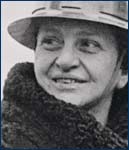 Today at Trinity Collinsville we had a guest sermon by our bishop suffragan, the Rt. Rev. Laura Ahrens [the audio file of the sermon should be up in a few days). She started the sermon by talking about the tragic Triangle Shirtwaist Factory Fire in 1911, the worst industrial disaster in U.S. history up that that point. Being a smarty-pants women’s historian I thought, okay where is she going with this? Well, Prof. Smarty Pants didn’t know that Frances Perkins (pictured at left), witnessed the fire and as a good Episcopilian, was called to find a way to prevent this from happening again. So, Perkins became active in the U.S. labor movement, fighting for the rights of workers in New York State, and later as Secretary of Labor under Presidents Roosevelt and Truman.
Since today is Palm Sunday, the bishop made a link between the horrors witnessed by Perkins, and the horrors of the Passion, asking us what we will do to prevent things like this from happening again. Good question — I guess this is what this week is for, to mediate on such things.
It is a truth universally acknowledged that a single woman must be in want of a drink
Orientalism and Yoga in the 21st Century
is a Vice Provost, Dean, and Professor at Northeastern University
History for the Future
By Norse code
Follow me on twitter: @jmedwards29
Why Do You Write Like You're Running Out Of Time?
A site to think about my academic work the same way I do everything: by overthinking it.
Blog for History 511: Digital History
History in the Digital Age
History Happens
A Group Blog on Early American History
A journal of New England cultural, literary, political, and social history
The latest news on WordPress.com and the WordPress community.
 Knitting Clio