Earth Day and the Pill

As many of you know, today is the 40th anniversary of  Earth Day. Next month will mark the 50th anniversary of the introduction of the contraceptive Pill in the United States.  This afternoon, I’m giving a paper at a conference celebrating 40 years of coeducation at Trinity College in Hartford (conference logo at left) that ties the two stories together.   My talk is adapted from my chapter in this book with some additional material on Connecticut incorporated.  I start with Gloria Steinem’s claim that the “contraceptive revolution” started on college campuses in 1962.  This certainly wasn’t true in Connecticut, where it was illegal for married persons to get contraception.  Even after the Griswold v. Connecticut decision in 1965, individual states did not guarantee that the right to privacy extended to married persons.  The state of Massachusetts explicitly outlawed giving contraceptives to unmarried minors, and Bill Baird was arrested for “crimes against chastity” for giving contraceptive foam to an unmarried students following a lecture at Boston University in 1967.

My paper contrasts the situation at Trinity with that at Yale University, which also went coed in 1969 (actually the undergraduate college went coed; the graduate school already admitted women).  The Yale Student Health Service hired a gynecologist shortly before the college admitted women, out of fears that “that all the young girls descending on campus would get pregnant,” [this quote comes from an interview by Judy Klemesbud, “Yale Students Have Own ‘Masters and Johnson,” in the New York Times April 28, 1971]. Trinity College, however, did not hire a gynecologist but instead sent students to Planned Parenthood or local hospitals.  Female students didn’t like this situation, of course, and formed the Trinity Women’s Organization and organized a women’s week in 1972 to express their concerns that the college was not doing enough to accommodate women.  According to one of the women’s organization’s founding members, sophomore Sara Throne, many women “came here feeling like invaders in a foreign land” since. no one had done anything to make welcoming to women. Male professors trivialized women’s intelligence, there was no gynecologist or woman counselor on campus, no feminist literature in the library, no woman in the athletic department. Instead, said Throne, “We’re expected to fit ourselves into what’s already here.” [this comes from an article by Linda Greenhouse, “Problems Seen in Women’s Bias Fight,” in the Hartford Courant February 13, 1972]

At the same time that Yale and Trinity were going coed, the organization Zero Population Growth was sponsoring teach-ins on college campuses emphasizing the “catastrophic impacts of ever more human beings on the biosphere.” The first Earth Day celebration in 1970 made U.S. human population limitation a major theme. ZPG started a regional group in Connecticut in 1972 in order to lobby for better family planning services in the state and removal of state laws prohibiting abortion. The group actively recruited students at Trinity, University of Connecticut, Connecticut College, and other colleges around the state.

Even though some student organizers emphasized that the baby boom among middle-class Americans was the main cause of “overpopulation” in the United States, the alliance between birth control advocates and ZPG was an uneasy one. Officials at Planned Parenthood Federation of America were especially cautious about the appeal of ZPG on college campuses. Dan Pellegrom, Director of Planned Parenthood’s Program of Student Community Action, told University of Connecticut Biology Professor Nancy Clark, that given the controversial nature of ZPG, and population groups more generally, it was “essential” that Planned Parenthood provide leadership at the ZPG’s teach-ins, and use it as a way to increase student interest in forming campus chapters of PPFA. Pellegrom warned of the dangers of affiliating with ZPG, however. Based on his experience working with black community groups, he had “personal problems” with ZPG, “one, because their rhetoric could be taken by the black communities as genocidal and two, because they seem to be often politically in adept.” [this comes from a letter in the PPFA archives at Smith College]

Planned Parenthood leaders recognized that enlisting the support of black students was essential in establishing the legitimacy of birth control among the African American community, both on and off campus.  One of the earliest college chapters was at Hampton Institute, a historically black college in Virginia.

So, I’m concluding that the “contraceptive revolution” didn’t just happen because the Pill was invented:  students had to organize and demand reproductive health services be provided on campus.  This work continues with Planned Parenthood’s Vox program.

Today is Equal Pay Day!

via American Association for University Women who sends a message from Lilly Ledbetter (pictured below).  After Lilly lost her Supreme Court case alleging pay discrimination against Goodyear Tire, Congress passed and President Obama signed into law the Lilly Ledbetter Equal Pay Act of 2009:

An Equal Pay Day Message from Lilly
Lilly Ledbetter at AAUW Convention
April 20 is Equal Pay Day, the symbolic day when women’s earnings catch up to men’s from the year before.  In honor of this day, I’m joining forces with AAUW and their coalition partners to urge the Senate to quickly pass the Paycheck Fairness Act (S. 182).  And I’m asking you to join us in this fight for pay equity as well.  Make sure your senators know that this legislation is important to you by emailing them now.  As I said at an AAUW conference last year, giving women the Ledbetter Act without the Paycheck Fairness Act is like giving them the nail without the hammer.
Without the Paycheck Fairness Act, women will continue to be silenced in the workplace, just like I was-prohibited from talking about wages with coworkers without the fear of being fired.  This forced silence keeps many women from discovering pay discrimination in the first place.  It happened to me for several decades, and it can happen to you, your daughters and granddaughters, your sisters and moms, and your friends.  Especially in this economy, the fear of being fired is strong enough to keep women from even broaching the subject.
Now I know that some people will say that with times as tough as they are, we can’t afford to worry about pay discrimination now.  But I’m here to tell you that this recession makes pay equity even more important. With women now making up half of the workforce, more and more families are dependent upon a woman’s paycheck to make ends meet.  Ensuring that women are paid fairly is critical – now more than ever.
That’s why I continue to fight for the Paycheck Fairness Act.  While the legislation that bears my name was signed into law over a year ago, the Paycheck Fairness Act still needs a vote in the Senate.  Almost 47 years have passed since the Equal Pay Act was enacted, and I believe it’s past time we make that law live up to its name; Equal Pay Day is a fine time to make that happen.
While my legal battle is long over, I’m still fighting for all the other women and girls out there who deserve equal pay and equal treatment under the law.  Please join me and AAUW, and take a moment on Equal Pay Day to urge your senators to support the Paycheck Fairness Act.  Send a picture of yourself along with your message as well, and show them that we are all, together, the faces of pay equity.
Sincerely,
Lilly Ledbetter signature
Lilly Ledbetter
Here’s how to take action.

Bunnies take on the FDA over emergency contraception

via Center for Reproductive Rights.

One year ago, on March 23, 2009, a federal court ruled that the U.S. Food and Drug Administration must reevaluate its decision to limit access to emergency contraception to women age 17 and older.

In its decision in Tummino v. von Eschenback,  the Court found that the FDA “acted in bad faith and in response to political pressure” and ordered the agency to reconsider the age and behind-the-counter restrictions to emergency contraception.

According to the Center for Reproductive Rights:

“These intrusive restrictions, unprecedented for drugs with over-the-counter status, make it harder and more stigmatizing for consumers to get the contraception during its most effective window.”

Here’s how the bunnies put it:

Just a side note — this video is rather interesting in terms of the history of girls and the material culture of contraception (which I’ve been asked to write about for a edited volume on girls and material culture entitled Material Girls.)

Tell the FDA to respect the scientific evidence and move quickly to end restrictions on emergency contraception!

Take Action!

Share the video through Vimeo or YouTube >

Blog for International Women’s Day

Today is International Women’s Day, and this is my blog post for Gender Across Borders’ Blog for IWD.  This year’s theme, set by the United Nations, is Equal rights, equal opportunity: Progress for all.”  In answer to the questions posed by GAB:

What does “equal rights for all” mean to you?

For me, equal rights means equal economic rights — equal pay, the ability to have a decent standard of living, affordable and accessible health care, including contraception and abortion.  However, it  DOESN’T mean a marketing opportunity to sell stuff to the “ladies”.  From Susan Campbell’s blog for her book, Dating Jesus:

“similar to Washington’s Birthday (where car sellers honor our first president by saying things like “I cannot tell a lie: This is the lowest price you’ll find.”), IWD has become a special window through which to hawk products.

Check out Feminist Peace Network’s wall of shame here. Note particularly the special deals on Hot Russian Brides, in honor of the day, March 8.”

Describe a particular organization, person, or moment in history that helped to mobilize a meaningful change in equal rights for all.

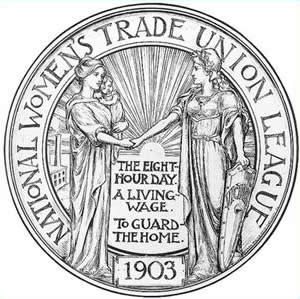
There are so many — how does one choose?   In my introductory remarks for our annual women’s history month celebrations, I point out that International Women’s Day began as a day to honor and promote the rights of working women.  So, I choose the Women’s Trade Union League as my example of promoting economic rights for all.  This organization demonstrated the emerging political awareness and activism of working women during this time. It was also an example of cross-class cooperation between women in the early twentieth century, a time of social and political reform tied to Progressive movement and the campaign for women’s suffrage.  The annual May Day celebrations by labor leaders served as a model for IWD.  Historically May Day (May 1st) celebrated the arrival of spring.  In the 1880s, labor leaders adopted May 1st to promote the rights of workers — and most of the time this meant the rights of men to earn a “family wage” so that their women did not have to work to support their families.  Male labor leaders criticized the women’s suffrage movement as a “bourgeois” agenda to consolidate the power of the middle and upper-classes (and given the elitism and nativism of some suffrage leaders, this claim was not unfounded).

However, it’s important to recognize the ways in which middle-class suffrage leaders recruited working-class women to the cause of suffrage and how both fought together for better wages and hours for working women.  Here’s their symbol:

The Socialist party in the U.S. created a Women’s National Committee to Campaign for the Suffrage, which held their first mass meeting on March 8, 1908.   Middle-class women participated in strikes and other protests by working women.  For example, during the Uprising of 20,000 in 1909, college girls who wore shirtwaists and the striking garment workers who made them walked arm in arm down Fifth Avenue to protest for working women’s rights.   The success of women labor leaders and their supporters led to the creation of International Women’s Day in 1911.

Unfortunately, the Red Scare of the 1920s, and later McCarthyism in the 1950s, targeted leftist women’s groups in the United States.  While other countries continued to celebrate International Women’s Day, the United States didn’t until Second Wave feminists in the 1960s revived the event.   Radical Women, an organization that emerged in Seattle, Washington, are a prime example of how some women’s organizations in the U.S. revived this link between women’s rights and economic and social justice for all women.  Here is Radical Women’s statement for this year’s IWD celebration:

“Women now, just as they did one hundred years ago, hold a unique economic and social position in society – oppressed in the home and super-exploited in the workplace. Women suffer more frequently from poverty; they labor long hours at home, raising the young and nursing the aged and sick; and they often also perform double-duty outside the home, working for lower wages than their male counterparts. This harsh reality makes women the best and toughest leaders of movements fighting for social and economic justice. In other words, women always have everything to gain and little to lose by organizing for a better world. As the South African song proclaims, “When you strike a woman, you strike a rock!”

Rebellion by women against an unjust global economic order is very much alive. In Iran, women are revolting against a thoroughly bankrupt, oppressive regime; in Gaza and the West Bank, Palestinian women are organizing an international boycott of Israel; in Italy, France and Spain, immigrant women went on strike against xenophobic racism; in Australia, feminists convened a national conference to coordinate and re-energize the abortion rights movement; in Mexico, women staunchly defend striking mine workers who fight for basic labor and human rights.

In the United States, queers and their allies are agitating for equality in all aspects of life. On university and college campuses, young women are organizing strikes and conferences in answer to the draconian cuts and tuition hikes that politicians of both parties are implementing to balance shrinking state budgets.

Radical Women in the U.S. and Australia is in the thick of these fights. Over the past year, members have also campaigned for fully-funded health care and other human services; helped pass laws to tax the rich and corporate profits; defended clinics and protested for reproductive freedom; organized to stop raids by Immigration and Customs Enforcement (ICE); raised money for our sisters and brothers in Haiti, who are rebuilding their homeland; and much more.

On this 100th anniversary of the declaration of IWD, the issues may have changed, but the nature of the struggle remains the same. Like the socialist women who founded IWD, Radical Women believes the movements for social and economic justice must be independent and anti-capitalist to realize their full potential. Independent because it doesn’t matter which political party holds power if they aren’t accountable to the workingclass majority. If women are ever to achieve equality, we must cut the ties to politicians who demand our votes and hard-earned money, but give little, if anything, in return.

Our movements must also be anti-capitalist and tackle head-on the bankrupt economic system that pits nations and peoples against each other in a dog-eat-dog race to the bottom so that a tiny minority can exploit the earth’s resources and human labor for private gain. The day the world’s peoples turn this “free” market pyramid upside down will be a great advance along the path of achieving full equality and quality of life for all of humanity.

So, on this March 8, Radical Women unites in solidarity with all our sisters and brothers around the world who are marching, protesting, and raising their voices to win a socialist future where all people have not only bread, but roses too!

Margaret Viggiani
Radical Women
National Executive Committee
www.RadicalWomen.org

National Radical Women
625 Larkin St. Ste 202, San Francisco, CA 94109
Phone 415-864-1278 ● Fax 415-864-0778
RadicalWomenUS@gmail.com

White Privilege and Amy Bishop

via Jack and Jill Politics, who suggest  that the best way to prevent violence in the workplace is not to focus on the weird people, but to treat  privileged white people the same as people of color.  Margaret Soltan has a roundup of Bishop’s violent past.  Would a black female professor have received probation after  punching another woman in the head at an IHOP? Not bloody likely.

Blog for Choice Day 2010

via NARAL Blog for Choice

This is NARAL’s 5th annual Blog for Choice Day, which falls on the 37th anniversary of the landmark U.S. Supreme Court decision Roe v. Wade.  In honor of the late Dr. George Tiller, who often wore a button that simply read, “Trust Women,” this year’s Blog for Choice Day question is: What does Trust Women mean to you?

Followers of this blog know that I’m currently working on a book on the history of the emergency contraceptive pill (ECP), aka the “morning-after pill” for the series Critical Issues in Health and Medicine for Rutgers University Press.   [please take the survey by clicking at the link at the bottom of this blog]

Right now, I’m working on Chapter 5, which looks at feminist activism to raise awareness about and convince the FDA to approve a dedicated ECP product.  Some of the leaders of this endeavor were also prominent in NARAL, so covering the history of this organization is important to my work. In her essay, “Toward Coalition: The Reproductive Health Technologies Project,” from Abortion Wars, edited by Rickie Solinger, Marie Bass describes how RHTP arose out of her work as political action director for NARAL.  Bass found her experience unsatisfying because of the way in which the abortion issue “had been appropriated by shallow, insensitive, and opportunistic politicians.” She found that congressional candidates — “usually male, but not always” — formed their position on abortion according to “how the political winds in their state or district were blowing.”  She found the politicians who claimed to be pro-choice to be the most frustrating. Even though public opinion polls indicated that the majority of Americans were pro-choice, these politicians would give torturous “non-answers” to the question “are you pro-choice”.  Even more disturbing for Bass was the fate of former congresswoman Geraldine Ferraro during her historic run for vice-president in 1984, who was “brutally assaulted for her audacity, as a Catholic woman, to espouse a position on abortion that contradicted the Church.”  Meanwhile, pro-choice Catholic men (e.g. Mario Cuomo and Ted Kennedy) were given a pass.  “Evidently, men could be indulged in a little waywardness, but a Catholic woman — never!”

Around the same time, Bass heard about a new drug called RU-486, which would terminate an early pregnancy.  Bass’ first thought was maybe “this was a way out of the quagmire of the abortion issue” since it would take abortion “out of the political arena and put the decision back in the hands of women and medical practitioners, where it belonged.”  She joined with other activists from NARAL, Planned Parenthood, and other organizations — including Joanne Howes, Nanette Falkenberg, and Sharon Camp — to work on bringing RU-486 to market in the United States.   When they called the first meeting of what would become RHTP in 1988, Bass and her “small cabal of collaborators” assumed that opposition would come solely from anti-choice individuals and organizations.   They were quite surprised to find that while everyone at the table was pro-choice, they had widely divergent opinions about RU-486 and reproductive technologies in general.  Consumer advocates, such as Judy Norsigian from the Boston Women’s Health Book Collective, “introduced concerns about whether the drug affected white women and women of color differently and about access to hospital care in the event of emergencies such as prolonged bleeding.” Others called attention to the ways in which technologies had been used coercively to control reproduction among poor women of color “at the expense of women’s autonomy and health.”  Some recalled how drugs or devices such as DES and the Dalkon Shield, once touted as wonders, “had turned into disasters for women.”

Therefore, before RHTP could get anywhere with RU-486 or anything else, they had to build trust among various activists, especially women of color: “No matter how well-meaning we may have been, as white middle-class women, we simply could not represent the interests of women from other groups.”

So, this is what “trust women” means to me — building coalitions around the common issue of abortion and reproductive rights more generally, while respecting diversity — whether this be race, class, age, sexuality, disability status, or political affiliation [on this last note, this would mean supporting pro-choice Republican women over anti-choice Democratic men or women].

Finally, on the issue of blogging more generally, I’d like to address an article from Newsweek, entitled “Who’s Missing at the ‘Roe v. Wade’ Anniversary Demonstrations: Young Women.”  According to Kristy Maddux, assistant professor of Communication at the University of Maryland, who specializes in historical feminism, young women are still concerned about reproductive rights, “but they’re not trained to go out and protest.” Instead of marching in the streets, young women are writing on their blogs or social network sites.  “I don’t want to frame young women as lazy, ” says Maddux, “but they don’t have any reason to believe that it matters if they go out and protest. Instead, they talk about their positions to friends and neighbors.”

Excuse me, but what the heck is wrong with blogging?!  [and why isn’t a scholar in the field of Communication paying attention to the impact of social media on feminist activism]?  Get with the program, sister, and  blog for choice [or tweet or whatever] yourself!

History Lesson for Pat Robertson

via Think Progress » Pat Robertson Cites Haiti’s Earthquake As What Happens When You ‘Swear A Pact To The Devil’.

To paraphrase Woody Allen, if Jesus heard this, He would never stop throwing up!

On the Rachel Maddow show last night, the Haitian ambassador provided a history lesson for Robertson and other false prophets.

The only thing I would add is by Robertson’s logic, both the American and French revolutions were a “deal with the Devil” as the Haitians used these countries’ concepts of universal human rights as the underpinning of their revolt.  [except, unlike the U.S.A., Haiti abolished slavery]

Mary Daly not allowed to rest in peace

via : Historiann who comments on the shitsorm heated discussion in the comments section of an obituary for Mary Daly posted at Shakesville.  The fourth comment at Shakesville said, “Honestly I am somewhat happy [to hear of her death] considering the transphobic bigotry of hers that I have read.”  There ensued further discussions of transphobia in Mary Daly’s work.  Kittywampus also has a thoughtful discussion of this issue, and also mentions the ways in which creation of a “safe space” at Shakesville also tends to silence those who want to make nuanced arguments.  One of the commentators on Kittywampus, who blogs at Solidaridad, wrote the following in defense of Daly:

“I got to know Mary in the last few years of her life – and of course I had to speak up for my trans friends – I’ll gladly report that Mary no longer held the same trans-phobic views that Jan Raymond expressed in her dissertation decades ago. I cannot report changes about Raymond’s thoughts only because I have not followed up on how her ideas developed. But I can attest that Mary’s own thoughts and perspective on this definitely changed – which only makes sense considering that for her to live is to change and move and grow with the movement of Ultimate Intimate Reality – Goddess is Verb for Mary Daly – there is no way she would have maintained static ideas.

One day I will write more on this – I do not want future generations of feminists, trans friends included, thinking of Mary Daly as their enemy.

She really is an ally. Of course this is not to diminish the harm and effect that any trans-phobic expressions will continue to have. That’s the risk any of us take when we put something in writing – it seems so permanently true. But in reality, all texts simply capture one moment – it is only a reflection of that one moment in ones developing thoughts and theories…”

In the comments on Historiann’s post, I wrote:

’m glad you and Sungold have commented on this issue. This problem isn’t limited to blogs — I saw the same thing happen on WMST-L last year, only in that case it involved a living person whom I know very well and whose work I respect.

Part of the problem is the lack of historical perspective. Daly’s early work was a product of its time — similar to the homophobia and racism in NOW and other mainstream feminist organizations. Women of color and LGBT theorists called them out on this and their views changed over time. Daly apparently also changed her views over time as well. That doesn’t seem to get acknowledged.

I think folks need to give some thought to diversity among trans persons. For example, a few trans men have told me that trans women are not necessarily allies to either trans equality or feminism. Just thought I’d throw that in there.

The same thing happened to Margaret Sanger, who has been picked apart for not being perfectly politically correct according to today’s standards.  Like many individuals across the political spectrum  endorsed eugenics and who reflected many of the race and class prejudices of the era.  This sad fact has been picked up by religous conservatives and used to discredit the entire birth control movement.

Ellen Chesler told me that when writing her biography of Sanger, she struggled with how to handle the issue of eugenics.  In the end, she decided to “give Sanger the biography she deserved” by balancing her obvious flaws with her accomplishments.  Chesler didn’t whitewash Sanger’s participation in eugenics — in fact, she takes Sanger to task for failing to consider that persons with disabilities had a right to reproduce — she also puts Sanger’s work within the “popular craze” for eugenics among key public figures in the early twentieth century,  including, ironically, Helen Keller.

The following quote, often misattributed to Sanger, actually was made by W.E.B. Dubois in article published in Birth Control Review:

“The mass of ignorant still breed carelessly and disastrously, so that the increase among Negroes, even more than the increase among Whites, is from a part of the population least intelligent and fit, so that the least able to rear their children properly.”

As Loretta Ross observes in her essay in Abortion Wars, this quote “reflected the shared race and class biases” of those who worked with Sanger in the Negro Project of the Birth Control Federation.

Ross and other women of color rightly trounced white middle-class women for their elitism and racism in promoting birth control as a solution to the “population crisis.”  As a result, the reproductive rights movement has become more inclusive and mindful of issues of diversity, including differing opinions of women from the same background.    I wish certain blogs written by third wave feminists would do the same.

Health Care Reform: Where Are the Students?

Via Inside Higher Ed.  This could be the theme of the keynote I’ve been invited to give at the American College Health Association meeting in Philadelphia this summer.

This subject certainly is of great interest to the students in my honors class this semester.  Several of the final projects addressed health reform.  More were against the public option than were for it, although perhaps if they had more information on how much health insurance would cost under the health bills now being considered by Congress, they might  change their minds.