Little Berks Report

Interlaken Inn and Conference Center

Interlaken Inn and Conference Center

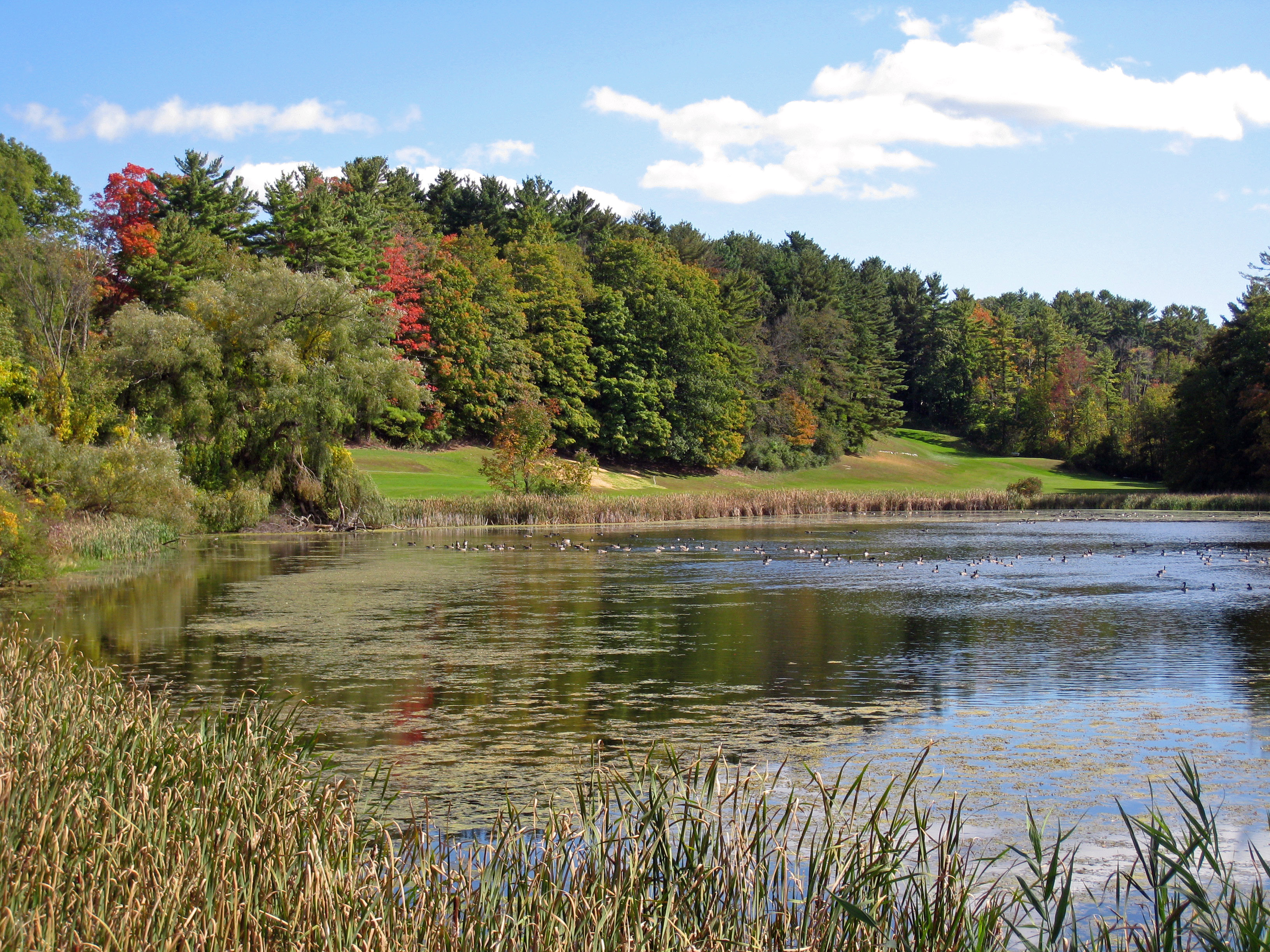
Yesterday, I drove out to the Interlaken Inn and Conference Center in Lakeville, CT to attend the second day of the “Little Berks” meeting (I was too sick on Friday to drive out and back — turns out that since I’m on the program, they would have paid for me to stay there. Oh well, it was less than an hour each way).  I arrived just before lunch.  Here’s a view of Lake Wononscopomuc, where we ate al fresco:

And since “Interlaken” means between the lakes, here is the other lake that I walked to after lunch:

As you can see, it was a gorgeous autumn day.

Now the schedule at these things is very leisurely — there was a good couple of hours between lunch and the business meeting, during which one can stroll, troll for antiques, or loll around as one sees fit.  The business meeting was very informative — we learned that Kathleen Brown, Professor of History at UPenn, will be the next Berkshire President.  A few proposals for the location of the next Big Berks were discussed although I’m not sure how much I’m supposed to divulge here.  I imagine there will be an official report sometime on the Berks homepage.

I heard that the weekend was supposed to be casual — so I fit right in when I arrived in jeans and a knit shirt.  However, no no told me that there was a tradition of dressing for dinner.  So, I remained in my jeans and shirt while others went back to their rooms to get into various levels of elegance (okay, a few others remained pretty casual too).  Apparently this is a hold over from the organizations beginnings in the glamorous 1930s.

The panel went extremely well.  Tenured Radical has posted the highlights of her talk at her blog and Clio Bluestocking plans to do so shortly.  I gushed at length about the possibilities of social scholarship and waxed nostalgic for the heyday of H-Women in the 1990s, when the list was a discussion forum rather than an announcement board. The response was overwhelmingly positive and the discussion continued for nearly an hour.  Hopefully we encouraged at least a few to consider blogging.

I neglected to mention that one way to keep up the momentum of the Sunday seminars at the Big Berks going is to have use the Berks  blog for discussion after (or even before) the meeting starts.  Or perhaps we can have carnivals of posts by women’s history bloggers as they do at Disability Studies, Temple U.  At the very least, I hope we can get a larger group of bloggers and/or digital history folks together for a panel for the next Big Berks (any takers out there?).

Outline for Little Berks Talk

How I Got Started

Evolution of Blog

  • from sandbox to scholarship
  • see category cloud for themes — women’s history, medical history, disability history, childhood/youth
  • reports from the field — e.g. conference reviews
  • some political commentary, silliness, hobbies

Graduate History Course:

  • course blog
  • blogging as reflective practice
  • mixed results
  • “digital natives” more interested in Facebook than blogging

Current Status

  • very low traffic
  • busiest day was right after Big Berks and “Bre’r Rusticus” article at History News Network
  • what happened to H-Women
  • H-Net goes 2.0 — Matrix
  • need for critical mass of bloggers and social scholars for robust exchange to occur [see roundup at Berks Blog]
  • why not start your own blog?

Rethinking the Drinking Age: a historical perspective

Once again, Historiann has beat me in posting on a hot political topic — the Amethyst Initiative, initiated last month by a group of college presidents who argue that the National Minimum Drinking Act (1984), which imposed a penalty of 10% of a state’s federal highway appropriation on any state setting its drinking age lower than 21, has been a disaster.  Not only has it not solved the problem of alcohol abuse among college students, it has actually exacerbated it by creating a “clandestine culture of binge drinking.”

[See this article from the Hartford Courant for local news on this issue]

I commented briefly on Historiann’s blog, but since this falls squarely in my area of expertise, I think a blog post of my own is in order.

As I argue in my recently published book, Student Bodies, concerns about undergraduate alcohol use and abuse date back to at least the early twentieth century. Many college presidents supported prohibition as a great solution to the problem of drinking on campus.  Even after prohibition ended in 1933, college administrators supported total abstinence even as alcohol became a normative part of adult sociability. Most states at this time established a minimum drinking age of 21.

At the same time, mental health experts classified excessive drinking as a disease.  Researchers at the Yale University Center for Alcohol Studies (later relocated to Rutgers), working closely with the Yale Mental Hygiene department in the health services, in 1949 conducted a survey of twenty-seven colleges around the country, encompassing both public and private, coeducational and single-sex, white and black, non-sectarian and religious (including Catholic, Jewish, and one Mormon college), and different regions of the country. Reports in the popular press made fun of the study, joking “Yale will get its facts about student drinking ‘At a table down at Mory’s,’” a New Haven bar popular among undergraduates.  The results of the study were that drinking was not a major problem at colleges and universities, and that patterns of drinking were no different in colleges and universities than in other parts of society.  They concluded that the key to prevention was not “scare tactics” that emphasized the pathological consequences of excessive drinking, but education that helped students make responsible choices about whether or not to consume alcohol.

During the early 1970s, partly in response to student movements of the period — many states lowered the drinking age to 18 — the thought being that if a young man could be sent to war, he should be able to legally purchase and consume alcohol. It was also at this time that the voting age was lowered to 18. In short, what happened at this time is that college students demanded, and received, the same constitutional rights as adults — e.g. to vote, freedom of speech, freedom of assembly, rights to privacy (including access to contraception, and abortion), etc.

This consensus was challenged by the College Alcohol Study started by a group of researchers at the Harvard School of Public Health, led by social psychologist Henry Wechsler, who began exploring the problem of college drinking in the late 1970s and early 1980s.  Their work in part led to the passage of the National Minimum Drinking Age act of 1984. It also led to the construction of “binge drinking” as a disease and social problem particular to young adults in higher education settings.  I was an undergraduate at the University of Vermont while all this was going on — the state was a holdout on keeping the drinking age at 18 but was eventually forced to raise the drinking age to get those federal highway funds.

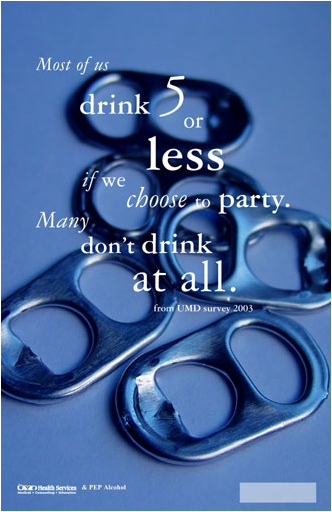
More recently still, the abstinence approach bolstered by the College Alcohol Study has been challenged by research conducted by the Social Norms Institute, who argue that the “health terrorism” perpetuated by the “binge drinking” model has not solved the problem of campus drinking, it simply has created an underground culture of drinking. They argue that by focusing on the most egregious cases, prevention efforts have exaggerated the extent to which most college students drink.  Their approach is remarkably similar to that proposed by the Yale Center in the 1940s — i.e. emphasize wellness, resilience, and informed decision making.  To illustrate how their approach differs:

NOT social norms marketing:

Social norms marketing:

So, to summarize — it seems to me that Historiann is asking the wrong questions, and perpetuating notions of 18-21 as “others” who need to be controlled by older adults, especially if they enroll in colleges and universities.  Earlier this week, I sent a colleague in Scotland an article by local columnist and radio host Colin McEnroe regarding a recently imposed curfew in the city of Hartford.  He replied:

“I find our politicians approaches to ‘young people’, as they are called, as
if they are a   separate breed from humanity, rather contradictory.  Young
people like to congregate on street corners.  It doesn’t mean they are doing
any harm.  Some get up to mischief, but most of the more serious crimes are
perpetuated by not-so-young people.  The curfew experiment was carried out
in Hamilton, a town in the county of Lanarkshire.  The latest plan to
control ‘young people’ is to prevent them from buying alcohol if they are
under 21.  The problem that I have with this is that people under 21, carte
blanche, are being considered irresponsible in their consumption of alcohol,
while those over 21, carte blanche, are considered responsible.  This idea
is occurring at the same time as it is considered OK to send teenagers in
the military to Iraq or Afghanistan (they are responsible enough to be
entrusted with that!), while there is also a wish by the present governing
party in Scotland to reduce the voting age from 18 to 16 so as to include
and engage young adults in the political process.  ‘Young people’ are our
nation’s future, the responsible citizens and decision-makers for tomorrow,
but I think that today you would be hard pushed to convince them of that.”

I couldn’t have said it better.  Thanks Iain!

P.S.  After I wrote this, I saw an excellent post by Kittywampus — amen, sister!
Back from Disability History Conference

I got back very early this morning (2am) from the Disability history conference and extended vacation with various family members.  Penny Richards has a post on her panel here.  My panel, and the conference as a whole, went extremely well.  It was reassuring to hear others mention the need to look at disability outside of institutions.  Sarah Rose, a recent Ph.D. from U of Illinois, Chicago, observed that in working-class neighborhoods, having a work-related disability was “normal” — individuals injured on the job continued to be part of their communities, although their employment opportunities and income were markedly diminished.

There were also a number of papers related to childhood/adolescence — and I recommended that folks at the conference submit proposals for the Society for History of Childhood and Youth conference at Berkeley next July.

One of the most interesting discussions regarded the limits of the medical model/social model dichotomy (briefly, the medical model situates defines disability as pathology, and places the burden on the disabled person to “recover” or “overcome”; the social model, on the other hand, looks at how social forces work to exclude disabled persons from full participation in society. )  Paul Longmore argued that access to appropriate medical treatment has always been part of the disability rights movement, and he does not see any incompatibility between seeking medical treatment and advocating for civil rights.  He is more concerned with public policies and social service professions that pathologize disabled persons and treat them as something to be “fixed” or “cured” or at least “corrected” into adopting a “positive” outlook on life.

Some other issues raised by Rosemary Garland Thompson in the final plenary session:

1.  The conceptual framework of disability

2. The intersectionality of disability with other identities, such as race, gender, class, age.

3. materiality — i.e. the interaction between the physical body and the material world.

4. how to maintain the political aspect of our work while avoiding presentism.

These are brief notes — maybe Penny can help me out here?

Berkshire Post-mortem

After I got transferred to a suite at the Holiday Inn, my conference experience got much better! I got to meet Historiann in person — very nice outfits, H! I would agree with her post that the sessions I attended emphasized a need to return to the archives to capture women’s lived experience, not just representations/discourse. Here are some summaries of the sessions I attended:

Session 23: Childhood as Useful Category of Historical Analysis

I led a session similar to this one at the 2002 Berks but this one was much better! Rebecca de Schweinitz argued that the movement for racial equality in the twentieth century was linked with changing ideals about childhood. She discussed the Children’s Charter passed in the 1930s, which extended the notion of a right to childhood beyond the white, middle-classes. This laid the groundwork for the legal arguments in the Brown V. Board of Education decision.

Leslie Paris discussed how the term “girl” became a pejorative term during Second Wave feminism, used by leftie men to trivialize women’s demands for equality. This in turn, she argues, led women historians who came of age during the Second Wave to ignore or underplay the role and place of girls — i.e. non-adult women — throughout history. For example, both Mary Beth Norton’s _Liberties Daughters_ and Kathy Peiss _Cheap Amusements_ prominently feature adolescent females (indeed, Peiss’ subjects are almost exclusively in their mid to late teens) yet their “girlness” and the ways in which their experience differs from that of adult women remains unanalyzed. She also mentioned that the role of girls in Second Wave feminism needs to be more fully explored. Finally, she gave a plug for an edited collection on girlhood that will be published by University of Illinois in Fall 2009.

Martha Saxton argued that the history of childhood has been a “silent partner” in historical scholarship, lurking beneath the surface but seldom analyzed as such. She also stated that historians could benefit from examining relationships between siblings, not just parent-child relationships.

Virginia Ott examined the lives of young women in the Confederate south, looking at the role they played in the construction of Confederate nationalism, as well as the impact of the war on their lives. Her key argument is that young women, like men, sought to preserve rather than challenge the Southern tradition of male chivalry and white ladyhood. At the same time, the war experiences did compel young women to expand the notion of what it meant to be female and Southern.

I found Tamara Myers’ paper on “Space, Place, and Bodies” to be the most useful for my work on the history of the body and sexuality. She looked at the ways in which the evolution of juvenile justice was embodied. What was surprising to me was that in the case of males, the focus was on preadolescent “waifs and strays,” young boys who were “stunted” by poverty and disease — images that inspired sympathy and compassion from the courts and the general public. During the discussion, I pointed out the connections between these images and disability history.

Session 63: Sexual Science Revisited: A Roundtable discussion with Cynthia Eagle Russett

This was the session I was most enthusiastic about attending, since my own work (like others who attended grad school in STS in the late 1980s and early 1990s) was strongly shaped by Russett’s book, which won the Berkshire book prize in 1989. All of the papers examined the ways in which feminists used evolutionary theory for their own purposes, to create what Carla Bittel called a “science” of women’s rights. They also acknowledged the dangers and pitfalls of this tactic — by and large, this was largely a white, middle-class phenomenon (with a few exceptions among the black middle-class), one that reinforced notions of white supremacy and fears of race suicide. Also, by rooting feminist principles in nature and the body, these ideas perpetuated an essentialist view of women with which we are still grappling in the 21st century.

Session 82: Transforming Health Care from Below

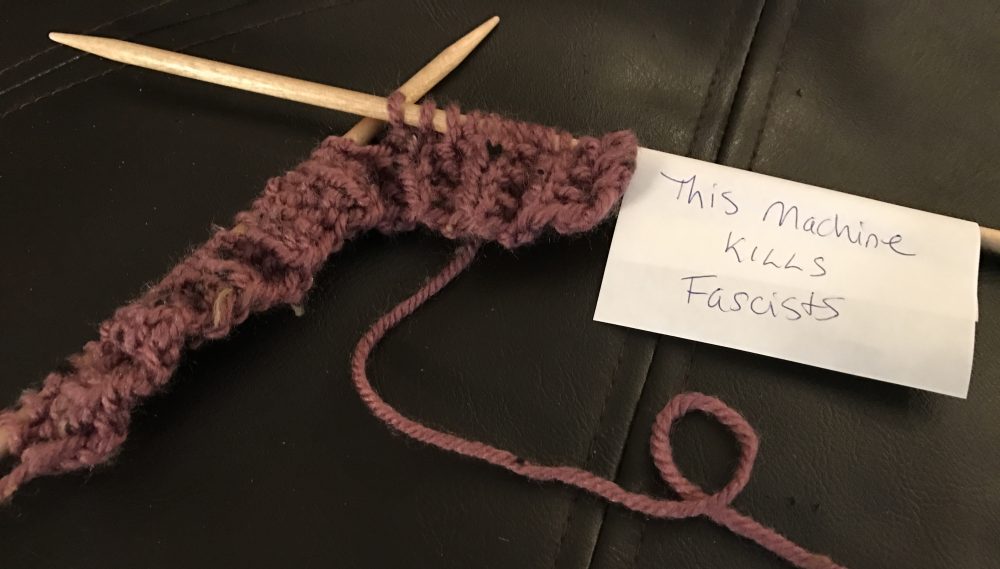
This was another fabulous session but by this point I was spending more time listening (and knitting) than taking notes! Jennifer Nelson had the awkward job of talking about leading feminist reproductive rights activist Loretta Ross while Ross herself was in the audience. All of the papers reminded us that theory and activism were connected, especially for women of color — i.e. that feminist perspectives emerged from lived organizing experiences.

Session 131 — Teaching about Health and Contraception outside the classroom

This was the only public history session I attended and I’m glad I did because it was extremely useful. Mary Melcher’s paper on using the Arizona women’s heritage trail to teach about birth control gave me some ideas about how to interpret and present birth control in the state — in fact, should tell the folks at Connecticut Women’s Hall of Fame that birth control and reproductive rights needs to be included in the CT Women’s Heritage Trail. I found Sarah Payne’s paper on “contraceptives on display” most helpful for my (possible) online exhibit on emergency contraception which I hope to get going once I master Omeka.

Finally, there was my Sunday seminar on “What is the History of the Body.” I was pleased to see so many people in the audience — over a dozen, or twice the number on the panel. It was also great to reconnect with Patty Stokes, a former classmate from Cornell — who blogs as Kitty Wampus. The main theme of the session, which is really a microcosm of the conference, is the need to move beyond the “linguistic turn,” to look at the physical experience of living in the body, not just discourse and representations of women’s bodies.

That’s it for now — got to get unpacked, start doing laundry and get back on track with various projects.

Off to the Berks, with an advance contract

I’m all packed and ready to go to Minneapolis for the Berkshire Conference on the History of Women. Too bad my flight isn’t for another 3 1/2 hours! Historiann has a nice post that gives a brief history of the organization. Tenured Radical wrote some interesting recollections of the recent history of the Berks while waiting for her flight at Bradley, delayed three hours (hope that doesn’t happen to me!) She not only wrote about the “Big Berks” i.e. the major international conference held every three years, but also the “Little Berks” held every year.

Despite living near the Berkshire area, I have never made it to one of these, partly due to schedule, but also partly due to the fact that information about the Little Berks is hard to come by. It’s nice to see that the website is now up to date and gives information about the upcoming one, but I seldom get mailings about this, snail or electronic — shouldn’t this be a benefit of membership? I have a retired colleague, with whom I had dinner last week, who said she received no information about this year’s Big Berks until it was too late to make plans to attend. Anyway, looks like my schedule is free that weekend, I just hope it doesn’t cost a fortune since it’s at the Lakeville Inn in expensive Litchfield County — oh well, at least it’s reasonable driving distance.

I just received great news that Rutgers University Press will be giving me an advance contract for the history of emergency contraception book. Something to celebrate when I get to Minneapolis!

Tribute to Barbara Seaman: Better Late than Never!

It must be spring break, because I have time to write two posts in one day! Seriously spring break is the time when I get caught up on various projects and get editors off my back by turning in work that is weeks late. One of the projects is the paper for the Cancer Vaccines for Girls conference at Rutgers. Given the very contemporary nature of this project, much of my sources are web-based, or at least from electronic library databases. I could even get the full transcript of the Gardasil docket from the FDA website instead of schlepping down to the Dockets Management reading room in Rockville. Plus, my web crawling brought me to this excellent tribute to Barbara Seaman on Our Bodies, Our Blog, which also criticizes the rather catty obituary of Seaman in the New York Times, which trivializes her accomplishments and contributions to women’s health activism. [why are some women so mean to other women? Jealousy? Wanting to be one of the guys? Sure is obnoxious]

I never had the good fortune to meet Barbara in person — she died before I could schedule an interview with her. But, I got a sense of how generous she was with her time when I posted a query on a listserv about how I could get in touch with her, and within twenty-four hours received an enthusiastic message from the lady herself! There followed a fast and furious exchange, most of which I was smart enough to keep. She also sent me free, autographed copies of her various publications. She must have had tremendous energy, even at the end of her life. I can only hope I’m as productive.

Now that I’ve made some headway on my writing, I feel like I can take a few real days off so I won’t be so cranky when I go back to teaching next week.

Cancer Vaccine Conference at Rutgers


Well, my proposal for the conference “Cancer Vaccines for Girls?” at Rutgers University was accepted — now I just need to figure out how to get it done before May 16! 😉

Yesterday’s New York Times had an interesting article on “Vaccinating Boys for Girls Sake.” I liked it because it made fun of the jolly “Gardasil Girls” — who typically are quite a bit older than the target demographic of girls aged 10-12. The article reminds me of a paper on rubella vaccines that Leslie Reagan gave at AAHM couple of years ago — in order to protect pregnant Moms, you have to go after the boys not just the girls. It’s also encouraging to see boys given some responsibility for preventing a disease that affects women! [historically, women have been portrayed as “reservoirs” of STDs — see some of the posters from this online exhibit at National Library of Medicine].