Female Shooter at University of Alabama

via The Human Condition Blog – Newsweek.com, Historiann, Kittywampus, and others.   University of Alabama, Huntsville biology professor Amy Bishop shot and killed several colleagues during a faculty meeting on Friday. Campus shootings are always shocking, but this was is especially so since, as Historiann observes, men are the overwhelming majority of mass murderers and the overwhelming majority of people who kill with guns.

I was planning to wait until the weekend is over to comment on this and focus on my knitting, but even even the Ivory Tower Fiber Freaks group on Ravelry is abuzz about this.   The facts are still developing so I hesitate to comment about Amy Bishop’s mental state.  However, more than one article I’ve seen has raised the issue of Bishop’s mental state — e.g. did she have a psychotic break?  Was she taking SSRIs, which can cause mania or psychosis? Bishop shot her brother, supposedly by accident, in 1986.   Was that also the result of a psychotic or manic episode?

So, I’m just going to toss some initial thoughts out there, even if they turn out not to apply to this case.   Previous instances of campus shootings have prompted more attention to student mental health issues.   Will this case lead to more focus on faculty mental health?  Our campus has an Employee Assistance Program, but how many people actually use it?  How many more are afraid to get counseling because they don’t want to be labeled a “nut” — especially before they have tenure?

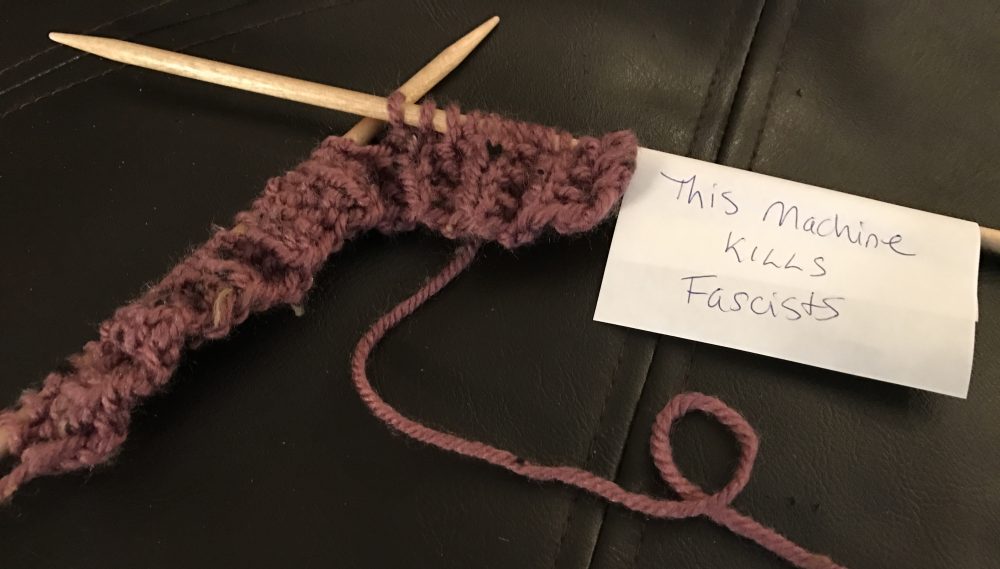
I’ll wait and see how this develops before  I say more on this.  Meanwhile, I’ll continue to stay calm and carry yarn.

Added later:  this article from SF Gate hints that bullying might have been a factor, although the author does it in a stupid assed intellectually lazy way (i.e. Southerners are stupid, hate intellectual Yankees, especially those who are from Harvard).

Update 2/15/10:  From the website Chronicle of Higher Education.   The ableist language in the comments is quite disturbing.

Here’s a first hand account from another UAH faculty member.  I hope they’re including faculty in the crisis counseling.

New Emergency Contraception Drug

via Our Bodies Our Blog.  They report, “A recent ABC news piece and two new journal articles (in The Lancet and Obstetrics and Gynecology) have drawn attention to an emergency contraception drug that is not currently available in the U.S. but apparently has been submitted to the FDA for review.”

I need to figure out how to fit this in the book project, but first I need to look up ulipristal acetate.

Knitting Clio has been busy blogging elsewhere

This blog has been quiet lately since I maintain two other blogs.  One is the course blog for my graduate digital history seminar. The other is Women Historians of Medicine, where we are having a lively discussion about suggestions for an exhibit honoring the 50th anniversary of the Pill that Suzanne Junod at the FDA History Office is putting together.

Since I’m an expert on the history of college health, no discussion of the history of the Pill would be complete without mentioning that female students’ access to the Pill was recently weakened by changes in Medicaid pricing rules. Prior to 2005, pharmaceutical companies were able to provide Title X clinics and college health centers with birth control pills at a substantial discount.  In 2005, these rules changed, and in 2007 the price of birth control pills for women who came to these clinics skyrocketed, going from $10 to as much as $50 per package. The Feminist Majority Foundation Campus Program worked hard to change this, and in 2009 Congress reversed this and once again made low-cost birth control clinics available to student health centers and clinics for low-income women.  Yet some student health centers still don’t offer discounted pills.  So, to ensure access, please do the following:

  1. Go to your Student Health Center and make sure birth control and emergency contraception is offered and its given a discounted price.
  2. If you can’t access birth control on campus, start a petition, write op-eds in your student newspaper, present resolutions to student government and administration.
  3. Encourage the Health Center to be on your side.
  4. Plug into FMF’s Birth Control Access Campaign action kit to disseminate information on campus.

Blog for Choice Day 2010

via NARAL Blog for Choice

This is NARAL’s 5th annual Blog for Choice Day, which falls on the 37th anniversary of the landmark U.S. Supreme Court decision Roe v. Wade.  In honor of the late Dr. George Tiller, who often wore a button that simply read, “Trust Women,” this year’s Blog for Choice Day question is: What does Trust Women mean to you?

Followers of this blog know that I’m currently working on a book on the history of the emergency contraceptive pill (ECP), aka the “morning-after pill” for the series Critical Issues in Health and Medicine for Rutgers University Press.   [please take the survey by clicking at the link at the bottom of this blog]

Right now, I’m working on Chapter 5, which looks at feminist activism to raise awareness about and convince the FDA to approve a dedicated ECP product.  Some of the leaders of this endeavor were also prominent in NARAL, so covering the history of this organization is important to my work. In her essay, “Toward Coalition: The Reproductive Health Technologies Project,” from Abortion Wars, edited by Rickie Solinger, Marie Bass describes how RHTP arose out of her work as political action director for NARAL.  Bass found her experience unsatisfying because of the way in which the abortion issue “had been appropriated by shallow, insensitive, and opportunistic politicians.” She found that congressional candidates — “usually male, but not always” — formed their position on abortion according to “how the political winds in their state or district were blowing.”  She found the politicians who claimed to be pro-choice to be the most frustrating. Even though public opinion polls indicated that the majority of Americans were pro-choice, these politicians would give torturous “non-answers” to the question “are you pro-choice”.  Even more disturbing for Bass was the fate of former congresswoman Geraldine Ferraro during her historic run for vice-president in 1984, who was “brutally assaulted for her audacity, as a Catholic woman, to espouse a position on abortion that contradicted the Church.”  Meanwhile, pro-choice Catholic men (e.g. Mario Cuomo and Ted Kennedy) were given a pass.  “Evidently, men could be indulged in a little waywardness, but a Catholic woman — never!”

Around the same time, Bass heard about a new drug called RU-486, which would terminate an early pregnancy.  Bass’ first thought was maybe “this was a way out of the quagmire of the abortion issue” since it would take abortion “out of the political arena and put the decision back in the hands of women and medical practitioners, where it belonged.”  She joined with other activists from NARAL, Planned Parenthood, and other organizations — including Joanne Howes, Nanette Falkenberg, and Sharon Camp — to work on bringing RU-486 to market in the United States.   When they called the first meeting of what would become RHTP in 1988, Bass and her “small cabal of collaborators” assumed that opposition would come solely from anti-choice individuals and organizations.   They were quite surprised to find that while everyone at the table was pro-choice, they had widely divergent opinions about RU-486 and reproductive technologies in general.  Consumer advocates, such as Judy Norsigian from the Boston Women’s Health Book Collective, “introduced concerns about whether the drug affected white women and women of color differently and about access to hospital care in the event of emergencies such as prolonged bleeding.” Others called attention to the ways in which technologies had been used coercively to control reproduction among poor women of color “at the expense of women’s autonomy and health.”  Some recalled how drugs or devices such as DES and the Dalkon Shield, once touted as wonders, “had turned into disasters for women.”

Therefore, before RHTP could get anywhere with RU-486 or anything else, they had to build trust among various activists, especially women of color: “No matter how well-meaning we may have been, as white middle-class women, we simply could not represent the interests of women from other groups.”

So, this is what “trust women” means to me — building coalitions around the common issue of abortion and reproductive rights more generally, while respecting diversity — whether this be race, class, age, sexuality, disability status, or political affiliation [on this last note, this would mean supporting pro-choice Republican women over anti-choice Democratic men or women].

Finally, on the issue of blogging more generally, I’d like to address an article from Newsweek, entitled “Who’s Missing at the ‘Roe v. Wade’ Anniversary Demonstrations: Young Women.”  According to Kristy Maddux, assistant professor of Communication at the University of Maryland, who specializes in historical feminism, young women are still concerned about reproductive rights, “but they’re not trained to go out and protest.” Instead of marching in the streets, young women are writing on their blogs or social network sites.  “I don’t want to frame young women as lazy, ” says Maddux, “but they don’t have any reason to believe that it matters if they go out and protest. Instead, they talk about their positions to friends and neighbors.”

Excuse me, but what the heck is wrong with blogging?!  [and why isn’t a scholar in the field of Communication paying attention to the impact of social media on feminist activism]?  Get with the program, sister, and  blog for choice [or tweet or whatever] yourself!

Another reason we need a feminist approach to breast cancer

via Well Blog – NYTimes.com.  I agree with many of the comments on this one — TPP really is condescending towards anyone who challenges her point of view.  I think there really is cause for concern about a drug that is not really that effective and causes a lot of serious side effects.

Feminist Law Professors has another commentary on the recent recommendations regarding breast cancer screenings.  I didn’t have the same reaction to the NYT Op-Ed criticized in this post. I also was aware of an earlier report this year that the CSA Prostate Test Found to Save Few Lives. [in fact, I had heard this from GPs at a conference in Scotland in Fall 2008). Again, I find the most compelling points in the comments section, from Jay who had ductal cancer in situ (DCIS) and criticizes condescending treatment at her breast cancer treatment center.  So, this is another example of why the “pink ribbon” industry is not feminist.  It’s especially horrifying to me that so many women have healthy breasts and ovaries removed because they are so afraid of getting cancer.

Thoughts on New Breast Cancer Screening Guidelines

I’ve been replying to a query about this on Hartford Courant columnist Susan Campbell’s blog, so am going to put some of my thoughts down here at Knitting Clio as well.  Susan writes:

“Here are the new recommendations. Tell me I’m getting all conspiracy-theorist and I will at least half-listen, but we all know women whose breast cancer was first detected while those women were in their 40s.

And here’s a bit more on the topic.”

In my first reply I wrote:  I ‘m not sure what to think. I recently reviewed a book by historian-physician Robert Aronowitz called Unnatural History: Breast Cancer and American Society which makes a convincing case that advances in screening and diagnosis have not delivered on their promise to improve cancer outcomes (I’ve heard similar arguments made about prostate cancer).  In fact, the  emphasis on yearly mammograms and self-exams is rooted in the medical profession’s view of the breast as a “precancerous organ.”

So, on a population level, the new recommendations about mammograms seem to make sense. On a personal level, though, who wants to get cancer?

Susan later replied, “I haven’t read that book, but have read about that book (not quite the same, is it) and I get that, I think. But why also discourage women from doing self-exams?  I am starting to get all conspiracy theorist about this. I knew I would. I knew this was in my future, but I thought I could hold it together just a few more years. But here’s some information from an organization I respect: http://bcaction.org/index.php?page=mammography-and-new-tech

My response:

re: the self-exam recommendation — it could be because pre-menopausal women tend to have denser breast tissue, detecting lumps through self-exams isn’t very effective.

Another way of thinking of this is to look at an earlier routine screening recommendation — annual x-rays to detect TB. It later turned out the test was worse than the disease.

Finally, breast cancer is not the most common form of cancer — skin cancer is. Yet there doesn’t seem to be a major industry dedicated to early screening and prevention. Also, the number one killer of women over age 50 is heart disease. Awareness and education about this is starting to catch up, but pales in comparison to the breast cancer industry.

Susan wrote: ” I really don’t want to sound like a crank here, but I know women who’ve had secondary cancers that doctors told them came from the treatment of their earlier breast cancer. There’s a feel of women as guinea pigs here. I know science is evolving, but Jaysus.”

To which I replied, You’re not a crank, Susan — and this isn’t the first time in history women are used for experimental medical treatments (e.g. DES)

In the midst of that exchange, Our Bodies Our Blog posted an entry, “New Mammogram Guidelines are Causing Confusion, But Here’s Why they Make Sense.”  They observe that feminist health groups were ahead of the medical profession on this:   “A number of women’s health organizations, including Our Bodies Ourselves, the National Women’s Health Network and Breast Cancer Action, for years have warned that regular mammograms do not necessarily decrease a women’s risk of death. Premenopausal women in particular are urged to consider the risks and benefits.

In fact, the NWHN issued a position paper in 1993 recommending against screening mammography for pre-menopausal women. It was a very controversial position at the time — even more so than now. The breast cancer advocacy movement was in its infancy and efforts were focused on getting Medicare and insurance companies to cover mammograms. What the NWHN found — and other groups have since concurred — is that the potential harm from screening can outweigh the benefits for premenopausal women.”

Further adding to the confusion is this week’s statement by Department of Health and Human Services Sec. Kathleen Sebelius who advised women and medical professionals to ignore government-issued recommendations.

Yesterday’s edition of “All Things Considered” had several interesting reports on this issue .  The first  story on “All Things Considered” interviewed my colleague at Columbia, Barron Lerner, author of Breast Cancer Wars: Hope, Fear, and the Pursuit of a Cure in Twentieth-Century America.

If you think about finding a cancer in your breast using your fingers, especially one that’s deep in the breast, it’s got to be at least a centimeter in size, maybe even a little larger. We call that early detection, but it’s not early. Most of those cancers, many of those cancers have been there growing for months or years, and we now know, in contrast to when early detection was invented, that a lot of breast cancers spread early on in their course.

So the notion that finding a lump in your breast is truly early, and it’s before the cancer has spread, and therefore, you’re going to save a life doing that doesn’t make the sense that it used to. ”

Two other interesting stories: First, “Breast Cancer Advocates not Buying New Guidelines,”  discusses the outcry against the new guidelines from breast cancer survivors and the Susan G. Komen foundation.  The second story, “Mammogram Wars: Experts feel the Backlash,” features breast cancer surgeon Dr. Susan Love whose reaction was, “It’s about time!”  [see Dr. Love’s blog for a longer version of this]  The reactions on Dr. Love’s blog have ranged from “thank you for having the guts to say this” to “are you crazy?”  The reply that best sums up my thoughts on the subject come from Cassie:  “Sadly indvidual stories don’t constitute science. We already ration care in this country since 20% of all women of child bearing age lack health insurnace. This is as high as 39% for hispanic women so the 5 billion a year spent on unnecessary testing is forcing these women to receive rationed care.

I don’t support pitting one group against another and yes all life is priceless but grow up people. Tons and tons of medical care has nothing to do with outcomes or need. Only 8% of diabetics get the right care for example but there is no outcry to treat them properly.. BTW diabetes account for 35% of all medicare costs but are only 10% of the population. Focus on what works and not what has been marketing to us. Dr Love is ahead of the curve and I for one stand by her.”

Amen, sister!  For more criticism of the “breast cancer industry” see Samantha King’s excellent book, Pink Ribbons, Inc: Breast Cancer and the Politics of Philanthrophy, as well as Barbara Ehrenreich’s personal account of breast cancer — unlike other survivors, Ehrenreich was not thrilled with the “princess treatment” given to cancer patients– she found it nauseating and infantilizing.  She also finds nothing feminist in the sentimental “sisterhood” of breast cancer survivorship.

This is sadly true of the women’s health in general — true feminist voices are overshadowed by the corporate women’s health industry.

Added later:  here’s a story from today’s New York Times, featuring another medical historian from Columbia, Sheila Rothman.  To her comments I would add that the standard of care for breast cancer used to be radical mastectomy.  It took a paradigm shift among surgeons forced by women’s activism to change that.

Breast Cancer Advocates Not Buying New Guidelines
 

Sex and “Mad Men”

mad_menvia  Historiann, who asks what we think about the portrayal of sex on “Mad Men.”  Historiann observes that this is the era of Helen Gurley Brown’s Sex and the Single Girl (1962) — so where’s all the fun?  Well, my first reaction is that Brown’s main message was that because women were at a disadvantage economically, they needed to use their sex appeal to get ahead. I also find a lot of similarities between “Mad Men” and the classic Billy Wilder film, The Apartment (1960).  The key difference is that the film’s hero, Bud Baxter, is a mensch who actually respects women.  So far, there aren’t any of those in “Mad Men.”  [maybe they are hidden in the mail room with the token Jewish guy from Season One).

In addition, as a historian of sexuality and contraception, I need to deflate some myths about sex in the 1960s.  Here are some thoughts, from Chapter 7 of my recent book, Student Bodies, and my current project on the history of emergency contraception, complete with footnotes!

One of the most intractable historical myths about the contraceptive pill is the claim that this discovery caused the sexual revolution of the 1960s. Carl Djerassi, one of the chemists who worked on synthesizing the chemical components of the Pill, recalled that he had “no regrets that the Pill contributed to the sexual revolution of our time and possibly expedited it.”[i] Yet Alfred Kinsey’s surveys of sexual behavior indicated that a sexual revolution was underway well before the Pill arrived on the market. His Sexual Behavior in the Human Female (1953) disclosed that over 50 percent of the women in his sample had engaged in premarital sex.[ii] Kinsey’s findings were accompanied by the somewhat reassuring fact that the percentage of married teenaged girls increased markedly. By 1959, 47% of all brides had married before the age of nineteen, and the percentage of girls married between fourteen and seventeen had grown by one-third since 1940.[iii]

Commentaries written in the early 1960s reinforced the link between the sexual revolution and a contraceptive revolution. However, access to the Pill and other forms of contraception remained far from universal. Prior to the Griswold v. Connecticut Supreme Court decision of 1965, many states banned birth control even for married persons. Furthermore, Griswold only established the right to marital privacy. Few states allowed single women to obtain birth control, and those that did only allowed them to do so if they had reached the age of majority, which most states set at age 21. Some women were able to circumvent the law by convincing sympathetic physicians to prescribe the Pill for gynecological disorders. Even in areas where providing contraceptives for single women were not forbidden by law, physicians were often unwilling to contribute to “sexual immorality” by prescribing the pill to young unmarried women. When single women did manage to get a prescription there was no guarantee that they would find a pharmacist willing to fill it.[iv]

During season one of “Mad Men,” Joan Holloway gives Peggy Olson the name of a doctor who will prescribe the pill to unmarried women.  The scene between Peggy and the doctor is probably typical — he gives Peggy a prescription, but only after lecturing her about the irresponsibility of intercourse outside of marriage.  The show’s writers reinforce this moral framework with Peggy’s pregnancy and delivery at the end of Season One.

Let’s also not forget that Mad Men is set long before Roe v. Wade.  When Betty Draper finds herself pregnant at the end of Season Two, she tells her doctor that this is bad timing because her marriage is on the rocks.  The doctor is sympathetic and knows of doctors who will perform the procedure sub rosa, but says that the option of termination is really meant for young, single women who are “in trouble.”

In short, I think the show does capture fairly accurately the problems of this transitional period in the history of sexuality in the U.S.  Women were told to be sexy, but if you got pregnant (or raped), it was your own fault for “tempting” men.

Also, there is more continuity between the allegedly “repressed” 1950s and the so-called “sexual revolution” of the 1960s — as demonstrated in work by Beth Bailey.


[i] Carl Djerassi, This Man’s Pill: Reflections on the 50th Anniversary of the Pill (New York: Oxford University Press, 2004),  95.


[ii]Kinsey, Sexual Behavior in the Human Female (Philadelphia:  Saunders, 1953).

[iii] Beth L. Bailey, From Front Porch to Back Seat: Courtship in Twentieth-Century America (Baltimore, MD: Johns Hopkins University Press, 1988), p. 43.

[iv] Beth Bailey, “Prescribing the Pill: Politics, Culture, and the Sexual Revolution in America’s Heartland, Journal of Social History 30 (1997): 827-856; Heather Munro Prescott, A Doctor of Their Own: The History of Adolescent Medicine (Cambridge, MA: Harvard University Press, 1998); Prescott, Student Bodies: The Impact of Student Health on American Society and Medicine (Ann Arbor: University of Michigan Press, 2007).