Blog for International Women’s Day

Today is International Women’s Day, and this is my blog post for Gender Across Borders’ Blog for IWD.  This year’s theme, set by the United Nations, is Equal rights, equal opportunity: Progress for all.”  In answer to the questions posed by GAB:

What does “equal rights for all” mean to you?

For me, equal rights means equal economic rights — equal pay, the ability to have a decent standard of living, affordable and accessible health care, including contraception and abortion.  However, it  DOESN’T mean a marketing opportunity to sell stuff to the “ladies”.  From Susan Campbell’s blog for her book, Dating Jesus:

“similar to Washington’s Birthday (where car sellers honor our first president by saying things like “I cannot tell a lie: This is the lowest price you’ll find.”), IWD has become a special window through which to hawk products.

Check out Feminist Peace Network’s wall of shame here. Note particularly the special deals on Hot Russian Brides, in honor of the day, March 8.”

Describe a particular organization, person, or moment in history that helped to mobilize a meaningful change in equal rights for all.

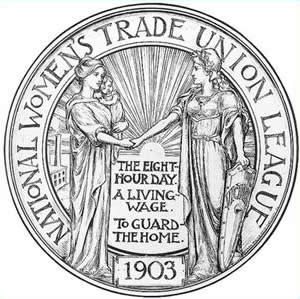
There are so many — how does one choose?   In my introductory remarks for our annual women’s history month celebrations, I point out that International Women’s Day began as a day to honor and promote the rights of working women.  So, I choose the Women’s Trade Union League as my example of promoting economic rights for all.  This organization demonstrated the emerging political awareness and activism of working women during this time. It was also an example of cross-class cooperation between women in the early twentieth century, a time of social and political reform tied to Progressive movement and the campaign for women’s suffrage.  The annual May Day celebrations by labor leaders served as a model for IWD.  Historically May Day (May 1st) celebrated the arrival of spring.  In the 1880s, labor leaders adopted May 1st to promote the rights of workers — and most of the time this meant the rights of men to earn a “family wage” so that their women did not have to work to support their families.  Male labor leaders criticized the women’s suffrage movement as a “bourgeois” agenda to consolidate the power of the middle and upper-classes (and given the elitism and nativism of some suffrage leaders, this claim was not unfounded).

However, it’s important to recognize the ways in which middle-class suffrage leaders recruited working-class women to the cause of suffrage and how both fought together for better wages and hours for working women.  Here’s their symbol:
The Socialist party in the U.S. created a Women’s National Committee to Campaign for the Suffrage, which held their first mass meeting on March 8, 1908.   Middle-class women participated in strikes and other protests by working women.  For example, during the Uprising of 20,000 in 1909, college girls who wore shirtwaists and the striking garment workers who made them walked arm in arm down Fifth Avenue to protest for working women’s rights.   The success of women labor leaders and their supporters led to the creation of International Women’s Day in 1911.

Unfortunately, the Red Scare of the 1920s, and later McCarthyism in the 1950s, targeted leftist women’s groups in the United States.  While other countries continued to celebrate International Women’s Day, the United States didn’t until Second Wave feminists in the 1960s revived the event.   Radical Women, an organization that emerged in Seattle, Washington, are a prime example of how some women’s organizations in the U.S. revived this link between women’s rights and economic and social justice for all women.  Here is Radical Women’s statement for this year’s IWD celebration:

“Women now, just as they did one hundred years ago, hold a unique economic and social position in society – oppressed in the home and super-exploited in the workplace. Women suffer more frequently from poverty; they labor long hours at home, raising the young and nursing the aged and sick; and they often also perform double-duty outside the home, working for lower wages than their male counterparts. This harsh reality makes women the best and toughest leaders of movements fighting for social and economic justice. In other words, women always have everything to gain and little to lose by organizing for a better world. As the South African song proclaims, “When you strike a woman, you strike a rock!”

Rebellion by women against an unjust global economic order is very much alive. In Iran, women are revolting against a thoroughly bankrupt, oppressive regime; in Gaza and the West Bank, Palestinian women are organizing an international boycott of Israel; in Italy, France and Spain, immigrant women went on strike against xenophobic racism; in Australia, feminists convened a national conference to coordinate and re-energize the abortion rights movement; in Mexico, women staunchly defend striking mine workers who fight for basic labor and human rights.

In the United States, queers and their allies are agitating for equality in all aspects of life. On university and college campuses, young women are organizing strikes and conferences in answer to the draconian cuts and tuition hikes that politicians of both parties are implementing to balance shrinking state budgets.

Radical Women in the U.S. and Australia is in the thick of these fights. Over the past year, members have also campaigned for fully-funded health care and other human services; helped pass laws to tax the rich and corporate profits; defended clinics and protested for reproductive freedom; organized to stop raids by Immigration and Customs Enforcement (ICE); raised money for our sisters and brothers in Haiti, who are rebuilding their homeland; and much more.

On this 100th anniversary of the declaration of IWD, the issues may have changed, but the nature of the struggle remains the same. Like the socialist women who founded IWD, Radical Women believes the movements for social and economic justice must be independent and anti-capitalist to realize their full potential. Independent because it doesn’t matter which political party holds power if they aren’t accountable to the workingclass majority. If women are ever to achieve equality, we must cut the ties to politicians who demand our votes and hard-earned money, but give little, if anything, in return.

Our movements must also be anti-capitalist and tackle head-on the bankrupt economic system that pits nations and peoples against each other in a dog-eat-dog race to the bottom so that a tiny minority can exploit the earth’s resources and human labor for private gain. The day the world’s peoples turn this “free” market pyramid upside down will be a great advance along the path of achieving full equality and quality of life for all of humanity.

So, on this March 8, Radical Women unites in solidarity with all our sisters and brothers around the world who are marching, protesting, and raising their voices to win a socialist future where all people have not only bread, but roses too!

Margaret Viggiani
Radical Women
National Executive Committee
www.RadicalWomen.org

National Radical Women
625 Larkin St. Ste 202, San Francisco, CA 94109
Phone 415-864-1278 ● Fax 415-864-0778
RadicalWomenUS@gmail.com

Oh, by the way, it’s women’s history month

via Tenured Radical, who announces that one of my former profs., Mary Beth Norton, Mary Donlan Alger Professor of History at Cornell University, and distinguished member of he Berkshire Conference of Women Historians, will appear on the new NBC series, “Who Do You Think You Are?”  this Friday, March 5, at 8pm EST.  Norton is the author of In the Devil’s Snare: The Salem Witchcraft Crisis of 1692 (Knopf, 2002) and will tell Sarah Jessica Parker of Sex and the City fame about her Salem witch ancestor.  Norton is also descended from a Salem witch.   Can’t wait to see how this turns out.   MB is a real hoot — this should be very entertaining.

Our Bodies, Ourselves Author Coming to CCSU

Hey folks,

One of my women’s history heroines is coming to my campus.  Since this year’s theme is “Writing Women Back Into History,” it’s fitting that we have booked a noted woman author.  Here’s more information:

The Ruthe Boyea Women’s Center and the Committee on the Concerns of Women invites you to purchase your ticket to attend….

The 2010 Women’s History Month Luncheon

Keynote Speaker

Judy Norsigian

co-author of Our Bodies, Ourselves

“Women’s Health and the Media: Sorting Fact from Fiction”

Tuesday, March 9, 2010

12pm

Memorial Hall, Connecticut Room

Ticket Cost: $20.00. To purchase your ticket, contact CENTix at 860- 832-1989.

Meal choices: Beef Tenderloin Gratin, Pan Seared Salmon, Chicken Francais or Vegetarian Tart

__________________________________________________

2pm

Lecture, Free and Open to the Public

Memorial Hall, Constitution Room

Speaker: Judy Norsigian

The Women’s Health Movement: Accurate, Accessible Information on Health, Sexuality, and Reproduction”

Booksigning after lecture. Books can be purchased at the CCSU Bookstore or at the event.

___________________________

Judy Norsigian Bio: Co-founder of the BWHBC and co-author of all editions of Our Bodies, Ourselves, Judy is a graduate of Radcliffe College and an internationally renowned speaker and writer on a wide range of women’s health concerns.  Her interests include national health care reform, tobacco and women, midwifery advocacy, reproductive health, genetic technologies, and contraceptive research.  She has appeared on numerous television and radio programs including Oprah, Donahue, The Today Show, Good Morning America, and NBC Nightly News with Tom Brokaw.

New Emergency Contraception Drug

via Our Bodies Our Blog.  They report, “A recent ABC news piece and two new journal articles (in The Lancet and Obstetrics and Gynecology) have drawn attention to an emergency contraception drug that is not currently available in the U.S. but apparently has been submitted to the FDA for review.”

I need to figure out how to fit this in the book project, but first I need to look up ulipristal acetate.

Knitting Clio has been busy blogging elsewhere

This blog has been quiet lately since I maintain two other blogs.  One is the course blog for my graduate digital history seminar. The other is Women Historians of Medicine, where we are having a lively discussion about suggestions for an exhibit honoring the 50th anniversary of the Pill that Suzanne Junod at the FDA History Office is putting together.

Since I’m an expert on the history of college health, no discussion of the history of the Pill would be complete without mentioning that female students’ access to the Pill was recently weakened by changes in Medicaid pricing rules. Prior to 2005, pharmaceutical companies were able to provide Title X clinics and college health centers with birth control pills at a substantial discount.  In 2005, these rules changed, and in 2007 the price of birth control pills for women who came to these clinics skyrocketed, going from $10 to as much as $50 per package. The Feminist Majority Foundation Campus Program worked hard to change this, and in 2009 Congress reversed this and once again made low-cost birth control clinics available to student health centers and clinics for low-income women.  Yet some student health centers still don’t offer discounted pills.  So, to ensure access, please do the following:

  1. Go to your Student Health Center and make sure birth control and emergency contraception is offered and its given a discounted price.
  2. If you can’t access birth control on campus, start a petition, write op-eds in your student newspaper, present resolutions to student government and administration.
  3. Encourage the Health Center to be on your side.
  4. Plug into FMF’s Birth Control Access Campaign action kit to disseminate information on campus.

Blog for Choice Day 2010

via NARAL Blog for Choice

This is NARAL’s 5th annual Blog for Choice Day, which falls on the 37th anniversary of the landmark U.S. Supreme Court decision Roe v. Wade.  In honor of the late Dr. George Tiller, who often wore a button that simply read, “Trust Women,” this year’s Blog for Choice Day question is: What does Trust Women mean to you?

Followers of this blog know that I’m currently working on a book on the history of the emergency contraceptive pill (ECP), aka the “morning-after pill” for the series Critical Issues in Health and Medicine for Rutgers University Press.   [please take the survey by clicking at the link at the bottom of this blog]

Right now, I’m working on Chapter 5, which looks at feminist activism to raise awareness about and convince the FDA to approve a dedicated ECP product.  Some of the leaders of this endeavor were also prominent in NARAL, so covering the history of this organization is important to my work. In her essay, “Toward Coalition: The Reproductive Health Technologies Project,” from Abortion Wars, edited by Rickie Solinger, Marie Bass describes how RHTP arose out of her work as political action director for NARAL.  Bass found her experience unsatisfying because of the way in which the abortion issue “had been appropriated by shallow, insensitive, and opportunistic politicians.” She found that congressional candidates — “usually male, but not always” — formed their position on abortion according to “how the political winds in their state or district were blowing.”  She found the politicians who claimed to be pro-choice to be the most frustrating. Even though public opinion polls indicated that the majority of Americans were pro-choice, these politicians would give torturous “non-answers” to the question “are you pro-choice”.  Even more disturbing for Bass was the fate of former congresswoman Geraldine Ferraro during her historic run for vice-president in 1984, who was “brutally assaulted for her audacity, as a Catholic woman, to espouse a position on abortion that contradicted the Church.”  Meanwhile, pro-choice Catholic men (e.g. Mario Cuomo and Ted Kennedy) were given a pass.  “Evidently, men could be indulged in a little waywardness, but a Catholic woman — never!”

Around the same time, Bass heard about a new drug called RU-486, which would terminate an early pregnancy.  Bass’ first thought was maybe “this was a way out of the quagmire of the abortion issue” since it would take abortion “out of the political arena and put the decision back in the hands of women and medical practitioners, where it belonged.”  She joined with other activists from NARAL, Planned Parenthood, and other organizations — including Joanne Howes, Nanette Falkenberg, and Sharon Camp — to work on bringing RU-486 to market in the United States.   When they called the first meeting of what would become RHTP in 1988, Bass and her “small cabal of collaborators” assumed that opposition would come solely from anti-choice individuals and organizations.   They were quite surprised to find that while everyone at the table was pro-choice, they had widely divergent opinions about RU-486 and reproductive technologies in general.  Consumer advocates, such as Judy Norsigian from the Boston Women’s Health Book Collective, “introduced concerns about whether the drug affected white women and women of color differently and about access to hospital care in the event of emergencies such as prolonged bleeding.” Others called attention to the ways in which technologies had been used coercively to control reproduction among poor women of color “at the expense of women’s autonomy and health.”  Some recalled how drugs or devices such as DES and the Dalkon Shield, once touted as wonders, “had turned into disasters for women.”

Therefore, before RHTP could get anywhere with RU-486 or anything else, they had to build trust among various activists, especially women of color: “No matter how well-meaning we may have been, as white middle-class women, we simply could not represent the interests of women from other groups.”

So, this is what “trust women” means to me — building coalitions around the common issue of abortion and reproductive rights more generally, while respecting diversity — whether this be race, class, age, sexuality, disability status, or political affiliation [on this last note, this would mean supporting pro-choice Republican women over anti-choice Democratic men or women].

Finally, on the issue of blogging more generally, I’d like to address an article from Newsweek, entitled “Who’s Missing at the ‘Roe v. Wade’ Anniversary Demonstrations: Young Women.”  According to Kristy Maddux, assistant professor of Communication at the University of Maryland, who specializes in historical feminism, young women are still concerned about reproductive rights, “but they’re not trained to go out and protest.” Instead of marching in the streets, young women are writing on their blogs or social network sites.  “I don’t want to frame young women as lazy, ” says Maddux, “but they don’t have any reason to believe that it matters if they go out and protest. Instead, they talk about their positions to friends and neighbors.”

Excuse me, but what the heck is wrong with blogging?!  [and why isn’t a scholar in the field of Communication paying attention to the impact of social media on feminist activism]?  Get with the program, sister, and  blog for choice [or tweet or whatever] yourself!

Speaking of Helen Keller

Here’s an announcement of a panel on “Becoming Helen Kellery” at the American Historical Association in San Diego by the folks at the Disability History Museum:  [via H-Disability]

If you will be attending the AHA in San Diego, please consider joining a
panel discussion scheduled for Saturday, January 9, 2010: 11:30 AM-1:30
PM, entitled "Becoming Helen Keller: Perspectives and Experiences
Integrating Disability into U.S. Survey, Higher Education, and Secondary
School Coursework."  Chaired by Laurie Block of Disability History
Museum, www.disabilitymuseum.org, the panel will include Richard Cairn
of the Hampshire Educational Collaborative, William F. Kuracina of Texas
A&M University at Commerce, Laura L. Lovett of the University of
Massachusetts, and Graham Warder of Keene State College.  We will be
sharing our ongoing work creating curriculum materials in disability
history and would greatly appreciate input from anyone interested.

Sincerely,

Graham

Graham Warder, Ph.D.

Mary Daly not allowed to rest in peace

via : Historiann who comments on the shitsorm heated discussion in the comments section of an obituary for Mary Daly posted at Shakesville.  The fourth comment at Shakesville said, “Honestly I am somewhat happy [to hear of her death] considering the transphobic bigotry of hers that I have read.”  There ensued further discussions of transphobia in Mary Daly’s work.  Kittywampus also has a thoughtful discussion of this issue, and also mentions the ways in which creation of a “safe space” at Shakesville also tends to silence those who want to make nuanced arguments.  One of the commentators on Kittywampus, who blogs at Solidaridad, wrote the following in defense of Daly:

“I got to know Mary in the last few years of her life – and of course I had to speak up for my trans friends – I’ll gladly report that Mary no longer held the same trans-phobic views that Jan Raymond expressed in her dissertation decades ago. I cannot report changes about Raymond’s thoughts only because I have not followed up on how her ideas developed. But I can attest that Mary’s own thoughts and perspective on this definitely changed – which only makes sense considering that for her to live is to change and move and grow with the movement of Ultimate Intimate Reality – Goddess is Verb for Mary Daly – there is no way she would have maintained static ideas.

One day I will write more on this – I do not want future generations of feminists, trans friends included, thinking of Mary Daly as their enemy.

She really is an ally. Of course this is not to diminish the harm and effect that any trans-phobic expressions will continue to have. That’s the risk any of us take when we put something in writing – it seems so permanently true. But in reality, all texts simply capture one moment – it is only a reflection of that one moment in ones developing thoughts and theories…”

In the comments on Historiann’s post, I wrote:

’m glad you and Sungold have commented on this issue. This problem isn’t limited to blogs — I saw the same thing happen on WMST-L last year, only in that case it involved a living person whom I know very well and whose work I respect.

Part of the problem is the lack of historical perspective. Daly’s early work was a product of its time — similar to the homophobia and racism in NOW and other mainstream feminist organizations. Women of color and LGBT theorists called them out on this and their views changed over time. Daly apparently also changed her views over time as well. That doesn’t seem to get acknowledged.

I think folks need to give some thought to diversity among trans persons. For example, a few trans men have told me that trans women are not necessarily allies to either trans equality or feminism. Just thought I’d throw that in there.

The same thing happened to Margaret Sanger, who has been picked apart for not being perfectly politically correct according to today’s standards.  Like many individuals across the political spectrum  endorsed eugenics and who reflected many of the race and class prejudices of the era.  This sad fact has been picked up by religous conservatives and used to discredit the entire birth control movement.

Ellen Chesler told me that when writing her biography of Sanger, she struggled with how to handle the issue of eugenics.  In the end, she decided to “give Sanger the biography she deserved” by balancing her obvious flaws with her accomplishments.  Chesler didn’t whitewash Sanger’s participation in eugenics — in fact, she takes Sanger to task for failing to consider that persons with disabilities had a right to reproduce — she also puts Sanger’s work within the “popular craze” for eugenics among key public figures in the early twentieth century,  including, ironically, Helen Keller.

The following quote, often misattributed to Sanger, actually was made by W.E.B. Dubois in article published in Birth Control Review:

“The mass of ignorant still breed carelessly and disastrously, so that the increase among Negroes, even more than the increase among Whites, is from a part of the population least intelligent and fit, so that the least able to rear their children properly.”

As Loretta Ross observes in her essay in Abortion Wars, this quote “reflected the shared race and class biases” of those who worked with Sanger in the Negro Project of the Birth Control Federation.

Ross and other women of color rightly trounced white middle-class women for their elitism and racism in promoting birth control as a solution to the “population crisis.”  As a result, the reproductive rights movement has become more inclusive and mindful of issues of diversity, including differing opinions of women from the same background.    I wish certain blogs written by third wave feminists would do the same.

20th anniversary of the massacre at L’Ecole Polytechnique in Montreal

via Historiann : History and sexual politics, 1492 to the present.

Did you know that December 6 is the National Day of Remembrance and Action on Violence Against Women in Canada? Established in 1991 by the Parliament of Canada, this day marks the anniversary of the murders in 1989 of 14 young women at l’École Polytechnique de Montréal. They died because they were women.

Also, Anna a FWD/Forward asks us to remember girls and women with disabilities who have been murdered because of their disabilities.

Thoughts on New Breast Cancer Screening Guidelines

I’ve been replying to a query about this on Hartford Courant columnist Susan Campbell’s blog, so am going to put some of my thoughts down here at Knitting Clio as well.  Susan writes:

“Here are the new recommendations. Tell me I’m getting all conspiracy-theorist and I will at least half-listen, but we all know women whose breast cancer was first detected while those women were in their 40s.

And here’s a bit more on the topic.”

In my first reply I wrote:  I ‘m not sure what to think. I recently reviewed a book by historian-physician Robert Aronowitz called Unnatural History: Breast Cancer and American Society which makes a convincing case that advances in screening and diagnosis have not delivered on their promise to improve cancer outcomes (I’ve heard similar arguments made about prostate cancer).  In fact, the  emphasis on yearly mammograms and self-exams is rooted in the medical profession’s view of the breast as a “precancerous organ.”

So, on a population level, the new recommendations about mammograms seem to make sense. On a personal level, though, who wants to get cancer?

Susan later replied, “I haven’t read that book, but have read about that book (not quite the same, is it) and I get that, I think. But why also discourage women from doing self-exams?  I am starting to get all conspiracy theorist about this. I knew I would. I knew this was in my future, but I thought I could hold it together just a few more years. But here’s some information from an organization I respect: http://bcaction.org/index.php?page=mammography-and-new-tech

My response:

re: the self-exam recommendation — it could be because pre-menopausal women tend to have denser breast tissue, detecting lumps through self-exams isn’t very effective.

Another way of thinking of this is to look at an earlier routine screening recommendation — annual x-rays to detect TB. It later turned out the test was worse than the disease.

Finally, breast cancer is not the most common form of cancer — skin cancer is. Yet there doesn’t seem to be a major industry dedicated to early screening and prevention. Also, the number one killer of women over age 50 is heart disease. Awareness and education about this is starting to catch up, but pales in comparison to the breast cancer industry.

Susan wrote: ” I really don’t want to sound like a crank here, but I know women who’ve had secondary cancers that doctors told them came from the treatment of their earlier breast cancer. There’s a feel of women as guinea pigs here. I know science is evolving, but Jaysus.”

To which I replied, You’re not a crank, Susan — and this isn’t the first time in history women are used for experimental medical treatments (e.g. DES)

In the midst of that exchange, Our Bodies Our Blog posted an entry, “New Mammogram Guidelines are Causing Confusion, But Here’s Why they Make Sense.”  They observe that feminist health groups were ahead of the medical profession on this:   “A number of women’s health organizations, including Our Bodies Ourselves, the National Women’s Health Network and Breast Cancer Action, for years have warned that regular mammograms do not necessarily decrease a women’s risk of death. Premenopausal women in particular are urged to consider the risks and benefits.

In fact, the NWHN issued a position paper in 1993 recommending against screening mammography for pre-menopausal women. It was a very controversial position at the time — even more so than now. The breast cancer advocacy movement was in its infancy and efforts were focused on getting Medicare and insurance companies to cover mammograms. What the NWHN found — and other groups have since concurred — is that the potential harm from screening can outweigh the benefits for premenopausal women.”

Further adding to the confusion is this week’s statement by Department of Health and Human Services Sec. Kathleen Sebelius who advised women and medical professionals to ignore government-issued recommendations.

Yesterday’s edition of “All Things Considered” had several interesting reports on this issue .  The first  story on “All Things Considered” interviewed my colleague at Columbia, Barron Lerner, author of Breast Cancer Wars: Hope, Fear, and the Pursuit of a Cure in Twentieth-Century America.

If you think about finding a cancer in your breast using your fingers, especially one that’s deep in the breast, it’s got to be at least a centimeter in size, maybe even a little larger. We call that early detection, but it’s not early. Most of those cancers, many of those cancers have been there growing for months or years, and we now know, in contrast to when early detection was invented, that a lot of breast cancers spread early on in their course.

So the notion that finding a lump in your breast is truly early, and it’s before the cancer has spread, and therefore, you’re going to save a life doing that doesn’t make the sense that it used to. ”

Two other interesting stories: First, “Breast Cancer Advocates not Buying New Guidelines,”  discusses the outcry against the new guidelines from breast cancer survivors and the Susan G. Komen foundation.  The second story, “Mammogram Wars: Experts feel the Backlash,” features breast cancer surgeon Dr. Susan Love whose reaction was, “It’s about time!”  [see Dr. Love’s blog for a longer version of this]  The reactions on Dr. Love’s blog have ranged from “thank you for having the guts to say this” to “are you crazy?”  The reply that best sums up my thoughts on the subject come from Cassie:  “Sadly indvidual stories don’t constitute science. We already ration care in this country since 20% of all women of child bearing age lack health insurnace. This is as high as 39% for hispanic women so the 5 billion a year spent on unnecessary testing is forcing these women to receive rationed care.

I don’t support pitting one group against another and yes all life is priceless but grow up people. Tons and tons of medical care has nothing to do with outcomes or need. Only 8% of diabetics get the right care for example but there is no outcry to treat them properly.. BTW diabetes account for 35% of all medicare costs but are only 10% of the population. Focus on what works and not what has been marketing to us. Dr Love is ahead of the curve and I for one stand by her.”

Amen, sister!  For more criticism of the “breast cancer industry” see Samantha King’s excellent book, Pink Ribbons, Inc: Breast Cancer and the Politics of Philanthrophy, as well as Barbara Ehrenreich’s personal account of breast cancer — unlike other survivors, Ehrenreich was not thrilled with the “princess treatment” given to cancer patients– she found it nauseating and infantilizing.  She also finds nothing feminist in the sentimental “sisterhood” of breast cancer survivorship.

This is sadly true of the women’s health in general — true feminist voices are overshadowed by the corporate women’s health industry.

Added later:  here’s a story from today’s New York Times, featuring another medical historian from Columbia, Sheila Rothman.  To her comments I would add that the standard of care for breast cancer used to be radical mastectomy.  It took a paradigm shift among surgeons forced by women’s activism to change that.

Breast Cancer Advocates Not Buying New Guidelines