Signal Boost: New Video on the History of Women’s History

via National Women’s History Museum:

The National Women’s History Museum pays homage to the academic field of women’s history with the release of its newest mini-documentary series, “Keepers of History: Women Who Protected One Half of Our Nation’s Story.” The 20-minute video traces the development of the women’s history field and shines a spotlight on the women historians, who against tough barriers preserved the stories, contributions and experiences of American women. The video also pays tribute to the tremendously valuable contributions that women’s history archives played in the development of the discipline.

For much of its existence, the standard field of U.S. history ignored and diminished the importance of women’s lives, work and experiences. The type of history that long was taught focused almost exclusively on white men, usually those in politics and the military; and women historians as well as women’s history were relegated to the footnotes of our national story.

It was only in the mid 1960s that women’s history began to solidify as an academic field. Yet, for as long as there has been a United States of America, there have been female historians. Mercy Otis Warren, for example, not only helped create the American Revolution with her anonymous anti-British plays; she also recorded the war’s history in three handwritten volumes.

Historian Mary Ritter Beard (left) not only participated in the Suffrage Movement for the vote, but she also published on the topic of women’s history as early as 1915. Her seminal work, Women as a Force in History (1946), challenged the foundation of popular viewpoints that held women as inconsequential in the rise of American and global civilization. It also provided a guide to those historians who later would establish the field of American women’s history.

The documentary also features other important women’s history scholars, such as Gerda Lerner, who was paramount to the development of the field. She founded the first graduate program in women’s history in 1972 at New York’s Sarah Lawrence College.

The documentary is an informative and fascinating look at the challenges women historians faced in preserving the history of our foremothers, grandmothers, aunts, and sisters, and incorporating it into the larger story of U.S. History. To view the video go to  http://www.nwhm.org/about-nwhm/press/featured-press/keepers.
I’m Still here, just been very busy

Hi fans,

Wow, it’s been quite a month.  Shortly after my last post, I did a preview of my new book the Emergency Contraception Jamboree sponsored by International Consortium for Emergency Contraception. The meeting was very informative and fun, not quite a Jamboree though (never got the full story on that — apparently in the early days the group was a lot smaller and more informal.  Plus, given the depressing state of birth control politics in the U.S., I’m sure a party was just the thing to lift people’s spirits).

Then, I came back and got slammed by a (brief) illness, then mid-terms, and then yet another power outage, this time from the “October surprise” snow storm.  (fortunately I was able to stay with my new “gentleman caller” i.e. boyfriend who still had electricity, heat, and hot water).  So, I’ve been struggling to get caught up since.  I’m sure glad a long weekend in just ahead!


More Viral Politics: Teaching Students with Autism is Not Much Different than Teaching the Neurotypical

via Tenured Radical, who kvetches about the problems of teaching students with autism. I was shocked to see that someone as intelligent as TR repeated erroneous claims about autism and vaccines (see the CDC website for accurate information).  What was even more disturbing, though, was her rather dismissive attitude towards students with autism.  From the main article:

“What seems not debatable is that our sense of fairness, and the Americans with Disabilities Act (ADA) is way ahead of any conversation about what it will mean for young people who need a great deal of support to realize their human potential to attend college.  It seems certain is that increasing numbers of children on the autism spectrum — many of whom have unusual abilities — will go to college. As USA Today reported three years ago, they are already in our classrooms.  This is happening in a context in which there is little to no attention being paid to giving full-time faculty the training to teach students who have a wide range of capacities when it comes to what counts for normal classroom discipline:  sitting still for an hour and taking notes, being in crowded rooms where they risk being bumped and touched, overcoming obsessive behavior to get to class or hand in a paper on time, working in small groups with other students, or being in large classes with crowds of strangers.  It is also happening in a context in which being full-time faculty is becoming anomalous, and the financial “flexibility” of running higher education on per-course labor makes it unlikely that the vast majority of faculty will be eligible, or open to making unpaid time available, for the training that would make their classrooms accessible to autistic students. The challenges are somewhat different from the vast category of “learning disabilities” for which responsible colleges and universities provide learning centers to provide the support that makes what we euphemistically call “accommodation” useful.”

First, I’ll say that I’ve had several students with Asperger’s (aka Aspies) in my classes.  In general, they have been among the best students I’ve had.  In my experience the “obsessiveness” means that Aspies are more diligent about understanding assignments and meeting deadlines.  Yes some like to hog the conversation, but so do quite a few neurotypical students.  I’ve had plenty of neurotypicals fail to pay attention, sit still, or hand work in on time.

In the comments section, Elizabeth Switaj wrote:

“Yes, training and having the time to implement training is important, but if faculty are going to learn to support autistic students, a good first step would be to listen to autistic undergraduates themselves and to put the needs they express first instead of responding primarily to the perspective of the neurotypical parents of autistic children. The perspective of autistic undergraduates, which seems to me to be the most important on the subject, is entirely missing from this post.

One of the fundamental tenets of the disability rights movement is “nothing about us without us”–and this is no less important when it comes to autistic people (and I’m sorry but a single secondhand statement from an unnamed teenager really isn’t sufficient).”

I couldn’t say this better myself.  Unfortunately, TR didn’t get it. She said, ” And back to the “nothing without us” principle of political organizing: it’s incredibly attractive, ethical and powerful. But although bringing disabled people together as an identity group is important in terms of theory and social movement, there should be concern about the similarity that mandates, and silencing, within the group, in the name of empowerment for all. This is the lesson of other social movements. ASD children *can’t* speak for themselves, mostly because they are children, but for other reasons too. Without a movement largely driven by parents up to this point, which may evolve as ASD kids come together as adults in future decades, there would be no attention to this issue at all, vaccinations or no vaccinations.”

First, those of us in history of childhood and youth have pointed out time and time again that children CAN speak for themselves and we as adults should listen  More importantly, there IS an autism rights movement led by and for persons with autism.   Seriously, would TR have said that GLBT children and youth need parents to speak for them?  I doubt it.  So why not acknowledge the rights of persons with autism to speak and organize for themselves?

Thoughts on Bachmann’s “Viral Politics”

via Student Activism(among many others).  At Tuesday night’s CNN/Tea Party Republican presidential debate, Michelle Bachmann chastized Texas governor Rick Perry  for his 2007 support of a mandatory state program vaccinating girls against Human Papilloma Virus — a sexually-transmitted virus that can lead to cervical cancer.  during the debate, Bachmann called the vaccine  a “government injection,” and Perry’s decision as “a violation of a liberty interest.” She also suggested that Perry’s support of mandatory vaccination was payback for Merck’s support of his campaign (Perry’s former chief of staff was a lobbyist for Merck). After the debate, Bachmann went even further:

“When you have innocent little 12-year-old girls,” she said, “that are being forced to have a government injection into their body — this is a liberty interest that violates the most deepest personal part of a little child. … A little girl doesn’t get a do over — once they have that vaccination in their body, once it causes its damage, that little girl doesn’t have a chance to go back.”

Student Activism says he was “gobsmacked by the language itself — the use of such heavily loaded molestation imagery to describe a non-invasive, voluntary medical procedure.”

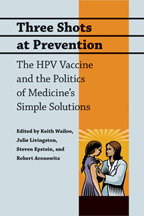
I wasn’t going to get mixed up in this but because I contributed to the volume picture at left, and I’ve been getting links to articles about this asking for my thoughts, I’ve decided to weigh in after all.

I agree that Bachmann’s rhetoric is outrageous (especially since she shows little  concern for women who have been sexually assaulted, or those who need basic reproductive health care like pelvic exams or cervical cancer treatment).

Even the conservative paper  Wall Street Journal has condemned Bachmann’s “viral politics” and demagoguery, calling this “the kind of know-nothingism that undermines public support for vaccination altogether and leads to such public health milestones as California reporting in 2010 the highest number of whooping cough cases in 55 years.”

Wow, it’s not often I agree with the WSJ!  It’s also not often that the WSJ critiques a Republican candidate — obviously Backmann is beyond the pale (and I bet Perry’s ties to Big Pharma is a plus for the pro-business publication).

At the same time, I’m going to plug my and my colleagues’ work in Three Shots of Prevention and suggest critics get it and learn about the multiple moral, ethical, and scientific questions regarding HPV vaccines.

Update:  I’m addressing Dr. Pete’s comments here rather than in the comments section.  First, I and others who work on adolescent health issues acknowledge that there is a qualitative difference between young children and teenagers.  One of the keys to successful adolescent health care is involving teenagers in the process (and as they age, asking Mom and Dad to step out of the room). In other words, girls (and boys) who are being offered the HPV vaccine should be part of the conversation about whether or not to receive it.  So individual liberty includes teenagers too, not just parents. The imagery used by Bachmann in her remarks does not acknowledge the developmental differences between teenagers and younger children.


Happy Second Birthday #twitterstorians

Two years ago today, Katrina Gulliver began compiling a list of fellow historians on Twitter, and coined the term “twitterstorian” to describe this group.  She also instructed to use the #twitterstorian hashtag (which I don’t always remember to do!).   Although I was a relative newcomer to Twitter, she invited me to a Twitterstorians happy hour and dinner at this year’s AHA convention in Boston.  In honor of this anniversary Katrina has asked us to write about our experiences with Twitter, how it has helped with our research, networking, finding information, and so forth.

In my experience, Jeremy Boggs nicely sums up the advantages and disadvantages of Twitter with the pithy phrase: “Twitter to connect, blogging to reflect.”  Readers of this blog will notice that my output here has dwindled since I joined Twitter, which is why I have my feed embedded on the blog, and have my feed automatically compiled as the Knitting Clio daily.   The “daily” isn’t just for my fans, though:  it’s the only way I can keep up with all the cool stuff that posted by those I follow without going out of my mind!   Even then, it feels overwhelming.  Also, the daily only compiles shared links, not the back and forth conversation on the network.  I don’t check the status updates on a constant basis — I just can’t or I wouldn’t get any work done (or find time to ride my bike, or knit, or play guitar, or sleep, or other stuff I like to do).

So, in short, Twitter has been a great way to connect with new people and to get new information about trends in the field.  The downside is that most of my digital output has shifted to Twitter and the longer, reflective writing that I used to do on this blog has shrunk considerably.  I need to find a balance, somehow.

Knitting Clio made it through Irene

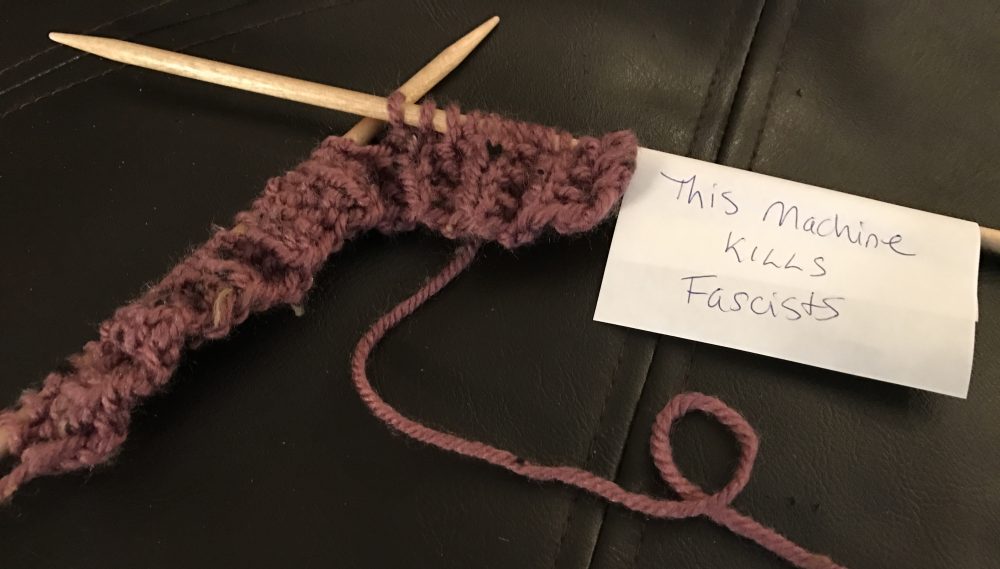
Well, I made it through the storm, along with my house, my belongings, and pets.  Others weren’t so luck — the lower half of my neighborhood is flooded and some were evacuated.  My power is still off as is half the town, so I’m updating this from the public library.  Now I need to get my act together for the start of classes tomorrow.  Of course, I couldn’t resist this time waster first (note knitting needles):

Posted in Uncategorized | 1 Reply

Happy Women’s Equality Day!

via National Women’s History Project.  Here is President Barack Obama’s proclamation:

WOMEN’S EQUALITY DAY,  August 26, 2011
BY THE PRESIDENT OF THE UNITED STATES OF AMERICA
A PROCLAMATION
The 19th Amendment to the United States Constitution tore down the last formal barrier to women’s enfranchisement in our Nation and empowered America’s women to have their voices heard in the halls of power.  This Amendment became law only after decades of work by committed trailblazers who fought to extend the right to vote to women across America.  For the women who fought for this right, voting was not the end of the journey for equality, but the beginning of a new era in the advancement of our Union.  These brave and tenacious women challenged our Nation to live up to its founding principles, and their legacy inspires us to reach ever higher in our pursuit of liberty and equality for all.

Before the Amendment took effect, women had been serving our Nation in the public realm since its earliest days.  Even before they gained the right to vote, America’s women were leaders of movements, academics, and reformers, and had even served in the Congress.  Legions of brave women wrote and lectured for change.  They let their feet speak when their voices alone were not enough, protesting and marching for their fundamental right to vote in the face of heckling, jail, and abuse.  Their efforts led to enormous progress    millions upon millions of women have since used the power of the ballot to help shape our country.

Today, our Nation’s daughters reap the benefits of these courageous pioneers while paving the way for generations of women to come.  But work still remains.  My Administration is committed to advancing equality for all of our people.  This year, the Council of Women and Girls released “Women in America:  Indicators of Social and Economic Well-Being,” the most comprehensive report in 50 years on the status of women in our country, shedding light on issues women face in employment, crime, health, and family life.  We are working to ensure that women-owned businesses can compete in the marketplace, that women are not discriminated against in healthcare, and that we redouble our efforts to bring an end to sexual assault on college campuses.

On the 91st anniversary of this landmark in civil rights, we continue to uphold the foundational American principles that we are all equal, and that each of us deserves a chance to pursue our dreams.  We honor the heroes who have given of themselves to advance the causes of justice, opportunity, and prosperity.  As we celebrate the legacy of those who made enormous strides in the last century and before, we renew our commitment to hold true to the dreams for which they fought, and we look forward to a bright future for our Nation’s daughters.

NOW, THEREFORE, I, BARACK OBAMA, President of the United States of America, by virtue of the authority vested in me by the Constitution and the laws of the United States, do hereby proclaim August 26, 2011, as Women’s Equality Day.  I call upon the people of the United States to celebrate the achievements of women and recommit ourselves to the goal of gender equality in this country.

IN WITNESS WHEREOF, I have hereunto set my hand this twenty fifth day of August, in the year of our Lord two thousand eleven, and of the Independence of the United States of America the two hundred and thirty-sixth.

BARACK OBAMA
Women’s Rights and Women’s Equality Day Resources

National Women’s History Project
3440 Airway Dr Ste F
Santa Rosa, CA 95403
http://www.nwhp.org
(707) 636-2888
nwhp@nwhp.org

Where Did August Go?

Some of you may be wondering why I haven’t posted in over a month.  Don’t worry fans, I’ve just been on vacation (in the French Haute Pyrenees, where I did loads of cycling which unfortunately was off-set by a lot of great food and wine at the pension where I stayed.  Either that or I gained five pounds of muscle.  Oh well!)

Now I’m up to my ears getting ready to teach the graduate digital history course (hence my tweet about needing some help from my fellow #twitterstorians), as well as a new undergraduate public history course that I didn’t design but I agreed to teach because no one else was available.  I’m also going through the second most stressful life event on the Holmes and Rahne stress scale.  So, it’s no wonder this month has flown by!

Reminder to Certain Feminists: Teenagers have rights to choice and bodily autonomy too

via Historiann, who discusses Mary Elizabeth Williams’ Twitter battle with Katha Pollitt and Amanda Marcotte over her Salon article about her daughter getting the wrong vaccineat her annual checkup. Williams knew she would get flak for the article, but she “wrote it anyway, because I felt strongly about two key issues of the story. If you’re going in for any procedure, drug or vaccination, take a moment to double-check that the person administering it is giving you what you’re there for. Also, I believe my daughters should have final say in whether or not they receive the HPV vaccine. And flak, indeed, I got.”

As  an expert on the history of adolescent medicine and contributed to an edited collection on the politics of HPV vaccines, I have to say “right on.”

Certain feminists in the twiterverse disagreed, though:  “Amanda Marcotte took some mighty big umbrage on Twitter,”  calling Williams’ piece an “‘overreaction’ and then proceeded to engage in something that looks remarkably like overreacting.

“A single tear shed over this causes everyone else to wonder if you don’t have real problems,” she wrote. “I’m honestly not invested in freaking out on an innocent mistake that resulted in no real problems… I mean, I have real shit to deal with in my life… If that’s the most awful thing you’ve learned at 11, you live in a big time bubble…. I’m sure her mother’s reaction to it had nothing to do with the little girl thinking this was the worst thing ever.”

Author Katha Pollitt also jumped into the fray, calling the story “ridiculous.” Not the review I’d wish for, but all right. But I’d like to correct her assessment that “I just felt this woman was hyperfreakout helicopter parent, infecting her kids with anxiety.”

Unlike Historiann, I’m a twitterstorian who tweets regularly (see my feed to the right) although I must confess I find it impossible to keep up with all the people I follow and use an automatic aggregating program to compile all these posts into the Knitting Clio daily (paper.li does this automatically — I don’t stay up late at night putting the daily together!)  I went to Twitter to look at the exchange between Williams and her critics (and fans).  I especially liked Angus Johnston’s comment:  “I think it’s utterly reasonable for a parent to want to choose when and how she discusses the HPV vaccine with her daughter.”

I made the following comment at Historiann’s blog;  “Wow, this woman dares to treat her adolescent daughter as a developing adult (i.e. follows the recommendation of experts in adolescent medicine). Kudos to her. Interesting that feminists like Marcotte and Pollitt are all for choice and bodily autonomy, unless the body in question belongs to a teenager.”

Now looking forward to my own Twitter battle!

Birth Control Blog Carnival: “We’ve Got You Covered”

via National Women’s Law Center, who has teamed up with Planned Parenthood and bloggers such as yours truly to discuss the Institute of Medicine’s recommendations to the Department of Health and Human Services that “women’s health preventive services should be included in all new health care plans.” These preventive services include “contraception, yearly well-woman visits, support for breast feeding, counseling for sexually transmitted infections, and screening and counseling for domestic violence, among others that health insurers should be requires to cover at no cost to the woman.”  If these recommendations are approved by HHS (and it’s pretty certain that HHS Secretary Kathleen Sebelius will do so) then insurance companies must cover prescription birth control without charging co-pays.

Now, I agree with other bloggers that this is a great news.  Having coverage for prescription drugs in general is a good thing, and not having to pay anything at all for prescription birth control is even better.  At the risk of sounding like a party poop, though, I’d just like to draw on my most recent work is on the history of emergency contraception (the book will be out with Rutgers in October) to make an important point about affordability and access.  As many of you know, certain brands of EC are now available over-the-counter (OTC). However,  OTC products are not covered by health insurance.  So, a switch to OTC status increases access by removing the restriction of the prescription, but can decrease access by raising the cost.  Maybe this won’t be that problematic: if women can afford regular birth control, they will have less need for a “back-up” method.  According to Elizabeth Westley from the International Consortium for Emergency Contraception, “While it is not clear exactly how over-the-counter methods such as levonorgestrel-alone brands of EC (Plan B One-Step and Next Choice) would be covered, EC is clearly a part of the report’s recommendations.”

Also,  there are efforts to make regular oral contraceptives available without prescription (I have an article about this in a forthcoming book Prescribed: Writing, Filling, Using, and Abusing the Prescription in Modern America, edited by Elizabeth Watkins and Jeremy Greene, that will be coming out with Johns Hopkins University Press in the fall).  Therefore, the issue of how to help women pay for non-prescription contraception needs to be addressed too.