Sometimes being a Pain gets results

A few posts ago I complained about the Chronicle of Higher Education ignoring messages from me and my editors about my new book.  After several more futile attempts to contact them, I finally posted my frustrations on the Chronicle’s online forum.  Within a few hours the scholarly book editor replied. Since the book has been out for a year though, it won’t get listed.

Now, the online publication, Inside Higher Education, was more on the ball — and published an interview with me in February 2008.  And folks wonder why print media is dying. . .

Added later:  So, here’s the full story.  Shortly after the book came in December 2007, the UMP marketing department sent a copy to the Chronicle, along with copies to other periodicals including IHE.  The first copy never got to the right person, so noticing that the book had not appeared in the list of scholarly books, we sent another copy  in August.  Still no listing.  No answers to my follow-up emails to the book editor (the excuse –the editor was out of the country.  Yeah, well so was I but I still managed to get back to people on my return!).  No response at all until I posted on the online forum.

So, the lesson here for other authors out there — be obnoxious proactive from the get go.  Call the editors the week after your press sends the book to make sure they received it.  Call every week until the book appears, and follow that up with an email so that you have a record.  Raise a stink until you get results.

Girls Studies Conference at SCSU

The past two days I attended the 18th annual Women’s Studies conference at Southern CT State University, the topic of which was “Girls’ Culture & Girls’ Studies: Surviving, Reviving, Celebrating Girlhood.” Some interesting resources and papers I learned about included:

Leandra Preston teaches a course on girls’ studies and  has a fascinating virtual center for Girls Studies at the University of Central Florida.  She teaches the course on girls studies partly online — they meet every other week and in between the students are supposed to blog.  She had some interesting points to make about blogging as a form of social activism and media resistance.  I thought her paper was a nice counterpoint to one I heard earlier in the day, which hauled out the generational myth about “digital natives”  and warned that shows like “Hannah Montana” are way worse for girls than the “Partridge Family” and the “Monkees” were for our generation.  [for some excellent debunking of this myth, see Siva Vaidhyanathan’s and Thomas Benton’s recent articles in the Chronicle of Higher Education]

Sarah Projansky from University of Illinois gave an interesting paper on feminist girls’ studies.  She argued that we need to look not just at representations of girls in the media, but also how girls produce media. She too deflated the assumption that the dominant media opresses girls and that it’s worse than ever before. She said this assumption is based on the myth of an innocent, pre-media girl who needs to be protected. She traced this imagined child back to the early twentieth century and discussions of pulp novels, romance magazines, and early film — I would go back even further, perhaps even to the eighteenth century novels like “Charlotte Temple.”  Her main point is that girls, past and present, have often worked against the media aimed at them — mainly through humor and satire.  She mentioned the book Girls Make Media, by Mary Celeste Kearney, which I will have to take a look at if/when I get the time.  For now, I’ll just have to make do with her blog.

Miriam Forman-Brunell presented her work on the website, Children and Youth in History, one of the latest digital projects by the Center for New Media.  The project looks great.  I hope I can pull off something similar — although she warned me it was really hard to get the NEH to fund anything that had “girls” or “women” in the title, hence the words children and youth.  Guess they won’t go for a project on our Gender Equity Collection which has all sorts of GLBT stuff in it!

The last panel, and perhaps the coolest, I attended was one on “Girls in the Library: Documenting Third Wave Feminist Activism through Zines.”  Both Barnard and Duke have huge collections of these zines (numbering in the thousands).  Kelly Wooten from the Sallie Bingham Center at Duke talked about how zines fit within the longer history of girls’ literature as well as feminist theory and activism. In some ways they are etiquette manuals for the underground — i.e. how-tos on how not to conform. According to Kate Eichhorn, zine-making continues and some zine-sters are trying to write a history of Riot Grrls and similar zine scenes.  She made an interesting point about the problems of writing an “official” history of a movement that was polyvocal, and suspicious of authority and linear narrative.  I asked why not have a hypertext history, or a wiki, to which Jenna Freedman warned that zines should not be confused with blogs [see her article on this at the Barnard website.] I think she missed my point — I understand the importance of the material objects, but new media can address many of the concerns about multiple voices and experiments in language that Eichhorn raised.

Anyway, I left the conference energized but also exhausted.  I’m always envious when I go down to SCSU because their program is much bigger, much better funded, and in general much more respected than ours is.  If only I could get that level of participation on my campus!
Return Visit by Mary Jo Kane

Yesterday, we had the privilege of a return visit by Dr. Mary Jo Kane from the Tucker Center at the University of Minnesota, who gave a great presentation on her research on media representations of female athletes.  Her main points were that the “Sex sells” argument in favor of representing female athletes in sexualized ways is not only demeaning but counterproductive in that it alienates the core audience for women’s athletics — i.e. women and girls, and Dads of female athletes.  Media images depicting female athletes in action, demonstrating physical competence, is what sells women’s sports, she argued.  Great talk, but few attended – the eternal problem of getting folks to attend something in the middle of midterms with dozens of other stuff going on around campus at the same time.

October is ALSO Disability Awareness Month

But it gets buried under the flurry of pink crap products that get carted out for Breast Cancer Awareness Month every October. Yet Disability Awareness Month has been around longer — indeed, this is the 20th anniversary of the month, and a whole week for the “physically handicapped” was created in 1945. As Rosemary Garland-Thomson shows us, there are linkages between the “extraordinary bodies” of breast cancer survivors and persons with disabilities.  Yet, because the pink stuff is such a big business, and persons with disabilities are still such an object of horror and scorn (see the new film “Blindness” — wait, don’t see it!) it’s really no wonder that the disability awareness gets lost.

Even someone who should no better, i.e. me, has not done anything to celebrate disability awareness month on campus.  Why?  Because I’ve been buried neck deep in assessment crap — our NEASC Reaccreditation site visit is coming up the week after next.  Also, we have a two major events for WGSS coming up in the next two weeks.  Do I compete against myself?

I suppose it’s not too late, but where am I going to fit this into all the stuff that’s already going on around the U?  Besides, shouldn’t the disability office be taking the lead on this?  Oh right, they don’t take the lead on anything! In fact, they are very reactive not proactive, i.e. they don’t do outreach to students, they just wait for students to come to them, and then make it really burdensome for students to get the accomodations they need.  For example, I had a hearing impaired first-year student last Fall who had to wait three weeks to get an FM receiver she requested before she got there.  This year, I’m having problems getting adequate services for a visually impaired student.  In general, the office is not very user friendly and the director takes a rather disciplinary approach, i.e acts as if a student is trying to get away with something.

Book announcement: New Book on Women Physicians

Courtesy of H-Sci-Med-Tech:

Ellen More, Elizabeth Fee, and Manon Parry are pleased to announce a new, co-edited book from Johns Hopkins University Press, Women Physicians and the Cultures of Medicine (2008). This volume examines the diverse careers and lives of American women physicians since the mid-19th century, their struggles for equality, professional accomplishment, and personal happiness. Scholars in the history of medicine in the United States chronicle the professional and personal lives of women such as Drs. Marie Zakrzewska, Mary Putnam Jacobi, “Mom” Chung, Esther Pohl Lovejoy, and Mary S. Calderone as well as women physicians who were active in “alternative” medicine, the women’s health movement, college health, and second-wave medical feminism.

Illuminating the ethnic, political, and personal diversity of women physicians, the articles touch on most of the major issues in the history of women physicians-politics, medical science, medical education, health policy, patient care, sexuality, race and ethnicity, and, of course, gender discrimination. Contributors include Carla Bittel, Elizabeth Fee, Eve Fine, Erica Frank, Virginia Metaxas, Regina Morantz-Sanchez, Ellen S. More, Sandra Morgen, Heather M. Prescott, Robert Nye, Manon Parry, Naomi Rogers, Arleen M. Tuchman, Judy Tzu-Chun Wu, and Susan Wells.

First Review of my book

The first book review for my book, Student Bodies, just appeared in the September issue of Journal of American History.  Unfortunately you need a subscription to read the whole thing but the best parts are at the beginning anyway.

Now, if I can just get the Chronicle of Higher Education to include my book in the list of scholarly books.    It’s been ten months since it came out and they have received two copies from the publisher.  I’ve also nudged them a couple of times.  I know they receive lots of books, but come on, this book as actually ABOUT higher education!  What’s a lady scholar got to do to get noticed?

Guest Blogger: Janet Golden on testing and the election

This comes from my buddy Janet Golden at Rutgers.  Enjoy!

I got my lowest grade in school in Algebra class. It really wasn’t for my performance on tests and quizzes but because I annoyed the teacher by raising my hand and asking “why?” I didn’t want to learn formulas and calculations unless I understood what the entire process was really about and why it was useful knowledge. The “unsatisfactory” grade for conduct kept me out of contention for a lot of things–like membership in the honor society, but the worst thing was that my brother was punished for my sins when he took the course four years later and she recognized the shared last name. (Sorry, Richard).

Since then, I’ve avoided math classes as much as possible and when forced to take them in college and graduate school, I remained silent. I learned my lesson.

But now, I seem to be enrolled in a political science course and that urge to ask why has returned. Why is it that we are not hearing any discussion about the lives of the poor and about what grinding systemic poverty is doing to our country? (And yes, I miss John Edwards’ voice on this as well as the occasional newspaper articles that looked beyond what “middle class voters” were saying).

No, I don’t expect those running for office to, heaven forbid, alienate any middle class swing voters by suggesting that they are a lot better off than millions of other Americans. But I do expect my friends on the left to get past their obsession with the foibles of Sarah Palin and keep the discussion about economic injustice going at a time when the media seems to think we have a two-class system: Wall Street fat cats and everyone else who is, in their view, middle class. I expect people who are now in the habit of writing checks to support candidates for change to get ready to write checks for things that haven’t changed much or have changed for the worst–by supporting local food banks, for example. While we’ve been laughing about moose meat, a lot of people have been going to bed hungry. A lot of people never had homes to be foreclosed. A lot of people who managed to get jobs lost their Medicaid and their access to the health care they need. Why can’t we talk about these things?

I know I’m going to be getting another “unsatisfactory” mark for bringing up this subject. This time, I don’t mind.

Janet Golden

Professor of History

Rutgers University-Camden

Little Berks Report

Interlaken Inn and Conference Center

Interlaken Inn and Conference Center

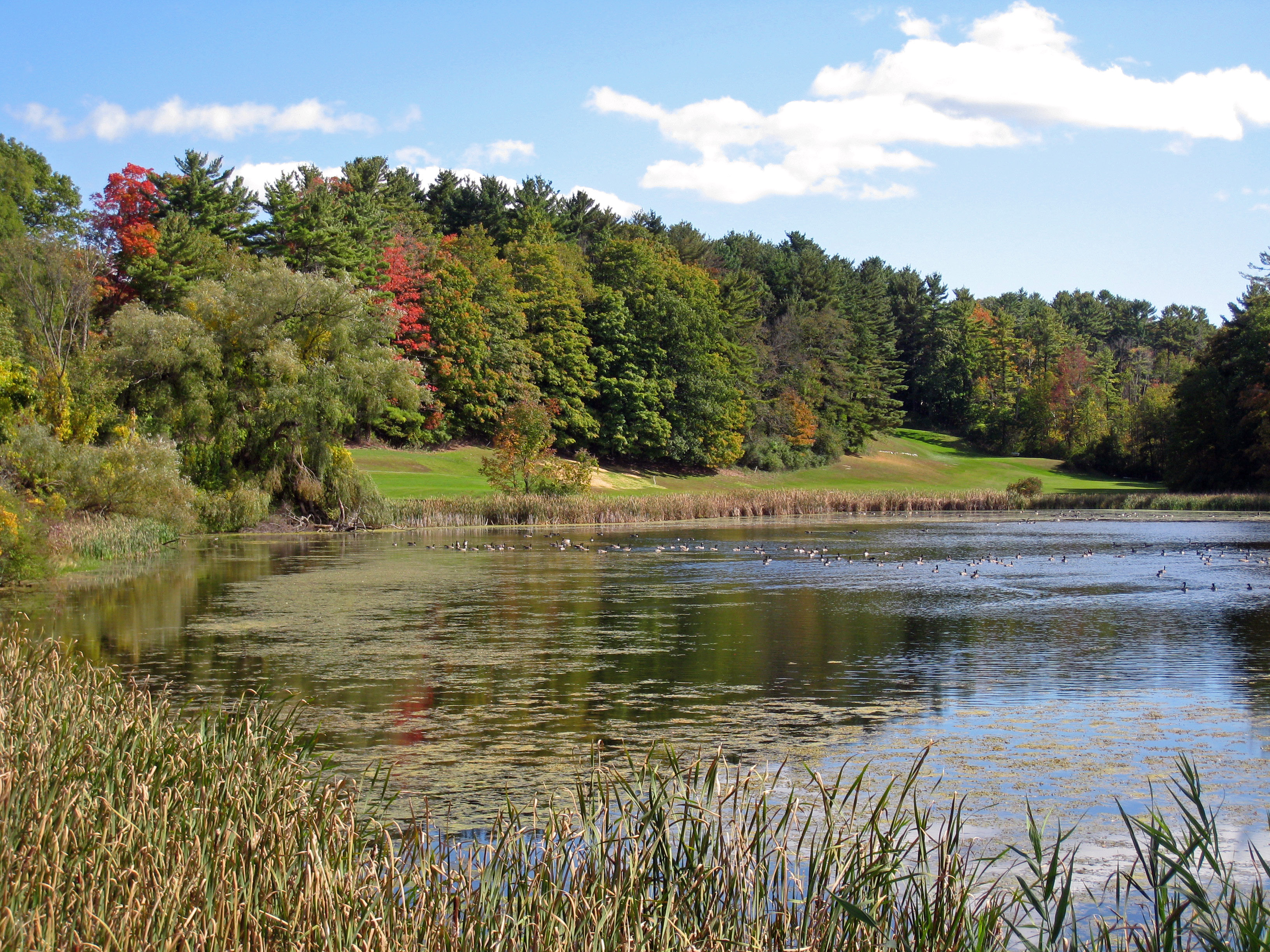
Yesterday, I drove out to the Interlaken Inn and Conference Center in Lakeville, CT to attend the second day of the “Little Berks” meeting (I was too sick on Friday to drive out and back — turns out that since I’m on the program, they would have paid for me to stay there. Oh well, it was less than an hour each way).  I arrived just before lunch.  Here’s a view of Lake Wononscopomuc, where we ate al fresco:

And since “Interlaken” means between the lakes, here is the other lake that I walked to after lunch:

As you can see, it was a gorgeous autumn day.

Now the schedule at these things is very leisurely — there was a good couple of hours between lunch and the business meeting, during which one can stroll, troll for antiques, or loll around as one sees fit.  The business meeting was very informative — we learned that Kathleen Brown, Professor of History at UPenn, will be the next Berkshire President.  A few proposals for the location of the next Big Berks were discussed although I’m not sure how much I’m supposed to divulge here.  I imagine there will be an official report sometime on the Berks homepage.

I heard that the weekend was supposed to be casual — so I fit right in when I arrived in jeans and a knit shirt.  However, no no told me that there was a tradition of dressing for dinner.  So, I remained in my jeans and shirt while others went back to their rooms to get into various levels of elegance (okay, a few others remained pretty casual too).  Apparently this is a hold over from the organizations beginnings in the glamorous 1930s.

The panel went extremely well.  Tenured Radical has posted the highlights of her talk at her blog and Clio Bluestocking plans to do so shortly.  I gushed at length about the possibilities of social scholarship and waxed nostalgic for the heyday of H-Women in the 1990s, when the list was a discussion forum rather than an announcement board. The response was overwhelmingly positive and the discussion continued for nearly an hour.  Hopefully we encouraged at least a few to consider blogging.

I neglected to mention that one way to keep up the momentum of the Sunday seminars at the Big Berks going is to have use the Berks  blog for discussion after (or even before) the meeting starts.  Or perhaps we can have carnivals of posts by women’s history bloggers as they do at Disability Studies, Temple U.  At the very least, I hope we can get a larger group of bloggers and/or digital history folks together for a panel for the next Big Berks (any takers out there?).

Outline for Little Berks Talk

How I Got Started

Evolution of Blog

  • from sandbox to scholarship
  • see category cloud for themes — women’s history, medical history, disability history, childhood/youth
  • reports from the field — e.g. conference reviews
  • some political commentary, silliness, hobbies

Graduate History Course:

  • course blog
  • blogging as reflective practice
  • mixed results
  • “digital natives” more interested in Facebook than blogging

Current Status

  • very low traffic
  • busiest day was right after Big Berks and “Bre’r Rusticus” article at History News Network
  • what happened to H-Women
  • H-Net goes 2.0 — Matrix
  • need for critical mass of bloggers and social scholars for robust exchange to occur [see roundup at Berks Blog]
  • why not start your own blog?