Speaking of Rosie — Governor of Maine decides to literally whitewash her and other workers from state history

via Inside Higher Education.

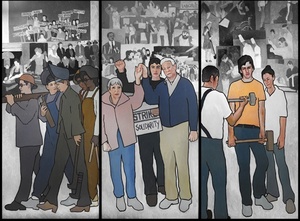
If the Republican assault on academic freedom weren’t bad enough, now we have an example of a Republican governor’s assault on artistic freedom, and a literal whitewash of state history.  Last weekend, Governor Paul LePage of Maine ordered that the mural of state workers (panel at left) be removed from the state’s Department of Labor building.  Employees returned to work on Monday to find the conference room where the mural was located replaced with white walls and fresh spackling.  All this because of one anonymous fax from a “secret admirer” [one of the Koch brothers perhaps?]  that complained the mural was too pro-labor and reminded him/her of “North Korean propaganda.”  What?  It’s the Department of Labor for crying out loud — isn’t it supposed to be pro-labor?

Naturally, Judy Taylor, the artist who was commissioned to paint the mural finds the decision horrible, and labor leaders in the state are outraged.  In an interview for the Portland Herald, Matt Schlobohm, executive director of the Maine AFL-CIO, called the decision “insulting to working people, petty and shortsighted.”

“It seems the governor is much more interested in picking fights with labor than creating jobs that people so desperately want,” he said. “We believe their story deserves to be told on the walls of the Department of Labor.”

Ralph Carmona, spokesman for the League of United Latin American Citizens, is troubled by the decision to rename a conference room now named after labor leader Caesar Chavez.

The really bad news is that his decision to remove a civil rights icon’s name from the Labor Department reflects an underlying pattern of actions and words that affect all Mainers,” he said.

That pattern includes LePage’s comment to the NAACP to “kiss my butt,” saying that women might grow “little beards” if they are exposed to the chemical Bisphenol-A, and a statement that he would go after union rights, Carmona said.

“What is next, the burning of books or the end of Labor Day as a holiday?” said Jose Lopez, director of the Latin American league. “When you add it all up, he is talking about business in a narrow sense that excludes Maine people and the public interest.”

Lynn Pasquerella, president of Mount Holyoke College, on Tuesday sent a letter to Governor Paul LePage criticizing this decision.  She and many students and alumnae are upset because the mural includes a panel of distinguished MHC alumna Frances Perkins (left), Secretary of Labor under President Franklin Delano Roosevelt and the first woman to hold a cabinet position.  According to Pasquerella, “the timing for this decision could not have been worse. Friday, March 25, marked the 100th anniversary of the horrific Triangle Shirtwaist Factory fire. This event strongly influenced Perkins’s lifelong commitment to the well-being of working men and women, as well as to working children in those days of rampant exploitation. But on an even larger scale, the Great Recession we are now struggling through–and which has hit Maine particularly hard–has numerous historical parallels with the Great Depression. Labor Secretary Frances Perkins, the first woman presidential Cabinet member, figured prominently in leading us out of that cataclysm.

I was particularly surprised to read that you were influenced by an anonymous fax comparing the 11-panel mural to North Korean political propaganda, because the act of removing images commemorating Maine’s history itself conjures thoughts of the rewriting of history prevalent in totalitarian regimes. If the U.S. Department of Labor in Washington, D.C. is housed in the Frances Perkins Building, why can’t she be honored with a conference room in Augusta?”

Why indeed.  As Civil Rights heroine Fannie Lou Hamer once said, is this America?
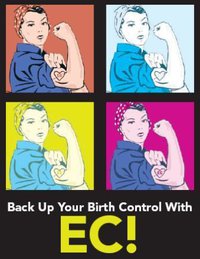
Blogging for Emergency Contraception

via Back Up Your Birth Control.  Today is the 10th annual national day of action for Back Up Your Birth Control, a media campaign sponsored by the National Institute for Reproductive Health. I’ve agreed to blog to raise awareness about this.

Because I’m a shameless self-promoter, I’m also going to start with an update on my forthcoming book, The Morning After: A History of Emergency Contraception in the United States.  The page proofs will be arriving in a couple of weeks.  Meanwhile, here’s the blurb that will appear on the publisher’s website, catalog, and the book cover:

“Since 2006, when the “morning-after pill” Plan B was first sold over the counter, sales of emergency contraceptives have soared, becoming an $80 million industry in the United States and throughout the Western world. But emergency contraception is nothing new. It has a long and often contentious history as the subject of clashes not only between medical researchers and religious groups, but also between different factions of feminist health advocates.

The Morning After tells the story of emergency contraception in America from the 1960s to the present day and, more importantly, it tells the story of the women who have used it. Side-stepping simplistic readings of these women as either radical feminist trailblazers or guinea pigs for the pharmaceutical industry, medical historian Heather Munro Prescott offers a portrait of how ordinary women participated in the development and popularization of emergency contraception, bringing a groundbreaking technology into the mainstream with the potential to radically alter reproductive health practices.”

I had to stop somewhere, so the book shortchanges the most recent developments — especially the most recent efforts to use of social media to raise awareness of EC. [BTW, the Back Up Your Birth Control campaign has a Facebook page and you can find related posts on Twitter using #backitup and/or by following @nirhealth).

The use of the Web to promote EC originated in the early 1990s with the emergency contraception website at Princeton. The Back Up Your Birth Control Campaign began amidst the battle to get the FDA to approve Plan B as an over-the-counter drug.  What’s interesting to me as a historian is the use of graphic artist J. Howard Miller’s “We Can Do It” poster, which he created for Westinghouse under the sponsorship of War Production Board (this image should not be confused with the Norman Rockwell painting “Rosie the Riveter” that appeared on the cover of the Saturday Evening Post May 29, 1943, and is still under copyright.  The Rockwell paiting was recently acquired by the Bentonville Museum in Arkansas, founded by Wal-mart heiress Alice Walton and the Walton Family Foundation — oh the irony!).  Personally, I like the Rockwell image better, but do you think the Waltons will allow anyone to use it without paying major $$ — not bloody likely!  “We Can Do It” does not have such copyright restrictions, so various groups use it freely.  (for more on these images and American popular culture, go here).  It’s become a feminist icon of female empowerment, but this article demonstrates that “during World War II the empowering rhetorical appeal of this Westinghouse image was circumscribed by the conditions of its use and by several other posters in its series.”

Returning to EC — the history of the various awareness campaigns over the years is fascinating but was nearly impossible to illustrate in the book because, like many of us, the organizations that created these images didn’t preserve them once they were no longer useful.  Others put them on their websites, then discarded the original files.  Then there’s the problem of finding the copyright holder and getting permission from him/her.  Here’s an image that I couldn’t use because there was no digital file that had a high enough resolution for reproduction — it also nicely sums up my frustrations with the whole process:

image courtesy of Canadian Federation for Sexual Health

So, here’s a recommendation for the Back Up Your Birth Control Campaign — back up your “born digital” materials and preserve your digital heritage!

Women’s historians and Dukes v. Wal-mart, or what we learned from the Sears case

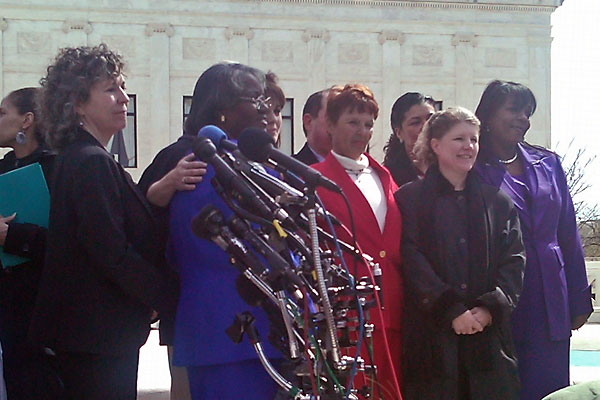
image courtesy of @ACLU via twitpic

via New Deal 2.0. which in honor of women’s history month, has a series of posts on “the surprising story of how women became citizens — and how their economic lives have evolved along with their rights.” Yesterday’s post considers the oral arguments that will be made before the U.S. Supreme Court  in the Dukes v. Wal-mart Stores, Inc. case “that will determine the power of women — and all Americans — to stand up to employer abuses.

While I wait to see what the SCOTUS says in this case, I’ll reflect on another case involving a retail giant — Sears — that happened 25 years ago when I was just a wee Clio graduate student at Cornell.  In the Fall of 1986, the hot topic among those of use studying women’s history was the recently decided district court case, EEOC v. Sears, in which two prominent women’s historians, Rosalind Rosenberg  and Alice Kessler-Harris served as expert witnesses.  Rosenberg, testifying on behalf of Sears, argued  “Men and women differ in their expectations
concerning work, in their interests as to the types of jobs they prefer or the types of products they prefer to sell. . It iss naive to believe that the natural effect of these differences is evidence of discrimination by Sears.” In other words, the reason that men were in high paying commission sales jobs (e.g. automotive, appliances) was because women chose other areas to work.

Kessler-Harris countered, “What appear to be women’s choices, and what are characterized as women’s ‘interests’ are, in fact, heavily influenced by the opportunities for work made available to them . . . Where opportunity has existed, women have never failed to take the jobs offered. . . . Failure to find women in so-called non-traditionall jobs can thus only be interpreted as a consequence of employers’ unexamined attitudes or preferences, which phenomenon is the essence of discrimination.”

Unfortunately for the EEOC who filed on behalf of female employees, the court believed Rosenberg and declared that Sears did not discriminate based on sex.  As Ruth Milkman observed in her analysis of the case in Feminist Studies in 1986, “Historians, even feminist historians, frequently disagree with one another. But it is difficult to imagine a forum less tolerant of the nuanced, careful arguments in which historians delight than a courtroom.”

This may explain why, to my knowledge at least, there haven’t been any women’s historians speaking about the Dukes case.  Then again, maybe like me, they’re waiting to hear what happens with the Supremes.  Based on early reports, things don’t look encouraging.

Trumbull Library presentation on Henrietta Lacks and the Immortal Life of Health Care Inequalities

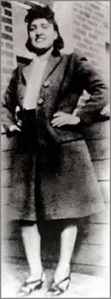
Earlier this week, I helped lead a discussion of Rebecca Skloot’s book The Immortal Life of Henrietta Lacks as part of the Trumbull public library‘s One Book One Town series.  My co-leader was Laura Stark from the Science and Society/Department of Sociology at Wesleyan University.  Laura was a fact-checker for the book while she was a fellow at the Office of National Institutes of Health History.  Laura focused on points raised in her forthcoming book, Behind Closed Doors: IRBs and the Making of Ethical Research, which will be published in November with The University of Chicago Press.  She looked at how the treatment of human subjects in the United States has evolved since the Second World War and this impacts Institutional Review Boards today.  My emphasis was on standards of care for cervical cancer patients then and now, and how this intersected with prevailing issues of race, gender, and class.   As Skloot observes, Henrietta’s care was typical of teaching hospitals at this time, and Johns Hopkins was one of the few in the region that admitted African American patients (albeit in segregated wards).  During the 1940s and early 1950s, there was no Medicaid and third party private insurance was only beginning to become an employee  benefit.  So, as a “charity patient” Henrietta received state of the art cancer treatment that many at that time could not afford.  The care would have been the same had she been white.  Yet, the prevailing attitude at the time was that since “charity cases” were treated for free, doctors were entitled to use them in research, whether the patients realized it or not. Henrietta’s doctor once wrote, “Hopkins, with its large indigent black population, had no dearth of clinical material.”

Also, epidemiological studies of cervical cancer tended to reinforce cultural prejudices about race and socioeconomic status of the time period. By the early 1950s, researchers noticed that cervical cancer was common in prostitutes and others with multiple sexual partners; rare in Jewish and Muslim women; and practically non-existent in nuns and virgins.  There was considerable debate about whether this was due to an infectious agent or genetics. The notion that different races had propensity to certain diseases was common  — e.g. blacks were characterized as a “notoriously syphilis-soaked race” while Jewish persons were believed to be more prone to respiratory illnesses like TB. So, “race medicine” included the theory that Jewish and Muslim women were more likely to develop cervical cancer because of their “race.”  We now know that male circumcision helps prevent the transmission of sexually transmitted infections, such as the human papilloma viruses that cause many genital cancers. Starting in the 1950s, scientists explored the link between adolescent sexual activity and the development of cervical cancer later in life. Several epidemiological studies published in the 1950s and early 1960s indicated that women who married before age 20 appeared to be at higher risk for cervical cancer. Some speculated that women who had multiple “broken marriages” were especially susceptible. Some cancer researchers hypothesized that some kind of infectious agent transmitted by male partners was a contributing factor, and that the adolescent cervix was especially vulnerable to “epithelial transformation” by exposure to such an agent. Given that a disproportionate number of patients were nonwhite, non-Jewish women of low socioeconomic status, recommended that routine pap smears were especially important for “nonvirgins” from underprivileged groups. These findings also tended to reinforce prevailing stereotypes about the links between disease risk, race, and class – those living in poverty – especially if they were nonwhite – more likely to be “promiscuous.”

At the same time, the introduction of Pap smear led to the notion that “cancer was curable” if caught early — this provided the justification for annual gynecological examinations.  Prior to Medicaid,  a young woman of Henrietta’s social class would not have had access to routine preventive medical care. Thus, the health disparities indicated by cervical cancer studies were used to justify government funded preventive screening for those living in poverty.

Another recent development has been efforts by health activists to make medical research more inclusive.  As Eileen Nechas and Denise Foley show in their book Unequal Treatment reformers fought to make sure that all studies funded by NIH included women, racial minorities, children and adolescents, where appropriate, historically “decisions on what aspect of health to study, on what research protocol to fund” were based “not only on scientific merit . . . but on a judgment of social worth. What is valuable to medicine is who is valuable to society, and that is white men.”  Since the late 1980, health activists fought to make sure that all studies funded by NIH included women, racial minorities, children and adolescents, where appropriate; and made sure that diseases that disproportionately affected these groups got “equal time” and money.

Here are the discussion questions we gave to the audience:

Should people have a right to control what’s done with their tissues once they’re removed from their bodies? And who, if anyone, should profit from those tissues?

Deborah says, “But I always have thought it was strange, if our mother cells done so much for medicine, how come her family can’t afford to see no doctors? Don’t make no sense” (page 9).   Should Lacks family be compensated by those who profited from research on HeLa cells?

How does this story relate to recent history of health care reform, and attempts to expand access to medical advances made possible by research on HeLa and other human tissues?

How can medical professionals recognize that certain diseases affect certain racial/ethnic groups without replicating prejudices of old “race medicine”?

Ms. Magazine also needs some help from women’s historians

via Ms. Magazine Blog where freelance writer Allison McCarthy asks “What Would an Intersectional Women’s History Month Look Like?”

If McCarthy had done research beyond the Hitler History Channel website she would have an answer — we women’s historians have been looking at this for years!   Look at resources produced by the Berkshire Conference of Women Historians, women’s history bloggers (including those like me who blog about a variety of things, and the intersections between them), metasites like Discovering Women’s History Online, and  the H-Women listserv where the vast majority of women’s historians still get information and connect on the Internet.  Then of course, there are numerous non-digital (aka “dead tree”) sources — books (including the textbook I use for my survey course), scholarly articles in women’s history journals, women’s history archives, etc.

Happy 100th anniversary of International Women’s Day

As stated in my last post, a group of us women’s historians are writing blog posts for a women’s history month edition of the History Carnival.  My original plan was to blog about my specialty — reproductive rights, which I will do in a future post.  Then this past Sunday, Theresa, the minister of education at the church I attend, Trinity Episcopal in Collinsville, CT, handed me a newsletter from the Sisters of Charity Action Network. Since today is Shrove Tuesday (aka Mardi Gras), I’ve decided to blog about this instead. Theresa is a former member of this Catholic religious order, and like many nuns and priests of her generation, left the the order when Vatican II decided against allowing priests and nuns to marry.  However, Theresa has remained in the Catholic church despite being minister of education at an Episcopal church, to continue the work of reforming the Church from within.  The Sisters of Charity Newsletter reminded me of the role that religious women played in the various social justice campaigns of the twentieth century — including access to higher education for women — work that often got them in trouble with the church hierarchy.  This work continues a hundred years later.  [see their prayer for International Women’s Day] Some examples:

Social justice for immigrants — including an Ash Wednesday pilgrimmage to Elizabeth Detention Center on Ellis Island, where 1,500 immigrants are being held awaiting trial and eventual deportation. This is part of the New Sanctuary Movement of New York, a coalition of religious congregations opposed to the Secure Communities Act.

Campaigns against human trafficking, including a panel at Fordham University on March 26, featuring Rachael Lloyd, founder of Girls Educational & Mentoring Services (GEMS), dedicated to helping young women who are sold into labor or sex slavery in New York, throughout the U.S. and worldwide.  Lloyd’s memoir, Girls Like Us, will be released next month.

Activism on behalf of the environment — including celebration of Earth Hour on March 26.

Here’s a tribute to women’s work for social justice in honor of International Women’s Day, From Suffragette to Social Networker:

Women’s History Carnival 2011

via History Carnival.

It’s that time of year, the one that makes those of us in the field of women’s history slightly batty super busy getting everything ready for our women’s history month events, with the help of the National Women’s History Project (image above).  If that weren’t enough, some of us in the women’s history blog/twittersphere are so masochistic enthusiastic that we’re participating in a Women’s History Carnival too.  Here’s more information from the History Carnival site:

In honor of International Women’s Day and Women’s History Month the History Carnival is inaugurating a special Women’s History Carnival for March 2011, for all blogs and blogging about the history of women, gender and feminism. We don’t know exactly what’s going to happen yet, but hopefully it’ll be a bit different from the usual History Carnivals:

There should be at least one Carnival post, but we’d like to do much more than that! We’ll publicise any great blogging or themed events we come across (or you tell us about) and generally do our best to encourage discussion and bang the drum for women’s history.

There’ll be further updates on Twitter throughout the month at @historycarnival and on this website. If you’d like to get involved, if you’re doing something for Women’s History Month that you’d like to publicise, or you have ideas for different events, you can leave a comment below, use the contact form, or just send a tweet @historycarnival.

Plus, you can follow the RSS feed for WHC announcements

The Carnival

Depending on nominations, it’s likely that there will be a Carnival posting (venue tbc) shortly after International Women’s Day, with a follow-up towards the end of March to round up the month’s activities. You can nominate blog posts for the Carnival using this special nominations form. (Don’t use the normal HC nomination form.) Although recent material may be given priority, anything written since March 2010 will be considered!

Blog conversations

Join in blogging for Women’s History Month! A few people we hope to hear from are listed below (more to follow)…

Jen Newby, Writing Women’s History (twitter)
Judith Weingarten, Zenobia: Empress of the East (twitter)
Penny Richards (twitter)
Knitting Clio (twitter)
Katrina Gulliver, Notes from the Field (twitter)
Another Damned Medievalist, Blogenspiel
Sharon Howard (twitter)

Other places

Twitter
Follow @historycarnival for news: hashtags #whc11 or #twitterstoriennes

Women’s History and Wikipedia Part II: Wikiproject Women’s History

Ask and ye shall receive — Cliotropic has just set up a formal  Wikiproject: Women’s History.  This is also accessible by the shortcut WP:WMNHIST.

Cliotropic says that anyone can participate, but would “particularly love to see more professional scholars get involved. I know that there’s significant opposition to Wikipedia in some academic quarters, but I think that the information there isn’t going to get better unless people who actually know this stuff start pitching in. I’d really like WikiProject Women’s History to deploy a good quality scalethat helps our students evaluate whether the material in any given entry is trustworthy for their own research. And, as I’ve already said, I think that competent undergrads can be involved in this work very fruitfully as a learning project.”

Here’s more information on how to help:

  • Create a Wikipedia account. If you want to boost the contribution percentages credited to women, fill out your demographic information appropriately (even though it’s not required.)
  • Read a bit about how to contribute to Wikipedia. Start with their page onyour first article. For the social conventions of “talk pages,” which are where discussion about individual articles and projects happens, see the talk page guidelines.
  • Edit the WikiProject Women’s History proposal to add your username (in section 2, “Support”) and add any comments in section 3, “Discussion”.)
  • Go to the main page for the WikiProject and help expand our list of articles that should exist. If you’re an experienced Wikipedia editor, you might help reorganize the list if it’s getting unwieldy. If you’re unsure of what to do, ask on the talk page.
  • Once you’ve added anything, no matter how small, to the WikiProject page or to one of the articles mentioned, add your name to the WikiProject Women’s History Members page.
  • Wikipedia’s organized by a kind of benevolent anarchy. If you’re interested in taking a leadership role (formal definition of goals and scope; implementing a quality scale; starting a task force for entries on a particular national context, subfield, or time period) please go ahead. Write a note on the members page about what you’re interested in working on, and start doing it.

So, please help spread the word about this project to other women’s historians.  Like Historians of Science, we cannot allow a Wikipedia gap!

How Women’s Historians can help close the Wikipedia Gender Gap

via Cliotropic, who comments on the recent report that only about 15% of Wikipedia contributors are women. Cliotropic notes that ” Wikipedia’s user-demographics data is entirely voluntary and that many women, offered a chance not to identify themselves by sex, avoid doing so. Sometimes it’s an effort to avoid harassment, and sometimes it’s to avoid the women-targeted ads. So their data may well be off.”

Related to this gender gap in who writes for Wikipedia is the woefully inadequate coverage of women’s history in Wikipedia — not surprising since women’s history, after decades of research and teaching, is underrepresented in both higher education and K-12 history teaching.  Cliotropic says, “if you teach history courses on women, gender, or sexuality, or on the history of any racial or ethnic minority in the United States, it’s worth considering adding a Wikipedia assignment to your syllabus.”

One of the commenters suggests using Jeremy Boggs’  “stub-expanding” course assignment for his U.S. survey course  here -but there isn’t a stub section for women’s history!

It’s too late for me to assign this for my women’s history class this semester but I think I will take Cliotropic’s suggestions in the Fall.

Meanwhile, I think it’s a good idea for those of us who are professional women’s historians to think about investing our time in improving the representation of women’s history on Wikipedia.  Shelby Knox’s comments to my post about her Radical Women’s history project reminded me that digital sources like Wikipedia and “this date in history” sites are the point of entry for many young women, and young people in general.  Of course, we would like them to use more authoritative sources like Notable American Women and Notable Black American Women, but that still means schlepping to a bricks and mortar library (assuming there is one close by that’s open regular hours and actually owns the books).  And, we academics are all familiar with Gerda Lerner’s 1975 essay in Feminist Studies that pointed out the limitations of “compensatory history” that simply looks at the “women worthies.”  Still, if “great women” is where our students and feminist activists like Knox are starting, then we have to meet them there.

What do others think?

Help educate Shelby Knox about Radical Women’s History and the Limits of the Hashtag

via The Ms. Education of Shelby Knox.  Those of you who teach WGSS courses are no doubt familiar with the 2005 film, “The Education of Shelby Knox,”  which highlights “the need for comprehensive sex education, gay rights, and youth activism.”  Knox now has a blog, and has an account on Twitter, where she does a series of “this day in women’s history” tweets, marked with the #wmnhist tag.  Every morning she combs “through pages and pages of HIStory to find the couple of morsels pertaining to women that wind up on my Twitter feed.”  Knox finds that after a year of searching that “the “women” in that phrase are most often white, straight, cisgender, able-bodied, and Western. Just as women have been mostly left out of the broad discourse we call “history,” women of color, indigenous, queer, trans, disabled and non-Western women (and women living within all the intersection thereof) have been further marginalized, mostly left out of or tossed in as an afterthought in feminist attempts to add women to existing history.”  So, she’s decided to launch the Radical Women’s History Project. “What that means is that every day this year, starting on January 1st, 2011, I’m scouring the internet and books and any other source I can find to chronicle the lives and the accomplishments of the world’s women, explicitly centering women of color, indigenous, queer, trans, disabled, and non-Western women, and I’m posting them here for whomever would like to use them.”

This is an excellent endeavor, but before she reinvents the wheel, I encourage her to consult the wealth of resources produced by the Berkshire Conference of Women Historians, women’s history bloggers (including those like me who blog about a variety of things, and the intersections between them), metasites like Discovering Women’s History Online, and of course that “so twentieth century” technology, the H-Women listserv where the vast majority of women’s historians still get information and connect on the Internet.  Then of course, there are numerous non-digital (aka “dead tree”) sources — books (including the textbook I use for my survey course), scholarly articles in women’s history journals, women’s history archives, etc.

So, help me help educate Ms. Knox — suggest some links and sources that I’ve missed and/or endorse the ones I’ve already mentioned.