Belated Blogging Against Disablism

Please forgive this late post, but I just returned from the American Association for the History of Medicine meeting at the Mayo Clinic in Rochester, MN.  Even though I had my brand new Netbook with me, I completely forgot about Blogging Against Disabilism Day which was Saturday, May 1.  While the AAHM meeting was fabulous, the conference organizers, or perhaps the conference hotel, or both, forgot about accessibility issues when setting up for the presentations.   The speaker podiums were mounted on platforms that were over two feet high, with no stairs.  It was hard for even a long-legged temporarily able-bodied gal like myself to climb up and down from the platform.  One presenter who has a physical disability had to make her own arrangements (music stand, hand-held microphone) so that she could present without injuring herself.

So, word to the local arrangement folks for the AAHM’s  future meetings — make sure that the set-up accommodates the needs of  persons with disabilities.

More on the History of the Pill

via – NYTimes.com.  This is an editorial by University of Minnesota Professor Elaine Tyler May, whose new book America and the Pill: A History of Promise, Peril, and Liberation (pictured at left) was just released.   I’m glad to see that May deflates the truism that the Pill caused the sexual revolution — as Kinsey observed, the sexual revolution was well underway before 1960.  Furthermore, as said in my previous post, the Pill wasn’t available to many women when first released.  Even married women in the state of Connecticut could not legally obtain the Pill until 1965 and it took another seven years for the “right to privacy” to be extended to unmarried women as well.

Since Knitting Clio never misses an opportunity to plug her own work, I’ll mention that the Pill is the subject of my paper at the upcoming annual meeting of the American Association for the History of Medicine .   The title is “Safer Than Aspirin: The Campaign for Over-the-Counter Oral Contraceptives.” A longer version of the paper will appear in The Prescription in Perspective: Therapeutic Authority in Late 20th Century America. Edited by Jeremy A. Greene and Elizabeth Siegel Watkins, under contract with Johns Hopkins University Press.

Here’s the abstract:

On January 21, 1993 the U.S. Food and Drug Administration (FDA) announced in the Federal Register that the agency’s Fertility and Maternal Health Drugs Advisory Committee would hold an open public hearing to discuss issues related to providing oral contraceptives without prescription. Philip A. Corfman, director of the Center for Drug Evaluation and Research, stated the agency’s reasoning for this hearing:”I think the pill is safer than aspirin and aspirin is available over the counter.”

One week after the posted Federal Register notice of the open hearing, FDA officials canceled the session. The reasons for this abrupt move, and subsequent failures to make oral contraceptives available over-the-counter, are the subject of this paper. I will use the discussion about nonprescription status for oral contraceptives as a case study in the history of the switch from prescription to over-the-counter drugs. This paper will highlight the conflicting positions of the various stakeholders invested in restricting or promoting consumers’ direct access to their medications.

Earth Day and the Pill

As many of you know, today is the 40th anniversary of  Earth Day. Next month will mark the 50th anniversary of the introduction of the contraceptive Pill in the United States.  This afternoon, I’m giving a paper at a conference celebrating 40 years of coeducation at Trinity College in Hartford (conference logo at left) that ties the two stories together.   My talk is adapted from my chapter in this book with some additional material on Connecticut incorporated.  I start with Gloria Steinem’s claim that the “contraceptive revolution” started on college campuses in 1962.  This certainly wasn’t true in Connecticut, where it was illegal for married persons to get contraception.  Even after the Griswold v. Connecticut decision in 1965, individual states did not guarantee that the right to privacy extended to married persons.  The state of Massachusetts explicitly outlawed giving contraceptives to unmarried minors, and Bill Baird was arrested for “crimes against chastity” for giving contraceptive foam to an unmarried students following a lecture at Boston University in 1967.

My paper contrasts the situation at Trinity with that at Yale University, which also went coed in 1969 (actually the undergraduate college went coed; the graduate school already admitted women).  The Yale Student Health Service hired a gynecologist shortly before the college admitted women, out of fears that “that all the young girls descending on campus would get pregnant,” [this quote comes from an interview by Judy Klemesbud, “Yale Students Have Own ‘Masters and Johnson,” in the New York Times April 28, 1971]. Trinity College, however, did not hire a gynecologist but instead sent students to Planned Parenthood or local hospitals.  Female students didn’t like this situation, of course, and formed the Trinity Women’s Organization and organized a women’s week in 1972 to express their concerns that the college was not doing enough to accommodate women.  According to one of the women’s organization’s founding members, sophomore Sara Throne, many women “came here feeling like invaders in a foreign land” since. no one had done anything to make welcoming to women. Male professors trivialized women’s intelligence, there was no gynecologist or woman counselor on campus, no feminist literature in the library, no woman in the athletic department. Instead, said Throne, “We’re expected to fit ourselves into what’s already here.” [this comes from an article by Linda Greenhouse, “Problems Seen in Women’s Bias Fight,” in the Hartford Courant February 13, 1972]

At the same time that Yale and Trinity were going coed, the organization Zero Population Growth was sponsoring teach-ins on college campuses emphasizing the “catastrophic impacts of ever more human beings on the biosphere.” The first Earth Day celebration in 1970 made U.S. human population limitation a major theme. ZPG started a regional group in Connecticut in 1972 in order to lobby for better family planning services in the state and removal of state laws prohibiting abortion. The group actively recruited students at Trinity, University of Connecticut, Connecticut College, and other colleges around the state.

Even though some student organizers emphasized that the baby boom among middle-class Americans was the main cause of “overpopulation” in the United States, the alliance between birth control advocates and ZPG was an uneasy one. Officials at Planned Parenthood Federation of America were especially cautious about the appeal of ZPG on college campuses. Dan Pellegrom, Director of Planned Parenthood’s Program of Student Community Action, told University of Connecticut Biology Professor Nancy Clark, that given the controversial nature of ZPG, and population groups more generally, it was “essential” that Planned Parenthood provide leadership at the ZPG’s teach-ins, and use it as a way to increase student interest in forming campus chapters of PPFA. Pellegrom warned of the dangers of affiliating with ZPG, however. Based on his experience working with black community groups, he had “personal problems” with ZPG, “one, because their rhetoric could be taken by the black communities as genocidal and two, because they seem to be often politically in adept.” [this comes from a letter in the PPFA archives at Smith College]

Planned Parenthood leaders recognized that enlisting the support of black students was essential in establishing the legitimacy of birth control among the African American community, both on and off campus.  One of the earliest college chapters was at Hampton Institute, a historically black college in Virginia.

So, I’m concluding that the “contraceptive revolution” didn’t just happen because the Pill was invented:  students had to organize and demand reproductive health services be provided on campus.  This work continues with Planned Parenthood’s Vox program.

Today is Equal Pay Day!

via American Association for University Women who sends a message from Lilly Ledbetter (pictured below).  After Lilly lost her Supreme Court case alleging pay discrimination against Goodyear Tire, Congress passed and President Obama signed into law the Lilly Ledbetter Equal Pay Act of 2009:

An Equal Pay Day Message from Lilly
Lilly Ledbetter at AAUW Convention
April 20 is Equal Pay Day, the symbolic day when women’s earnings catch up to men’s from the year before.  In honor of this day, I’m joining forces with AAUW and their coalition partners to urge the Senate to quickly pass the Paycheck Fairness Act (S. 182).  And I’m asking you to join us in this fight for pay equity as well.  Make sure your senators know that this legislation is important to you by emailing them now.  As I said at an AAUW conference last year, giving women the Ledbetter Act without the Paycheck Fairness Act is like giving them the nail without the hammer.
Without the Paycheck Fairness Act, women will continue to be silenced in the workplace, just like I was-prohibited from talking about wages with coworkers without the fear of being fired.  This forced silence keeps many women from discovering pay discrimination in the first place.  It happened to me for several decades, and it can happen to you, your daughters and granddaughters, your sisters and moms, and your friends.  Especially in this economy, the fear of being fired is strong enough to keep women from even broaching the subject.
Now I know that some people will say that with times as tough as they are, we can’t afford to worry about pay discrimination now.  But I’m here to tell you that this recession makes pay equity even more important. With women now making up half of the workforce, more and more families are dependent upon a woman’s paycheck to make ends meet.  Ensuring that women are paid fairly is critical – now more than ever.
That’s why I continue to fight for the Paycheck Fairness Act.  While the legislation that bears my name was signed into law over a year ago, the Paycheck Fairness Act still needs a vote in the Senate.  Almost 47 years have passed since the Equal Pay Act was enacted, and I believe it’s past time we make that law live up to its name; Equal Pay Day is a fine time to make that happen.
While my legal battle is long over, I’m still fighting for all the other women and girls out there who deserve equal pay and equal treatment under the law.  Please join me and AAUW, and take a moment on Equal Pay Day to urge your senators to support the Paycheck Fairness Act.  Send a picture of yourself along with your message as well, and show them that we are all, together, the faces of pay equity.
Sincerely,
Lilly Ledbetter signature
Lilly Ledbetter
Here’s how to take action.

Update on Kofi Adu-Brempong case

via Independent Florida Alligator.  This is an update of the post about the University of Florida graduate student I wrote about last month.  Like many campuses, University of Florida strengthened its programs to help students in distress in the wake of the Virgina Tech shootings.  One of these measures included creating a Critical Response Team, or CRT, composed of safety and mental health professionals including professors, police officers, counselors and housing coordinators. The CRT  “determines if individuals pose threats to themselves or others and intervenes when necessary to maintain campus safety.”  According to the article:

“Kofi Adu-Brempong was afraid he was going to be kidnapped, taken to Africa and slain in a ritual killing.

In the days leading up to his shooting and arrest on March 2, the 35-year-old Ghanan graduate student sent e-mails to the faculty and staff in the UF geography department, accusing them of scheming to kill him, said Keith Yearwood, Adu-Brempong’s friend and fellow graduate student.”

These emails prompted the CRT into action:

“The day before Adu-Brempong was arrested and shot, a CRT counselor, along with a University Police Department officer and Adu-Brempong’s adviser, visited him at his apartment in Corry Village for two and a half hours, according to a police report.

The counselor, Laura Templeton, did not get a good chance to talk with Adu-Brempong and was unable to determine his overall mental state, Griffin said. No counselors came the night of the shooting because the situation had become too volatile and dangerous.

When Templeton met with Adu-Brempong the day before the incident, she determined Adu-Brempong did not meet the criteria for the Baker Act, according to the report.” [the Baker Act, aka the Florida Mental Health Act, allows for the involuntary commitment of someone found to be a harm to oneself and/or others]

“Had he been submitted under the Baker Act, Adu-Brempong would have been taken to one of two crisis units in Alachua County where he would have remained under observation for up to three days.”

Bruce Stevens, a professor in the UF College of Medicine and a member of the Florida chapter of NAMI , “is calling for an additional investigation to determine if the officers involved in the incident violated what they learned in the CIT course” that trains police how to handle emergencies involving persons with mental illness.

“’The implementation of what the officers learned in CIT training broke down,” Stevens said. “I don’t know what happened.’

Before the standoff and arrest, other breakdowns prevented Adu-Brempong from getting the mental care he needed, he said.”

Another article reports that “although several of the officers who were present in Adu-Brempong’s apartment at the time of the shooting had undergone CIT training, the shooter, Keith Smith had not been through the course, said Bruce Stevens, the co-president of Gainesville’s National Alliance on Mental Illness chapter.”  [Stevens has also spoken out on negative images of persons with mental illness in the media which prevents patients and families from seeking treatment and legislative funding for research and treatment. He also condemned air marshall’s shooting of a delusional passenger back in 2006 ].

So, what good is crisis response training if officers don’t take it?
Book Club/Women’s Health Hero 2010

via Our Bodies, Our Blog.  Based on last year’s list they are looking for nominees who are still living.  So, I will have to think about whom to choose although I have some ideas.

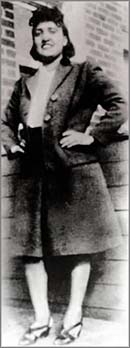
Speaking of health heroines, and a long unsung one at that, meet Henrietta Lacks (image below), subject of a riveting new book by Rebecca Skloot that my book club discussed last night.

As a medical historian, this gripping and horrifying story of a black woman whose cells were used for medical research without her knowledge or consent (or that of her family) was no surprise.  There is a long history of using African-Americans and other marginalized people (orphans, immigrants, persons with disabilities, the poor) for the “advancement” of medical research. Henrietta’s cancer cells, known by medical researchers as the cell line HeLa, were the first “immortal” cell line to be successfully grown in vitro. HeLa cells were later used for a host of medical discoveries, including research on the polio vaccine.  The story of Henrietta and her family, though, reveals the huge disparities in the American health care system past and present. Henrietta was a poor tobacco farmer from Clover, Virginia who received medical care in the “colored” ward of Johns Hopkins Hospital.  The virulent cervical cancer that led to her death was probably caused by a case of HPV given to her by her philandering husband (she had been treated for syphilis and gonorrhea).   It appears that the cancer treatment she received was pretty good for the day given the state of cancer research and therapy at this time.  Still, physicians’ refusal to listen to her complaints about a “knot on her womb” until it was too late reflect the paternalism and sexism of the medical establishment at this time.

The book also tells the story of Henrietta’s family, who only learned about the HeLa cells decades after her death when scientists began asking them for blood and tissue samples, and reporters from Ebony, Jet, and  Rolling Stone began interviewing them about their mother and the cell line derived from her cancer cells. The family’s horror at this revelation is nicely summed up by the statement by Henrietta’s daughter Deborah:

“I don’t know what they did [to my mother], “but it all sound like Jurassic Park to me.”

One of my fellow book clubbers plans to use this in her ethics class.  I plan to use it the next time I teach my graduate seminar on gender, health, and sexuality.  Meanwhile, I’m hoping to invite Skloot to come to CCSU as part of her totally insane book tour (which she organized largely through Facebook and Twitter — I’m stealing that idea!)

Unfortunately Cornell is not the only “suicide school”

via University Diaries, who reports on Yale undergraduate’s  suicide-by-Empire State Building yesterday, and like me was upset by the irresponsible headline of an otherwise useful article about college mental health services in the Huffington Post.  The latter says:

“What more can be done to save student lives?

To answer this question we must first recognize that our population of at-risk college students is larger than in previous decades, but not because we, as a nation, have a growing number of depressed adolescents. The fact is that improvements in the identification, diagnosis, and treatment of psychiatric disorders–coupled with more effective medications and new forms of psychotherapy, specifically cognitive behavioral therapy (CBT) and dialectical behavior therapy (DBT)–have enabled high school students with successfully treated psychiatric disorders to apply for and attend American colleges.”

The article then goes on to observe that students hide their psychiatric history during the application process (who wouldn’t?) and continue to do so when they arrive on campus because they want to make a “fresh start.”  The best piece of advice from the article:

Mental health services and classroom accommodations are a right, not a privilege. Your child is entitled to care, no matter how simple or common his condition. The school is not doing you a favor: they are required to provide to students with psychiatric disorders the appropriate services and accommodations in the same way they’re required to provide a ramp for students in wheelchairs.”

But what do you do if the student is reluctant to disclose the need for accommodation? We faculty were just sent a copy of a recent article by Allan L. Schackelford on the needs of student veterans with disabilities.  He writes that students with invisible disabilities — e.g. traumatic brain injury, hearing loss or impairment, and especially PTSD and other psychological issues, are often reluctant to self-identify these disabilities.  He observes that this failure to self-identify is “largely the result of the cultural norms” of the military, where “acknowledging, discussing, or reporting a personal problem or vulnerability would most likely prompt a negative reaction from superiors, as well as peers in their unit.”

I wouldn’t doubt that student veterans encounter the same negative response from some faculty who grumble about students taking advantage of a diagnosis.  It doesn’t help that the current dust-up over the DSM-5 has some folks outside psychiatry wondering about the scientific legitimacy of the field and even the mental health of its practitioners.

Who Says Real Men Can’t Knit?

via WSJ.com.   Like other occupations, long-haul trucking has seen a decline in demand.  So, in their down-time, some truckers have taken up stitching.  At left is Kevin Abraham-Banks, a Sioux Falls, S.D., trucker, with tattoos and shave head,  who likes to pass time at truck stops by knitting — here he is making a sweater for his wife.  According to the article:

“Creating something tangible beats sitting around the truck stop “talking about who has a bigger radio,” he said. He’s finished a scarf and socks, and is working on a sweater for his wife.

“The fact that you can take strands of thread and basically make something out of it, that’s awesome I think,” he said. “It’s pretty cool stuff, man.”

Comments on the article range from “this is pathetic” to observations that knitting by men used to be (and still is) common in some cultures — e.g. 19th century Scotland:  according to one comment, “only men were allowed to knit in public as it was their winter livelihood. Women were only allowed to knit in their own home and for personal use. The men knit the Royal Army uniforms. They don’t seem to have found it ‘funny’ to KIP their WIP (Knit In Public their Work In Progress). Even well into the 20th century, knitting was a required class in British schools (my husband attended in the 60s).”

So men, don’t be afraid to KIP your WIP!

Ada Lovelace Day/Emergency Contraception Day of Action

via Finding Ada and Back Up Your Birth Control.  So, here’s a blog post that combines a celebration of women in science and technology with a call to action on emergency contraception.

What is Ada Lovelace Day?

“Ada Lovelace Day is an international day of blogging to celebrate the achievements of women in technology and science.

The first Ada Lovelace Day was held on 24th march 2009 and was a huge success. It attracted nearly 2000 signatories to the pledge and 2000 more people who signed up on Facebook. Over 1200 people added their post URL to the Ada Lovelace Day 2009 mash-up. The day itself was covered by BBC News Channel, BBC.co.uk, Radio 5 Live, The Guardian, The Telegraph, The Metro, Computer Weekly, and VNUnet, as well as hundreds of blogs worldwide.

In 2010 Ada Lovelace Day will again be held on 24th March and the target is to get 3072 people to sign the pledge and blog about their tech heroine.

Ada Lovelace Day is organised by Suw Charman-Anderson, with design and development support from TechnoPhobia and hosting from UKHost4U.”

Now, for Ada Lovelace Day, I’m supposed to blog about my favorite tech heroine.  Why just one?  I’ll celebrate all those who worked on bringing emergency contraception to the U.S. and announcing the Back up your birth control day of action.  Here’s how you can help:

Back Up Your Birth Control is a national campaign committed to raising awareness of and expanding access to emergency contraception (EC). Every year, leading national advocacy organizations, service providers, and other community stakeholders participate in activities such as grassroots organizing, provider and public education, and policy debates, which culminate in our Day of Action.

Here’s how you can take action:

  1. Spread the Word about EC with FREE Materials
    Our popular EC educational materials featuring Rosie the Riveter are available for FREE! Just click above to place your order, and we’ll send you materials to distribute at health centers, to teens, at street fairs, etc.
  2. Enter the Campus Challenge
    If you’re a college student, get your group to raise awareness about EC on campus. The most original and informative idea will win a $250 prize!
  3. Write an OpEd or Blog
    Whether it’s for your local paper, campus publication, or blog, help educate readers about EC and how they can help others back up their birth control.
  4. Sign the Petition
    Send an email to the FDA and the White House asking them to end unnecessary age restrictions on over-the-counter access to EC.
  5. Celebrate the Back Up Your Birth Control Day of Action
    Use the Take Action Toolkit to get ideas about organizing educational activities in your community for the Day of Action on Wednesday March 24, 2010.

Other tips for engaging activists include:

  • Increase education for teen educators and teens by hosting a party, film screening, “Battle of the Bands,” or sporting event and distribute BUYBC materials on what EC is and where teens can get it.
  • Raise public awareness by organizing an EC roundtable discussion with elected officials, clinicians and medical experts to identify the work that needs to be done with respect to EC awareness/access in your community. Identify groups of advocates and local elected officials that are willing to help bring about any necessary changes and outline future steps.
  • Engage your local medical community by contacting local pharmacies and hospitals to inquire about their EC stocking and provision policies. Include educational materials and information to assist their staff with informing clients about EC, including advance provision of EC to patients.

Download the 2010 Back Up Your Birth Control Take Action Toolkit for more ideas including special activities for students and college campuses!