Targeting Weird People

She’s a brilliant scientist.  She’s been described as “weird.”  She talks excessively, often going off on tangents.  She’s socially awkward and often “tone deaf” to other’s body and facial language. No, I’m not talking about her.  I’m talking about her, the woman pictured at the left, focus of a new bio-pic on HBO.

This article from the Chronicle of Higher Education observes that while there are counseling services for students, “fewer resources are available for assistance with faculty and staff mental-health issues, and we have a high tolerance for erratic behavior.” The author advises us in higher education to look for “erratic” behavior in faculty and staff.  But how does one define “erratic”?  Or “normal” for that matter? As I’ve said before in the context of shootings by students, will this latest incidence of violence lead to better mental health services for those at risk, or further ostracism of people with mental illnesses and others who are not “neurotypical”?


Female Shooter at University of Alabama

via The Human Condition Blog – Newsweek.com, Historiann, Kittywampus, and others.   University of Alabama, Huntsville biology professor Amy Bishop shot and killed several colleagues during a faculty meeting on Friday. Campus shootings are always shocking, but this was is especially so since, as Historiann observes, men are the overwhelming majority of mass murderers and the overwhelming majority of people who kill with guns.

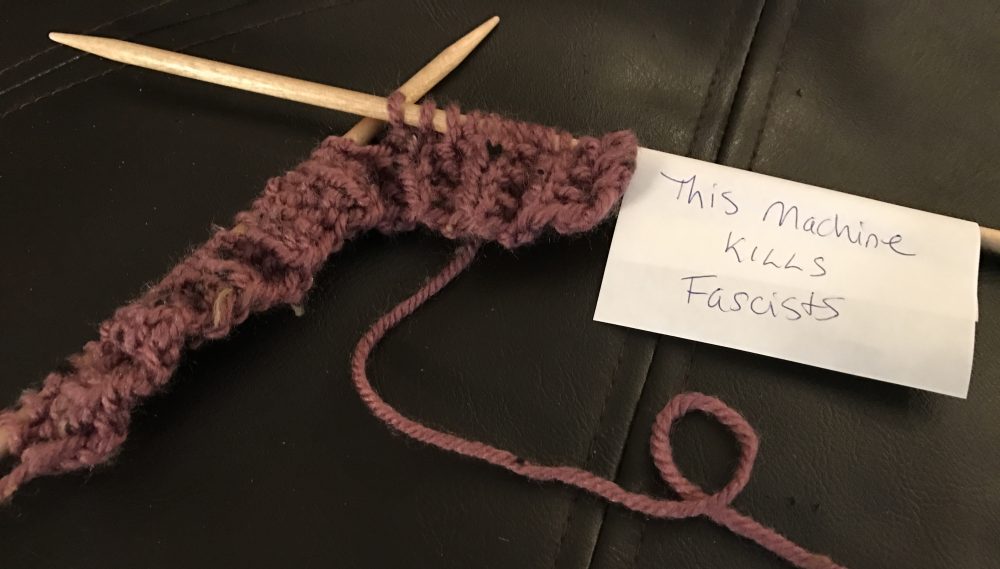
I was planning to wait until the weekend is over to comment on this and focus on my knitting, but even even the Ivory Tower Fiber Freaks group on Ravelry is abuzz about this.   The facts are still developing so I hesitate to comment about Amy Bishop’s mental state.  However, more than one article I’ve seen has raised the issue of Bishop’s mental state — e.g. did she have a psychotic break?  Was she taking SSRIs, which can cause mania or psychosis? Bishop shot her brother, supposedly by accident, in 1986.   Was that also the result of a psychotic or manic episode?

So, I’m just going to toss some initial thoughts out there, even if they turn out not to apply to this case.   Previous instances of campus shootings have prompted more attention to student mental health issues.   Will this case lead to more focus on faculty mental health?  Our campus has an Employee Assistance Program, but how many people actually use it?  How many more are afraid to get counseling because they don’t want to be labeled a “nut” — especially before they have tenure?

I’ll wait and see how this develops before  I say more on this.  Meanwhile, I’ll continue to stay calm and carry yarn.

Added later:  this article from SF Gate hints that bullying might have been a factor, although the author does it in a stupid assed intellectually lazy way (i.e. Southerners are stupid, hate intellectual Yankees, especially those who are from Harvard).

Update 2/15/10:  From the website Chronicle of Higher Education.   The ableist language in the comments is quite disturbing.

Here’s a first hand account from another UAH faculty member.  I hope they’re including faculty in the crisis counseling.

Join my team for Ravelympics 2010

Join Knitting Clio and other fiber addicted academics for Ravelympics 2010.    This is a  “competition” organized by the online fiber community Ravelry to  coincide with the Olympic Games. The first one was held in conjunction with the 2008 Summer Games  in Beijing.   [in between, Ravelry held the World’s Works-in-Progress Wrestlemania]   The concept: cast on or start your project during the opening ceremonies on February 12, and finish the project by the end of games on February 28th.   Official rules are posted here.

NB: Ravelympics is separate from the Knitting Olympics organized by Yarn Harlot, which also looks like a lot of fun.  I wonder if I can enter both?

New Emergency Contraception Drug

via Our Bodies Our Blog.  They report, “A recent ABC news piece and two new journal articles (in The Lancet and Obstetrics and Gynecology) have drawn attention to an emergency contraception drug that is not currently available in the U.S. but apparently has been submitted to the FDA for review.”

I need to figure out how to fit this in the book project, but first I need to look up ulipristal acetate.

Knitting Clio has been busy blogging elsewhere

This blog has been quiet lately since I maintain two other blogs.  One is the course blog for my graduate digital history seminar. The other is Women Historians of Medicine, where we are having a lively discussion about suggestions for an exhibit honoring the 50th anniversary of the Pill that Suzanne Junod at the FDA History Office is putting together.

Since I’m an expert on the history of college health, no discussion of the history of the Pill would be complete without mentioning that female students’ access to the Pill was recently weakened by changes in Medicaid pricing rules. Prior to 2005, pharmaceutical companies were able to provide Title X clinics and college health centers with birth control pills at a substantial discount.  In 2005, these rules changed, and in 2007 the price of birth control pills for women who came to these clinics skyrocketed, going from $10 to as much as $50 per package. The Feminist Majority Foundation Campus Program worked hard to change this, and in 2009 Congress reversed this and once again made low-cost birth control clinics available to student health centers and clinics for low-income women.  Yet some student health centers still don’t offer discounted pills.  So, to ensure access, please do the following:

  1. Go to your Student Health Center and make sure birth control and emergency contraception is offered and its given a discounted price.
  2. If you can’t access birth control on campus, start a petition, write op-eds in your student newspaper, present resolutions to student government and administration.
  3. Encourage the Health Center to be on your side.
  4. Plug into FMF’s Birth Control Access Campaign action kit to disseminate information on campus.

Blog for Choice Day 2010

via NARAL Blog for Choice

This is NARAL’s 5th annual Blog for Choice Day, which falls on the 37th anniversary of the landmark U.S. Supreme Court decision Roe v. Wade.  In honor of the late Dr. George Tiller, who often wore a button that simply read, “Trust Women,” this year’s Blog for Choice Day question is: What does Trust Women mean to you?

Followers of this blog know that I’m currently working on a book on the history of the emergency contraceptive pill (ECP), aka the “morning-after pill” for the series Critical Issues in Health and Medicine for Rutgers University Press.   [please take the survey by clicking at the link at the bottom of this blog]

Right now, I’m working on Chapter 5, which looks at feminist activism to raise awareness about and convince the FDA to approve a dedicated ECP product.  Some of the leaders of this endeavor were also prominent in NARAL, so covering the history of this organization is important to my work. In her essay, “Toward Coalition: The Reproductive Health Technologies Project,” from Abortion Wars, edited by Rickie Solinger, Marie Bass describes how RHTP arose out of her work as political action director for NARAL.  Bass found her experience unsatisfying because of the way in which the abortion issue “had been appropriated by shallow, insensitive, and opportunistic politicians.” She found that congressional candidates — “usually male, but not always” — formed their position on abortion according to “how the political winds in their state or district were blowing.”  She found the politicians who claimed to be pro-choice to be the most frustrating. Even though public opinion polls indicated that the majority of Americans were pro-choice, these politicians would give torturous “non-answers” to the question “are you pro-choice”.  Even more disturbing for Bass was the fate of former congresswoman Geraldine Ferraro during her historic run for vice-president in 1984, who was “brutally assaulted for her audacity, as a Catholic woman, to espouse a position on abortion that contradicted the Church.”  Meanwhile, pro-choice Catholic men (e.g. Mario Cuomo and Ted Kennedy) were given a pass.  “Evidently, men could be indulged in a little waywardness, but a Catholic woman — never!”

Around the same time, Bass heard about a new drug called RU-486, which would terminate an early pregnancy.  Bass’ first thought was maybe “this was a way out of the quagmire of the abortion issue” since it would take abortion “out of the political arena and put the decision back in the hands of women and medical practitioners, where it belonged.”  She joined with other activists from NARAL, Planned Parenthood, and other organizations — including Joanne Howes, Nanette Falkenberg, and Sharon Camp — to work on bringing RU-486 to market in the United States.   When they called the first meeting of what would become RHTP in 1988, Bass and her “small cabal of collaborators” assumed that opposition would come solely from anti-choice individuals and organizations.   They were quite surprised to find that while everyone at the table was pro-choice, they had widely divergent opinions about RU-486 and reproductive technologies in general.  Consumer advocates, such as Judy Norsigian from the Boston Women’s Health Book Collective, “introduced concerns about whether the drug affected white women and women of color differently and about access to hospital care in the event of emergencies such as prolonged bleeding.” Others called attention to the ways in which technologies had been used coercively to control reproduction among poor women of color “at the expense of women’s autonomy and health.”  Some recalled how drugs or devices such as DES and the Dalkon Shield, once touted as wonders, “had turned into disasters for women.”

Therefore, before RHTP could get anywhere with RU-486 or anything else, they had to build trust among various activists, especially women of color: “No matter how well-meaning we may have been, as white middle-class women, we simply could not represent the interests of women from other groups.”

So, this is what “trust women” means to me — building coalitions around the common issue of abortion and reproductive rights more generally, while respecting diversity — whether this be race, class, age, sexuality, disability status, or political affiliation [on this last note, this would mean supporting pro-choice Republican women over anti-choice Democratic men or women].

Finally, on the issue of blogging more generally, I’d like to address an article from Newsweek, entitled “Who’s Missing at the ‘Roe v. Wade’ Anniversary Demonstrations: Young Women.”  According to Kristy Maddux, assistant professor of Communication at the University of Maryland, who specializes in historical feminism, young women are still concerned about reproductive rights, “but they’re not trained to go out and protest.” Instead of marching in the streets, young women are writing on their blogs or social network sites.  “I don’t want to frame young women as lazy, ” says Maddux, “but they don’t have any reason to believe that it matters if they go out and protest. Instead, they talk about their positions to friends and neighbors.”

Excuse me, but what the heck is wrong with blogging?!  [and why isn’t a scholar in the field of Communication paying attention to the impact of social media on feminist activism]?  Get with the program, sister, and  blog for choice [or tweet or whatever] yourself!
History Lesson for Pat Robertson

via Think Progress » Pat Robertson Cites Haiti’s Earthquake As What Happens When You ‘Swear A Pact To The Devil’.

To paraphrase Woody Allen, if Jesus heard this, He would never stop throwing up!

On the Rachel Maddow show last night, the Haitian ambassador provided a history lesson for Robertson and other false prophets.

The only thing I would add is by Robertson’s logic, both the American and French revolutions were a “deal with the Devil” as the Haitians used these countries’ concepts of universal human rights as the underpinning of their revolt.  [except, unlike the U.S.A., Haiti abolished slavery]

Tweeting #AHA2010

Like many academics this year, my travel budget has been cut, so I did not attend the annual meeting of the American Historical Association in San Diego, CA.  Instead, I followed conference attendees on Twitter, using #AHA2010 to find tweets by those whom I don’t regularly follow.   Many of the posts involved comments and retweets of comments on Dan Cohen’s well-received talk, “Is Google Good for Historians?” [short answer: “yes”]  It was also nice to hear who won the Cliopatra awards and where all the #twitterstorians were meeting for drinks.  In the end, though, #AHA2010 was a disappointment. Coverage of the conference was far more thorough at History News Network.  So much for micro-blogging taking over blogs.

Cohen summed up with this tweet: ” So my sense is that the number of historians on Twitter at #aha2010 was roughly 0.1%. Something to think about.”  He chalked this up partly to lack of wi-fi access in conference hotels (guess the 3G network for iPhones isn’t great in San Diego), but also the lack of a critical mass of historians on Twitter.  @parezcoydigo put it another way:

“% of colleagues/others at History Cof that made fun of me for Twitter the past 3 days: approx. 90%”

So, in other words, most historians don’t use Twitter, haven’t heard of it, or if they have, make fun of those who use it. [even Dan Cohen’s colleague Mills Kelly has said “no thank you” to Twitter for now].

Why is this?  I can only guess but based on my experience with my colleagues, many historians have yet to be convinced that new media is useful to their work as historians. I’m by no means a genius when it comes to digital history but the mere fact that I know something about it and teach a graduate course on the subject puts me way ahead of my colleagues.  [Example: me: “hey folks, instead of emailing back and forth, let’s start a wiki for project X.” reply: “what the heck is a wiki?  I don’t have time to learn that. I’d rather stick with what I know.”]

Time is the critical issue here — we don’t have enough of it, and what little we have is spent trying to keep on top of our regular work.  There also doesn’t seem to be that many opportunities for those new to digital history to get help from those with more experience and expertise.  I was fortunate enough to get a grant to attend one of the digital history workshops at the Center for History and New Media a few summers ago.  However, the Center is no longer running this program, instead opting for a smaller and more exclusive THATcamp.   I’ve searched in vain for other conferences that are somewhere in between the original workshop for beginners and those that seem designed for those who already know what they’re doing.  If I’m missing something, someone out there please let me know.

added later: Yes, I know about the #PDP2010 conference at Yale.  I’m looking for something hands-on so I can upgrade my skills.

Caturday: Disability edition

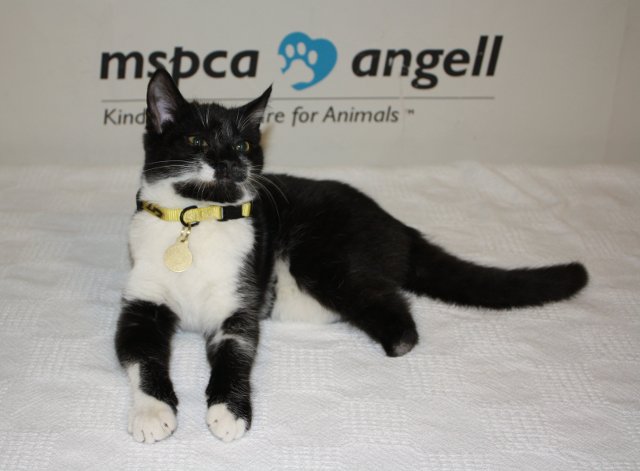
via Bostonist.   Meet Nubbins, a kitty born without hind legs, who is the pet of the week at the Massachusetts SPCA.  I’m tempted to adopt him, but I don’t have wall-to-wall carpeting which he needs to get around.  I also have two flights of stairs. More information on adoption is here.  There are numerous other kitties and doggies for adoption too.

If the still photo isn’t cute enough, here is a video: