Reminder to Certain Feminists: Teenagers have rights to choice and bodily autonomy too

via Historiann, who discusses Mary Elizabeth Williams’ Twitter battle with Katha Pollitt and Amanda Marcotte over her Salon article about her daughter getting the wrong vaccineat her annual checkup. Williams knew she would get flak for the article, but she “wrote it anyway, because I felt strongly about two key issues of the story. If you’re going in for any procedure, drug or vaccination, take a moment to double-check that the person administering it is giving you what you’re there for. Also, I believe my daughters should have final say in whether or not they receive the HPV vaccine. And flak, indeed, I got.”

As  an expert on the history of adolescent medicine and contributed to an edited collection on the politics of HPV vaccines, I have to say “right on.”

Certain feminists in the twiterverse disagreed, though:  “Amanda Marcotte took some mighty big umbrage on Twitter,”  calling Williams’ piece an “‘overreaction’ and then proceeded to engage in something that looks remarkably like overreacting.

“A single tear shed over this causes everyone else to wonder if you don’t have real problems,” she wrote. “I’m honestly not invested in freaking out on an innocent mistake that resulted in no real problems… I mean, I have real shit to deal with in my life… If that’s the most awful thing you’ve learned at 11, you live in a big time bubble…. I’m sure her mother’s reaction to it had nothing to do with the little girl thinking this was the worst thing ever.”

Author Katha Pollitt also jumped into the fray, calling the story “ridiculous.” Not the review I’d wish for, but all right. But I’d like to correct her assessment that “I just felt this woman was hyperfreakout helicopter parent, infecting her kids with anxiety.”

Unlike Historiann, I’m a twitterstorian who tweets regularly (see my feed to the right) although I must confess I find it impossible to keep up with all the people I follow and use an automatic aggregating program to compile all these posts into the Knitting Clio daily (paper.li does this automatically — I don’t stay up late at night putting the daily together!)  I went to Twitter to look at the exchange between Williams and her critics (and fans).  I especially liked Angus Johnston’s comment:  “I think it’s utterly reasonable for a parent to want to choose when and how she discusses the HPV vaccine with her daughter.”

I made the following comment at Historiann’s blog;  “Wow, this woman dares to treat her adolescent daughter as a developing adult (i.e. follows the recommendation of experts in adolescent medicine). Kudos to her. Interesting that feminists like Marcotte and Pollitt are all for choice and bodily autonomy, unless the body in question belongs to a teenager.”

Now looking forward to my own Twitter battle!

Celebrating the anniversary of Griswold v. Connecticut

via Ms Magazine blog. On June 7, 1965, the U.S. Supreme Court issued the decision, Griswold v. Connecticut [PDF] which struck down an 1879 state law “that prohibited the use of contraceptives and made it illegal to assist, abet or counsel someone about contraceptives. Griswold established a constitutional right to marital privacy that, in the words of Justice William O. Douglas, would no longer allow ‘the police to search the sacred precincts of marital bedrooms for telltale signs of the use of contraceptives.'”

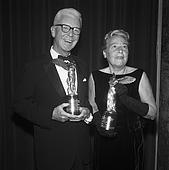
At left is a photo from Corbis.  The image is from an awards ceremony on October 19, 1965.  

Original caption: Dr. C. Lee Buxton (Left) and Mrs. Estelle T. Griswold are shown with planned Parenthood awards they received on October 19, at the annual dinner of Planned Parenthood at the Waldorf Astoria Hotel here. Along with the gold statuettes each gets a scroll and they share the 2,500 Albert Lasker Award of Planned Parenthood-World population.
Now, I’ve always wondered why Dr. Buxton seldom if ever gets mentioned in the commemoration of this event.  I reckon it’s because he was a male doctor, and that just doesn’t fit with the over-simplified narrative of the women’s health movement of women combatting the “evil,” mostly male medical profession.
I don’t want to overdo it and give Buxton too much credit — but what I’ve heard from the residents who worked under him at Yale-New Haven Hospital  is admiration for his willingness to put his reputation and career on the line to fight the state’s restrictions on contraception.  This acknowledgement came even from Virginia Stuermer,  who said that while Buxton was very progressive on issues of birth control and abortion, he was not”so hospitably disposed toward young women who wished to become resident physicians in our department. At a time when the government was scrutinizing the hiring practices of universities which received federal grants(vis-a-vis women and minority groups),our chairman still felt he could ask women residency candidates if they would forego childbearing for the duration of the four-year program. Needless to say,fewwomen became residents during that chairman’s tenure.Today, a preponderance of residents in our department is female. This fact has certainly brought a sea of change in the attitudes of physicians in my field in this community.”  Nevertheless, Stuermer acknowledged that Buxton’s work along with Griswold’s, was “paramount” in the struggle against Connecticut laws banning birth control.  Buxton also was willing to enlist Stuermer and another junior faculty member as clinicians at the New Haven Planned Parenthood clinic.  After the Griswold decision was handed down, Stuermer replaced Buxton as medical director at Planned Parenthood, and abortion became the “next battleground” in the Nutmeg state’s history of reproductive rights.  At the forefront of these efforts were female physicians and law students at Yale.
This “sea change” among women professionals in medicine and the law deserves more attention,.  For a start, see  the essays by Sandra Morgen and Naomi Rogers in Women Physicians and the Cultures of Medicine, edited by Ellen S. More, Elizabeth Fee, and Manon Perry (Johns Hopkins, 2009).

Two Invitations from Judy Norsigian of Our Bodies Ourselves

Yesterday I got an exciting email from Judy Norsigian, asking me if I’d finished my book on the history of emergency contraception (yes!) and even more thrilling, whether I’d like to guest blog on the history of EC for Our Bodies, Our Blog.  My reply was — you betcha!  (Okay, that’s not exactly what I said but that’s what I meant).  So, here I have an opportunity to plug my work to a larger audience than the dozen or so folks who read Knitting Clio.

The second invitation was to a 40th anniversary celebration of Our Bodies, Ourselves that will be held in Cambridge on October 1st.  Unfortunately I have a prior commitment that day but said I’d spread the word about it.  So, for more information, go here.

Invigorated and Exhausted from American Association for the History of Medicine meeting

I got back from the annual meeting of the American Association for the History of Medicine meeting yesterday as as usual am bursting with ideas and buried in work.  So, this will be quickie overview with more reflection and analysis at a later date.

First, I’d like to report that my forthcoming book  (cover photo at left) is moving much closer to actually being out.  I received the page proofs about a week ago and am working on getting them back ASAP.  Unfortunately the editor decided not to have them available at the meeting because they aren’t corrected — but there’s always next year.  Hopefully they will be available at the Berkshire Conference of Women Historians next month.

Meanwhile, I got an opportunity to plug my book and establish myself as an authority on the “morning after pill” in an interview for a documentary by Caryn Hunt, President of the Philadelphia chapter of the National Organization for Women.  It was a lot of fun and I wasn’t as nervous as I expected.  Also, I got a new suggestion for a doppelganger. Thanks,  I agree!

My presentation on The Pill at 50: Scientific Commemoration and the Politics of American Memory went very well and I had a substantial audience (at least 30) despite it being on first thing on the last day of the conference.  The reaction was enthusiastic (especially from this leading authority on the history of the Pill) so I’m planning to expand this and submit it to the Bulletin of the History of Medicine.

Since I’m teaching in a public history graduate program, and living in Connecticut, my “commemorative mania” will continue with some kind of commemorative event celebrating the 50th anniversary of Griswold v. Connecticut in 1965 (which follows soon after my own half-century mark).  Not sure what this will be but the folks at Yale and Planned Parenthood are keen so looks like it will happen.  I also told the editor at Rutgers that I’m interested in doing a narrative history (as opposed to a legal history that uses Griswold as a lead-up to Roe v. Wade rather than an event in it’s own right).  As it turns out, a very distinguished senior historian of medicine and public health was one of the witnesses who testified.  It seems that the New Haven police was willing to shut down the clinic so that birth control advocates in the state could use this as a test case, but they needed evidence that the clinic was dispensing birth control.  This historian was a graduate student at Yale and was one of Dr. Buxton’s patients.  She volunteered to get the evidence (a tube of contraceptive jelly) and then went straight to the police department to turn in the incriminating evidence and give a statement.  When she blurted out that contraception was “women’s right”, the Irish cop asked her, “don’t you mean a married woman’s right?” What a story!

I heard lots a great papers and connect with all my history of medicine buddies.  However, work awaits so I’ll have to continue these conference report later (most likely much later since research papers and finals will be landing on my desk shortly).

Walgreens doesn’t do pap smears but maybe they should

via Gawker, who links to  Stephen Colbert’s hilarious send up of Fox and Friend’s mansplanation about we don’t need Planned Parenthood:

That’s right, because the ladies can get their pap smears, breast exam, and other lady-business care at Walgreens! Colbert advises, “I’m pretty sure they’re between the Swiffer refills and the cat food.  Ladies, just look for the stirrups!”

But seriously, folks, why not let Walgreens (and CVS and other retail drugstores) expand their “minute clinics” and such to include, at the very least, pelvic exams and blood pressure screenings?  That way, women don’t have to make a doctor’s appointment to get a prescription for oral contraceptives.  [hmm, perhaps I should bring this up with the OCs OTCs Working Group] One stop shopping, right? After all, Kmart offers aneurysm screenings, so why not?

Update 4/15/2011: Ms. Magazine blog reports that tomorrow, “women will be taking Doocy and Kilmeade’s advice, and visiting Walgreens in search of pap smears. Planned informally by a group of friends, the Flash Mob event hopes to ‘raise awareness about the absurd and dangerous attempts to deny access to critical health services to women across the country,’ says organizer Courtney Berner. The event is not, Berner emphasizes, an attack on Walgreens or its employees, and she urges participants to “be respectful of all Walgreens employees.” Of course, Flash Mobbers should also understand that the answer to their pap-smear requests will probably be “no.” Indeed, the Walgreens health-care clinics’ spokeswoman, Lauren Nestler, told Media Matters earlier this week that “Neither Walgreens, nor its in-store health-care clinics, Take Care Clinics, offer pap smears or breast exams.” However if Congress plans to defund Planned Parenthood, Fox & Friends says Walgreens is our best bet.”

Ms. Magazine says that “to participate in the Saturday event, find a Walgreens near you and show up on Saturday at noon with a video camera. Ask politely for your pap smear and see/film what happens.Videos can be submitted to the YouTube channel WalgreensPapSmear or emailed to walgreenspapsmear@gmail.com. Tweet your mission using the hashtag #papsmearplease. If Fox & Friends is right, you should be set up in stirrups in no time.”

Blogging for Emergency Contraception

via Back Up Your Birth Control.  Today is the 10th annual national day of action for Back Up Your Birth Control, a media campaign sponsored by the National Institute for Reproductive Health. I’ve agreed to blog to raise awareness about this.

Because I’m a shameless self-promoter, I’m also going to start with an update on my forthcoming book, The Morning After: A History of Emergency Contraception in the United States.  The page proofs will be arriving in a couple of weeks.  Meanwhile, here’s the blurb that will appear on the publisher’s website, catalog, and the book cover:

“Since 2006, when the “morning-after pill” Plan B was first sold over the counter, sales of emergency contraceptives have soared, becoming an $80 million industry in the United States and throughout the Western world. But emergency contraception is nothing new. It has a long and often contentious history as the subject of clashes not only between medical researchers and religious groups, but also between different factions of feminist health advocates.

The Morning After tells the story of emergency contraception in America from the 1960s to the present day and, more importantly, it tells the story of the women who have used it. Side-stepping simplistic readings of these women as either radical feminist trailblazers or guinea pigs for the pharmaceutical industry, medical historian Heather Munro Prescott offers a portrait of how ordinary women participated in the development and popularization of emergency contraception, bringing a groundbreaking technology into the mainstream with the potential to radically alter reproductive health practices.”

I had to stop somewhere, so the book shortchanges the most recent developments — especially the most recent efforts to use of social media to raise awareness of EC. [BTW, the Back Up Your Birth Control campaign has a Facebook page and you can find related posts on Twitter using #backitup and/or by following @nirhealth).

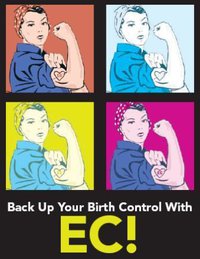
The use of the Web to promote EC originated in the early 1990s with the emergency contraception website at Princeton. The Back Up Your Birth Control Campaign began amidst the battle to get the FDA to approve Plan B as an over-the-counter drug.  What’s interesting to me as a historian is the use of graphic artist J. Howard Miller’s “We Can Do It” poster, which he created for Westinghouse under the sponsorship of War Production Board (this image should not be confused with the Norman Rockwell painting “Rosie the Riveter” that appeared on the cover of the Saturday Evening Post May 29, 1943, and is still under copyright.  The Rockwell paiting was recently acquired by the Bentonville Museum in Arkansas, founded by Wal-mart heiress Alice Walton and the Walton Family Foundation — oh the irony!).  Personally, I like the Rockwell image better, but do you think the Waltons will allow anyone to use it without paying major $$ — not bloody likely!  “We Can Do It” does not have such copyright restrictions, so various groups use it freely.  (for more on these images and American popular culture, go here).  It’s become a feminist icon of female empowerment, but this article demonstrates that “during World War II the empowering rhetorical appeal of this Westinghouse image was circumscribed by the conditions of its use and by several other posters in its series.”

Returning to EC — the history of the various awareness campaigns over the years is fascinating but was nearly impossible to illustrate in the book because, like many of us, the organizations that created these images didn’t preserve them once they were no longer useful.  Others put them on their websites, then discarded the original files.  Then there’s the problem of finding the copyright holder and getting permission from him/her.  Here’s an image that I couldn’t use because there was no digital file that had a high enough resolution for reproduction — it also nicely sums up my frustrations with the whole process:

image courtesy of Canadian Federation for Sexual Health

So, here’s a recommendation for the Back Up Your Birth Control Campaign — back up your “born digital” materials and preserve your digital heritage!

Trumbull Library presentation on Henrietta Lacks and the Immortal Life of Health Care Inequalities

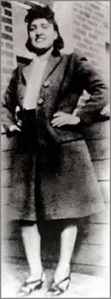
Earlier this week, I helped lead a discussion of Rebecca Skloot’s book The Immortal Life of Henrietta Lacks as part of the Trumbull public library‘s One Book One Town series.  My co-leader was Laura Stark from the Science and Society/Department of Sociology at Wesleyan University.  Laura was a fact-checker for the book while she was a fellow at the Office of National Institutes of Health History.  Laura focused on points raised in her forthcoming book, Behind Closed Doors: IRBs and the Making of Ethical Research, which will be published in November with The University of Chicago Press.  She looked at how the treatment of human subjects in the United States has evolved since the Second World War and this impacts Institutional Review Boards today.  My emphasis was on standards of care for cervical cancer patients then and now, and how this intersected with prevailing issues of race, gender, and class.   As Skloot observes, Henrietta’s care was typical of teaching hospitals at this time, and Johns Hopkins was one of the few in the region that admitted African American patients (albeit in segregated wards).  During the 1940s and early 1950s, there was no Medicaid and third party private insurance was only beginning to become an employee  benefit.  So, as a “charity patient” Henrietta received state of the art cancer treatment that many at that time could not afford.  The care would have been the same had she been white.  Yet, the prevailing attitude at the time was that since “charity cases” were treated for free, doctors were entitled to use them in research, whether the patients realized it or not. Henrietta’s doctor once wrote, “Hopkins, with its large indigent black population, had no dearth of clinical material.”

Also, epidemiological studies of cervical cancer tended to reinforce cultural prejudices about race and socioeconomic status of the time period. By the early 1950s, researchers noticed that cervical cancer was common in prostitutes and others with multiple sexual partners; rare in Jewish and Muslim women; and practically non-existent in nuns and virgins.  There was considerable debate about whether this was due to an infectious agent or genetics. The notion that different races had propensity to certain diseases was common  — e.g. blacks were characterized as a “notoriously syphilis-soaked race” while Jewish persons were believed to be more prone to respiratory illnesses like TB. So, “race medicine” included the theory that Jewish and Muslim women were more likely to develop cervical cancer because of their “race.”  We now know that male circumcision helps prevent the transmission of sexually transmitted infections, such as the human papilloma viruses that cause many genital cancers. Starting in the 1950s, scientists explored the link between adolescent sexual activity and the development of cervical cancer later in life. Several epidemiological studies published in the 1950s and early 1960s indicated that women who married before age 20 appeared to be at higher risk for cervical cancer. Some speculated that women who had multiple “broken marriages” were especially susceptible. Some cancer researchers hypothesized that some kind of infectious agent transmitted by male partners was a contributing factor, and that the adolescent cervix was especially vulnerable to “epithelial transformation” by exposure to such an agent. Given that a disproportionate number of patients were nonwhite, non-Jewish women of low socioeconomic status, recommended that routine pap smears were especially important for “nonvirgins” from underprivileged groups. These findings also tended to reinforce prevailing stereotypes about the links between disease risk, race, and class – those living in poverty – especially if they were nonwhite – more likely to be “promiscuous.”

At the same time, the introduction of Pap smear led to the notion that “cancer was curable” if caught early — this provided the justification for annual gynecological examinations.  Prior to Medicaid,  a young woman of Henrietta’s social class would not have had access to routine preventive medical care. Thus, the health disparities indicated by cervical cancer studies were used to justify government funded preventive screening for those living in poverty.

Another recent development has been efforts by health activists to make medical research more inclusive.  As Eileen Nechas and Denise Foley show in their book Unequal Treatment reformers fought to make sure that all studies funded by NIH included women, racial minorities, children and adolescents, where appropriate, historically “decisions on what aspect of health to study, on what research protocol to fund” were based “not only on scientific merit . . . but on a judgment of social worth. What is valuable to medicine is who is valuable to society, and that is white men.”  Since the late 1980, health activists fought to make sure that all studies funded by NIH included women, racial minorities, children and adolescents, where appropriate; and made sure that diseases that disproportionately affected these groups got “equal time” and money.

Here are the discussion questions we gave to the audience:

Should people have a right to control what’s done with their tissues once they’re removed from their bodies? And who, if anyone, should profit from those tissues?

Deborah says, “But I always have thought it was strange, if our mother cells done so much for medicine, how come her family can’t afford to see no doctors? Don’t make no sense” (page 9).   Should Lacks family be compensated by those who profited from research on HeLa cells?

How does this story relate to recent history of health care reform, and attempts to expand access to medical advances made possible by research on HeLa and other human tissues?

How can medical professionals recognize that certain diseases affect certain racial/ethnic groups without replicating prejudices of old “race medicine”?
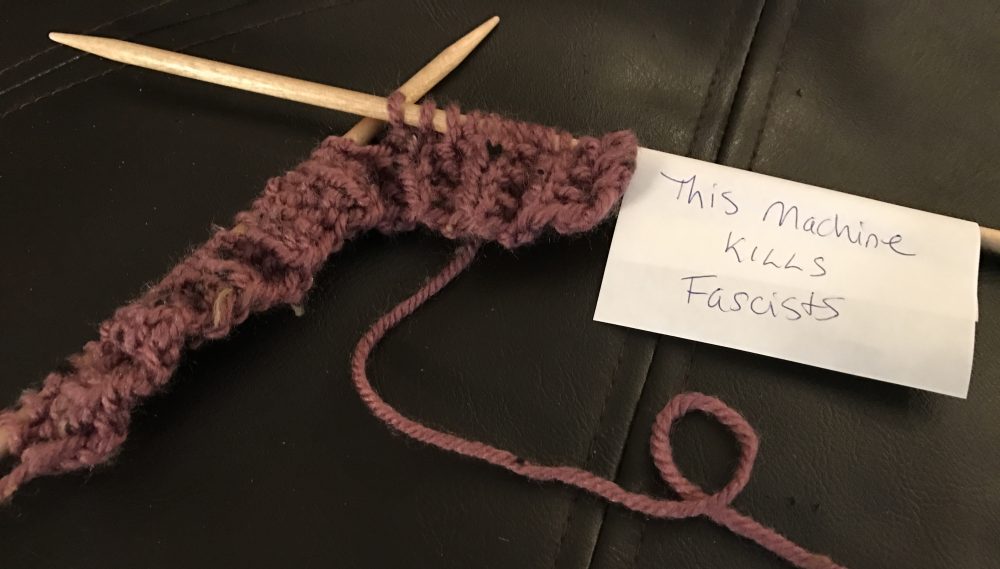
Help educate Shelby Knox about Radical Women’s History and the Limits of the Hashtag

via The Ms. Education of Shelby Knox.  Those of you who teach WGSS courses are no doubt familiar with the 2005 film, “The Education of Shelby Knox,”  which highlights “the need for comprehensive sex education, gay rights, and youth activism.”  Knox now has a blog, and has an account on Twitter, where she does a series of “this day in women’s history” tweets, marked with the #wmnhist tag.  Every morning she combs “through pages and pages of HIStory to find the couple of morsels pertaining to women that wind up on my Twitter feed.”  Knox finds that after a year of searching that “the “women” in that phrase are most often white, straight, cisgender, able-bodied, and Western. Just as women have been mostly left out of the broad discourse we call “history,” women of color, indigenous, queer, trans, disabled and non-Western women (and women living within all the intersection thereof) have been further marginalized, mostly left out of or tossed in as an afterthought in feminist attempts to add women to existing history.”  So, she’s decided to launch the Radical Women’s History Project. “What that means is that every day this year, starting on January 1st, 2011, I’m scouring the internet and books and any other source I can find to chronicle the lives and the accomplishments of the world’s women, explicitly centering women of color, indigenous, queer, trans, disabled, and non-Western women, and I’m posting them here for whomever would like to use them.”

This is an excellent endeavor, but before she reinvents the wheel, I encourage her to consult the wealth of resources produced by the Berkshire Conference of Women Historians, women’s history bloggers (including those like me who blog about a variety of things, and the intersections between them), metasites like Discovering Women’s History Online, and of course that “so twentieth century” technology, the H-Women listserv where the vast majority of women’s historians still get information and connect on the Internet.  Then of course, there are numerous non-digital (aka “dead tree”) sources — books (including the textbook I use for my survey course), scholarly articles in women’s history journals, women’s history archives, etc.

So, help me help educate Ms. Knox — suggest some links and sources that I’ve missed and/or endorse the ones I’ve already mentioned.

Blog for Choice 2011

As you can see from the graphic at left, the annual Blog for Choice Day was yesterday.   Since today is the actual 38th anniversary of Roe v. Wade, I figured, better late than not at all!  This year’s question, Given the anti-choice gains in the states and Congress, are you concerned about choice in 2011?

I don’t have much to add to other bloggers’ answer other than echo the overall consensus, Yes, I’m very concerned!

My worries extend beyond the choice of abortion — access to birth control also appears threatened, not so much by new laws, but more so because of economics.   The Republican majority in the House will not be able to revoke the health care law, at least not while President Obama is in the White House and the Democratic party still controls the Senate.  Yet, the existing health care law isn’t really adequate when it comes to contraceptive coverage.  Also, while many reproductive rights activists rightly celebrated making emergency contraception available over-the-counter (OTC), this might actually make things worse for some women because OTC products are not covered by private insurance plans or Medicaid.  Thus, while the rise of what pharmacy historicans call “OTCness” over the past two decades has weakened the boundary between patients and the health care professionals, it has done nothing to address the economic inequalities in the United States that continue to pose an insurmountable barrier to those without the means to pay for the products of this self-care revolution.

Documentary video on National Women’s Health Network

I’m still powering through the last few papers and exams, but am taking time to post this short documentary by/about the National Women’s Health Network.  The Network celebrated its 35th anniversary on December 16, 2010 (happy belated anniversary!)  They l will have a prominent place in my forthcoming book (which I plan to mail to the press after Christmas, I promise!)

And here’s a call for donations rom Executive Director Cindy Pearson:

Together, we have been improving women’s health in the US since 1975.

  • We bring the voices of women consumers to the policy and regulatory decision-making bodies in D.C.
  • We work to improve the health of all women by providing unbiased, evidence-based information that women need to make informed decisions about their own health.
  • We are supported by our diverse members from all across the country.

We play our watchdog role fearlessly. And, we do it without taking any financial contributions from drug companies, the health insurance industry, medical device manufacturers or anyone else with a financial stake in women’s health decision-making.

Will you help us?

We have a great opportunity with our 35th Anniversary Challenge Campaign. A small group of members are stepping forward with pledges to give $35,000 if we raise $35,000 from gifts ‘above and beyond’ usual year-end gifts.  These members generously pledged to help encourage others like you to step up and give more as well.  You can be sure that any gift you give to NWHN, large or small, will have a big impact on the lives of women and their families. Now, it’s on to the next 35!