 Courtesy of Shakesville.
I think a little of both, given the latest picks for cabinet posts and chair of DNC. Even less changey than I thought last summer. . .
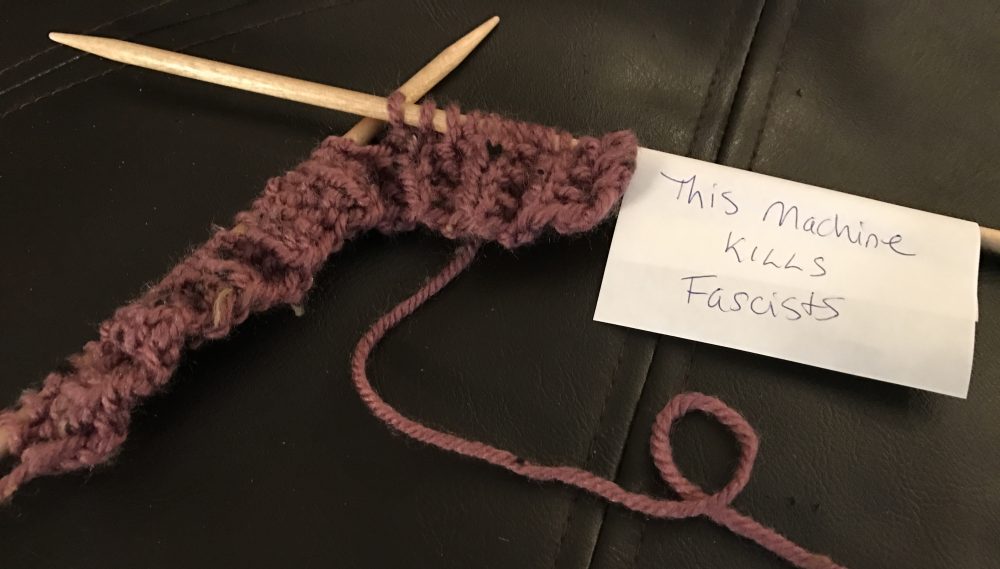
Courtesy of Shakesville.
I think a little of both, given the latest picks for cabinet posts and chair of DNC. Even less changey than I thought last summer. . .
It turns out I’m not the only one who’s been thinking about whether the plans to have a 21st century WPA will actually avoid the mistakes of the old WPA by ensuring fairness to women and minorities. Linda Gordon and other prominent women’s historians have put together the following letter to send to the President Elect. Here’s information on how to submit your name too:
—————————
Friends and colleagues,
Attached is a letter to President-elect Obama making a historical case for
more attention to gender equity in the proposed stimulus package. It is
based on a draft circulated by Linda Gordon with input from several others.
We are sending it out to you now in the hope of gathering signatures from
students of history–which we mean in the most inclusive sense. To sign on,
please send an email with your name and affiliation to Alice O’Connor:
aoconnor@history.ucsb.edu. Please respond NO LATER THAN 5pm (PST) Monday
December 15. We plan to send the letter on Tuesday, and then to have it
posted on appropriate websites. And DO forward to others.
With thanks in advance for your help,
Linda Gordon, New York University
Mimi Abramovitz, Hunter College
Rosalyn Baxandall, SUNY Old Westbury
Eileen Boris, UC Santa Barbara
Rosie Hunter
Alice Kessler-Harris, Columbia University
Alice O’Connor, UC Santa Barbara
Annelise Orleck, Dartmouth College
Sally Stein, UC Irvine
—————————
Dear President-elect Obama,
As students of American history, we are heartened by your commitment to a jobs stimulus program inspired by the New Deal and aimed at helping “Main Street.” We firmly believe that such a strategy not only helps the greatest number in our communities but goes a long way toward correcting longstanding national problems.
For all our admiration of FDR’s reform efforts, we must also point out that the New Deal’s jobs initiative was overwhelmingly directed toward skilled male and mainly white workers. This was a mistake in the 1930s and it is a far greater mistake in the 21st century economy, when so many families depend on women’s wages and when our nation is even more racially diverse.
We all know that our country’s infrastructure is literally rusting away. But our social infrastructure is equally important to a vibrant economy and livable society, and it too is crumbling. Investment in education and jobs in health and care work shores up our national welfare as well as our current and future productivity. Revitalizing the economy will require better and more widespread access to education to foster creative approaches and popular participation in responding to the many challenges we face.
As you wrestle with the country’s desperate need for universal health insurance, we know you are aware that along with improved access we need to prioritize expenditure on preventive health. We could train a corps of health educators to work in schools and malls and medical offices. As people live longer, the inadequacy of our systems of care for the disabled and elderly becomes ever more apparent. While medical research works against illness and disability, there is equal need for people doing the less noticed work of supervision, rehabilitation and personal care.
We are also concerned that if the stimulus package primarily emphasizes construction it is likely to reinforce existing gender inequities. Women today make up 46 percent of the labor force. Simple fairness requires creating that proportion of job opportunities for them. Some of this can and should be accomplished through training programs and other measures to help women enter traditionally male-occupied jobs. But it can also be accomplished by creating much-needed jobs in the vital sectors where women are now concentrated.
The most popular programs of the New Deal were its public jobs. They commanded respect in large part because the results were so visible: tens of thousands of new courthouses, firehouses, hospitals, and schools; massive investment in road-building, reforestation, water and sewage treatment, and other aspects of the nation’s physical plant–not to mention the monumental Golden Gate and Triborough Bridges, the Grand Coulee and Bonneville dams. But the construction emphasis discriminated against women. At best women were 18% of those hired and, like non-white men, got inferior jobs. While some of the well-educated obtained jobs through the small white-collar and renowned arts programs, the less well educated were put to work in sewing projects, often at busy work, and African American and Mexican American women were slotted into domestic service. This New Deal policy assumed that nearly all women had men to support them and underestimated the numbers of women who were supporting dependents.
Today most policy-makers recognize that the male-breadwinner-for-every-household assumption is outdated. Moreover, experts agree that, throughout the globe, making jobs and income available to women greatly improves family wellbeing. Most low-income women, like men, are eager to work, but the jobs available to them too often provide no sick leave, no health insurance, no pensions and, for mothers, pay less than the cost of child care. The part-time jobs that leave mothers adequate time to care for their children almost never provide these benefits.
Meanwhile the country needs a stronger social as well as physical infrastructure. Teachers, social workers, elder and child-care providers and attendants for disabled people are overwhelmed with the size of their classes and caseloads. We need more teachers and teachers’ aides, nurses and nurses’ aides, case workers, playground attendants, day-care workers, home care workers; we need more senior centers, after-school programs, athletic leagues, music and art lessons. These are not luxuries, although locality after locality has had to cut them. They are the investments that can make the U.S. economically competitive as we confront an increasingly dynamic global economy. Like physical infrastructure projects, these jobs-rich investments are, literally, ready to go.
A jobs-centered stimulus package to revitalize and “green” the economy needs to make caring work as important as construction work. We need to rebuild not only concrete and steel bridges but also human bridges, the social connections that create cohesive communities. We need a stimulus program that is maximally inclusive. History shows us that these concerns cannot be postponed until big business has returned to “normal.” We look to the new administration not just for recovery but for a more humane direction—and in the awareness that what happens in the first 100 days and in response to immediate need sets the framework for the longer haul of reform.
Those who follow my Facebook feed know that I’m relieved the election is over. I haven’t blogged anything because I’ve been too busy reading the other blogs I subscribe to [see the blogroll for just a few].
Today’s lecture on campus by Green VP candidate, Rosa Clemente, gave me some additional food for thought as we await inauguration day. Clemente was a campus activist during the 1990s and was highly critical of the Clinton administration’s policies on welfare reform and juvenile justice, not to mention bombings of Bosnia and Iraq. She described the ways in which the Patriot Act has shut down social movements and real political dissent in the United States, and how the Democratic party is not really a progressive party (no surprise there). She also described the way she and Mckinney were marginalized in this most racist/sexist election — none of the major media outlets covered the Green party candidates [except this one] nor were they allowed to debate the major party candidates. Like other women in history, they were told “wait your turn.” She said the benefits of the Obama victory is that it gives the possibility of opening up dialogue with the rest of the world. But she also warned that we need to call Obama on his promise for change, reiterating the message in Bruce Dixon’s article, “Cashing the Obama Check: Will it Come Back Marked ‘Insufficient Funds’?” — in other words, will there be real change, or more of the same?
I do find myself becoming uneasy as I hear about the various possibilities for cabinet posts and such — e.g. do we really need someone as Treasure secretary who said that it’s okay to export our toxic waste the developing world because people there “don’t live long enough to get cancer”? Who helped craft the deregulated system that has led to our current economic mess? Oh yeah, and let’s not forget about that remark he made about women and science while President of Harvard. My colleague, who voted enthuastically for the Green party candidates said on the way to Clemente’s lecture today, “I told you so.”
The past two days I attended the 18th annual Women’s Studies conference at Southern CT State University, the topic of which was “Girls’ Culture & Girls’ Studies: Surviving, Reviving, Celebrating Girlhood.” Some interesting resources and papers I learned about included:
Leandra Preston teaches a course on girls’ studies and has a fascinating virtual center for Girls Studies at the University of Central Florida. She teaches the course on girls studies partly online — they meet every other week and in between the students are supposed to blog. She had some interesting points to make about blogging as a form of social activism and media resistance. I thought her paper was a nice counterpoint to one I heard earlier in the day, which hauled out the generational myth about “digital natives” and warned that shows like “Hannah Montana” are way worse for girls than the “Partridge Family” and the “Monkees” were for our generation. [for some excellent debunking of this myth, see Siva Vaidhyanathan’s and Thomas Benton’s recent articles in the Chronicle of Higher Education]
Sarah Projansky from University of Illinois gave an interesting paper on feminist girls’ studies. She argued that we need to look not just at representations of girls in the media, but also how girls produce media. She too deflated the assumption that the dominant media opresses girls and that it’s worse than ever before. She said this assumption is based on the myth of an innocent, pre-media girl who needs to be protected. She traced this imagined child back to the early twentieth century and discussions of pulp novels, romance magazines, and early film — I would go back even further, perhaps even to the eighteenth century novels like “Charlotte Temple.” Her main point is that girls, past and present, have often worked against the media aimed at them — mainly through humor and satire. She mentioned the book Girls Make Media, by Mary Celeste Kearney, which I will have to take a look at if/when I get the time. For now, I’ll just have to make do with her blog.
Miriam Forman-Brunell presented her work on the website, Children and Youth in History, one of the latest digital projects by the Center for New Media. The project looks great. I hope I can pull off something similar — although she warned me it was really hard to get the NEH to fund anything that had “girls” or “women” in the title, hence the words children and youth. Guess they won’t go for a project on our Gender Equity Collection which has all sorts of GLBT stuff in it!
The last panel, and perhaps the coolest, I attended was one on “Girls in the Library: Documenting Third Wave Feminist Activism through Zines.” Both Barnard and Duke have huge collections of these zines (numbering in the thousands). Kelly Wooten from the Sallie Bingham Center at Duke talked about how zines fit within the longer history of girls’ literature as well as feminist theory and activism. In some ways they are etiquette manuals for the underground — i.e. how-tos on how not to conform. According to Kate Eichhorn, zine-making continues and some zine-sters are trying to write a history of Riot Grrls and similar zine scenes. She made an interesting point about the problems of writing an “official” history of a movement that was polyvocal, and suspicious of authority and linear narrative. I asked why not have a hypertext history, or a wiki, to which Jenna Freedman warned that zines should not be confused with blogs [see her article on this at the Barnard website.] I think she missed my point — I understand the importance of the material objects, but new media can address many of the concerns about multiple voices and experiments in language that Eichhorn raised.
Anyway, I left the conference energized but also exhausted. I’m always envious when I go down to SCSU because their program is much bigger, much better funded, and in general much more respected than ours is. If only I could get that level of participation on my campus!
Yesterday, we had the privilege of a return visit by Dr. Mary Jo Kane from the Tucker Center at the University of Minnesota, who gave a great presentation on her research on media representations of female athletes. Her main points were that the “Sex sells” argument in favor of representing female athletes in sexualized ways is not only demeaning but counterproductive in that it alienates the core audience for women’s athletics — i.e. women and girls, and Dads of female athletes. Media images depicting female athletes in action, demonstrating physical competence, is what sells women’s sports, she argued. Great talk, but few attended – the eternal problem of getting folks to attend something in the middle of midterms with dozens of other stuff going on around campus at the same time.
But it gets buried under the flurry of pink crap products that get carted out for Breast Cancer Awareness Month every October. Yet Disability Awareness Month has been around longer — indeed, this is the 20th anniversary of the month, and a whole week for the “physically handicapped” was created in 1945. As Rosemary Garland-Thomson shows us, there are linkages between the “extraordinary bodies” of breast cancer survivors and persons with disabilities. Yet, because the pink stuff is such a big business, and persons with disabilities are still such an object of horror and scorn (see the new film “Blindness” — wait, don’t see it!) it’s really no wonder that the disability awareness gets lost.
Even someone who should no better, i.e. me, has not done anything to celebrate disability awareness month on campus. Why? Because I’ve been buried neck deep in assessment crap — our NEASC Reaccreditation site visit is coming up the week after next. Also, we have a two major events for WGSS coming up in the next two weeks. Do I compete against myself?
I suppose it’s not too late, but where am I going to fit this into all the stuff that’s already going on around the U? Besides, shouldn’t the disability office be taking the lead on this? Oh right, they don’t take the lead on anything! In fact, they are very reactive not proactive, i.e. they don’t do outreach to students, they just wait for students to come to them, and then make it really burdensome for students to get the accomodations they need. For example, I had a hearing impaired first-year student last Fall who had to wait three weeks to get an FM receiver she requested before she got there. This year, I’m having problems getting adequate services for a visually impaired student. In general, the office is not very user friendly and the director takes a rather disciplinary approach, i.e acts as if a student is trying to get away with something.
Courtesy of H-Sci-Med-Tech:
Ellen More, Elizabeth Fee, and Manon Parry are pleased to announce a new, co-edited book from Johns Hopkins University Press, Women Physicians and the Cultures of Medicine (2008). This volume examines the diverse careers and lives of American women physicians since the mid-19th century, their struggles for equality, professional accomplishment, and personal happiness. Scholars in the history of medicine in the United States chronicle the professional and personal lives of women such as Drs. Marie Zakrzewska, Mary Putnam Jacobi, “Mom” Chung, Esther Pohl Lovejoy, and Mary S. Calderone as well as women physicians who were active in “alternative” medicine, the women’s health movement, college health, and second-wave medical feminism.
Illuminating the ethnic, political, and personal diversity of women physicians, the articles touch on most of the major issues in the history of women physicians-politics, medical science, medical education, health policy, patient care, sexuality, race and ethnicity, and, of course, gender discrimination. Contributors include Carla Bittel, Elizabeth Fee, Eve Fine, Erica Frank, Virginia Metaxas, Regina Morantz-Sanchez, Ellen S. More, Sandra Morgen, Heather M. Prescott, Robert Nye, Manon Parry, Naomi Rogers, Arleen M. Tuchman, Judy Tzu-Chun Wu, and Susan Wells.

Interlaken Inn and Conference Center
Yesterday, I drove out to the Interlaken Inn and Conference Center in Lakeville, CT to attend the second day of the “Little Berks” meeting (I was too sick on Friday to drive out and back — turns out that since I’m on the program, they would have paid for me to stay there. Oh well, it was less than an hour each way). I arrived just before lunch. Here’s a view of Lake Wononscopomuc, where we ate al fresco:

And since “Interlaken” means between the lakes, here is the other lake that I walked to after lunch:
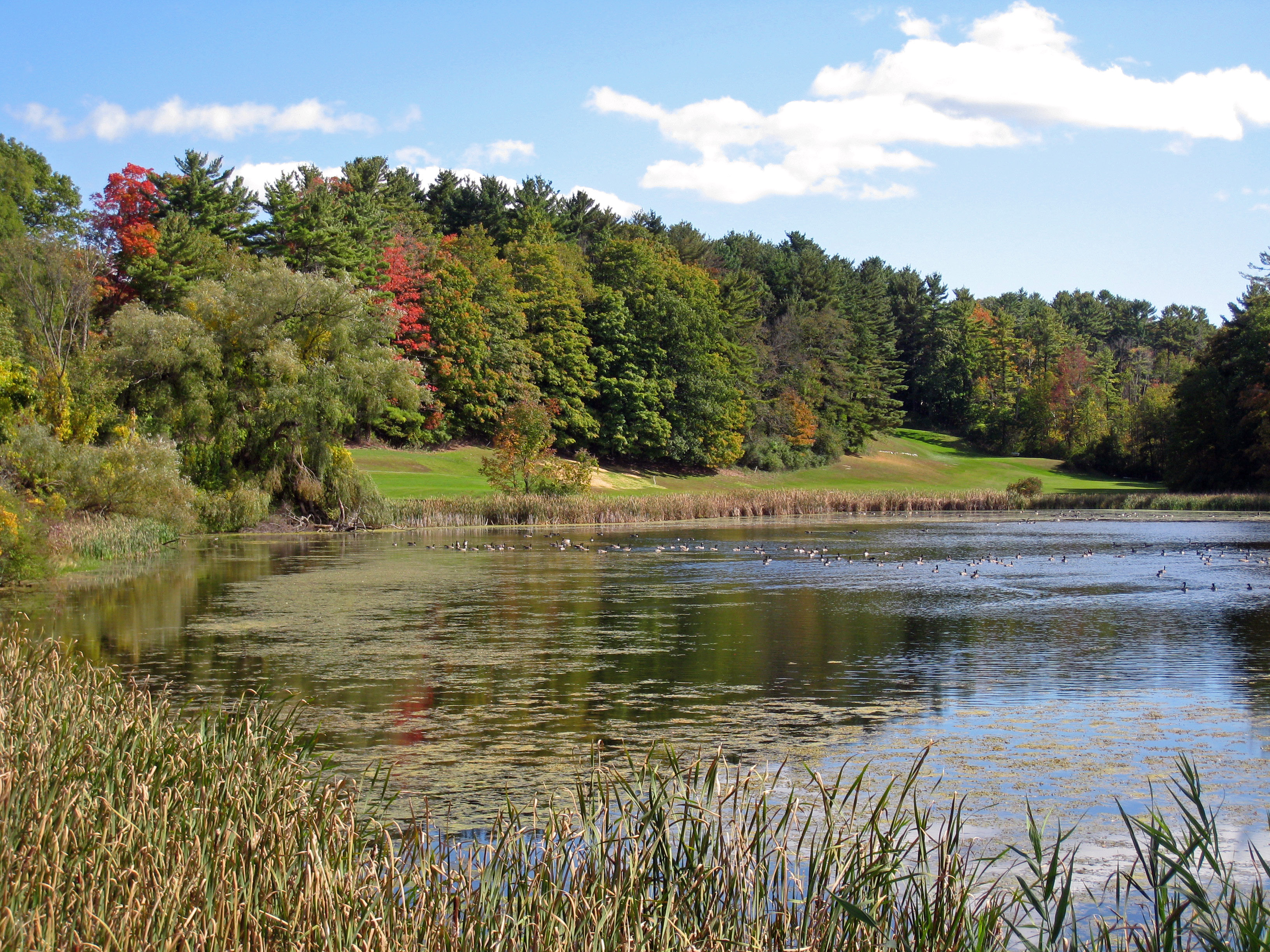
As you can see, it was a gorgeous autumn day.
Now the schedule at these things is very leisurely — there was a good couple of hours between lunch and the business meeting, during which one can stroll, troll for antiques, or loll around as one sees fit. The business meeting was very informative — we learned that Kathleen Brown, Professor of History at UPenn, will be the next Berkshire President. A few proposals for the location of the next Big Berks were discussed although I’m not sure how much I’m supposed to divulge here. I imagine there will be an official report sometime on the Berks homepage.
I heard that the weekend was supposed to be casual — so I fit right in when I arrived in jeans and a knit shirt. However, no no told me that there was a tradition of dressing for dinner. So, I remained in my jeans and shirt while others went back to their rooms to get into various levels of elegance (okay, a few others remained pretty casual too). Apparently this is a hold over from the organizations beginnings in the glamorous 1930s.
The panel went extremely well. Tenured Radical has posted the highlights of her talk at her blog and Clio Bluestocking plans to do so shortly. I gushed at length about the possibilities of social scholarship and waxed nostalgic for the heyday of H-Women in the 1990s, when the list was a discussion forum rather than an announcement board. The response was overwhelmingly positive and the discussion continued for nearly an hour. Hopefully we encouraged at least a few to consider blogging.
I neglected to mention that one way to keep up the momentum of the Sunday seminars at the Big Berks going is to have use the Berks blog for discussion after (or even before) the meeting starts. Or perhaps we can have carnivals of posts by women’s history bloggers as they do at Disability Studies, Temple U. At the very least, I hope we can get a larger group of bloggers and/or digital history folks together for a panel for the next Big Berks (any takers out there?).
How I Got Started
Evolution of Blog
Graduate History Course:
Current Status
My grad school buddy Sungold at Kittywampus listed 10 reasons why she is qualified to be VP. So, I shall turn this into a meme and present my qualifications as well.
1. Sparsely populated home state: Sungold is from North Dakota, a state with fewer people (639,715) than Alaska (683,478). I grew up in Vermont, which has fewer still (623,908).
2. Foreign policy experience: Vermont also borders a foreign country — and the French speaking part of it too boot! Quebec also has threatened many times to split off from the rest of Canada. This is not unlike what’s happening in the country of Georgia, eh?
3. Curious, yes — much too nosy for my own good, in fact.
4. The hair: Perm in 1980s — yep, but it didn’t last long in my stick-straight hair.
5. Age: I too am 44 years old — won’t be much longer, but my birthday is after the election.
6. Economics: No econ courses, but I have handled a department budget.
7. Education: Been in universities all my adult life.
8. The Mommy thing: Never been pregnant, don’t plan to be, ever.
9. Lipstick: I’m more of a lipgloss woman — still stuck in the ’70s.
10. Personality: Generally perky, but can be vicious and bitchy when situation requires it. Also, I played basketball, but didn’t make the JV team.
In addition –since I’m a historian, I can name several really bad Supreme Court decisions — especially Dread Scott, worst decision ever!
It is a truth universally acknowledged that a single woman must be in want of a drink
Orientalism and Yoga in the 21st Century
is a Vice Provost, Dean, and Professor at Northeastern University
History for the Future
By Norse code
Follow me on twitter: @jmedwards29
Why Do You Write Like You're Running Out Of Time?
A site to think about my academic work the same way I do everything: by overthinking it.
Blog for History 511: Digital History
History in the Digital Age
History Happens
A Group Blog on Early American History
A journal of New England cultural, literary, political, and social history
The latest news on WordPress.com and the WordPress community.
 Knitting Clio